
Summary
We’re going to wrap up our live blog coverage for the day. Here’s a summary of where things stand:
- Workers and activists in New York have gathered in Columbus Circle and are preparing to march down to Times Square.
- In Chicago, they have gathered at the University of Illinois at Chicago campus and are preparing to march downtown.
Chicago police officer just said that it looks to be over 5000 people marching here in Chicago. #fightfor15
— Zach Stafford (@ZachStafford) April 15, 2015
Protestors abiding by police instruction to stay on north side of Harrison #fightfor15 pic.twitter.com/sXLbRSDQgX
— Zach Stafford (@ZachStafford) April 15, 2015
- As Zach points out, the protesters and the police have been getting along all day long today. When similar protest was held on 4 September of last year, about 400 workers had been arrested in 32 US cities by 5 pm.
- According to organizers, no arrests have been reported so far today.
- The atmosphere in New York and Chicago is almost jubilant. It seems that as far as the organizers are concerned today’s day of action has been a success.
Don’t believe me? Eric Hauser, communications director at the AFL-CIO, sent us an email with the subject line ‘It’s days like this ...’
Workers are seizing, and moving, the agenda. What a day for the Fight for 15! Thousands in the streets, in cities and with people you couldn’t have imagined even five years ago.
You can read our wrap of today’s events here:
Students in New York City have gathered at the Columbia campus.
“It’s important for students to be involved because even if we aren’t working for McDonald’s or Walmart, we are still on McDonald’s or Walmart type of wages,” Robert Ascherman, a student activist from NYU, told the Guardian. According to him, some students have to choose between buying food or buying textbooks.
Among the groups joining the Fight for $15 activists was Columbia Divest for Social Justice group.
"No $15, no peace! No $15, no lease!" #FightFor15 pic.twitter.com/Iss7UNHem8
— Fast Food Forward (@FastFoodForward) April 15, 2015
The beautiful #FightFor15 crowd at @Columbia right now pic.twitter.com/mLzWNoRDf7
— Julia (@JuliaCarmel_) April 15, 2015
Columbia University #FightFor15 @PSC_CUNY pic.twitter.com/g1wM62Ew54
— Emma Powell (@EmmaPowell84) April 15, 2015
Back in Chicago, where the Guardian’s Zach Stafford is reporting from the ground, activists have gathered at the University of Illinois at Chicago and are about to begin their march downtown.
"There are so many out here struggling to survive off of inadequate wages, especially Black mothers" @BYP_100 Janae pic.twitter.com/5wlwqhUPwW
— Fight For 15 Chicago (@chifightfor15) April 15, 2015
Crowd erupts as the former mayoral candidate Chuy Garcia takes the stage. #FightFor15
— Zach Stafford (@ZachStafford) April 15, 2015
"This campaign is about lifting and improving the quality of life of all people!" - Chuy Garcia #FightFor15
— Zach Stafford (@ZachStafford) April 15, 2015
Chicago #FightFor15 crowd now swelling into the thousands as the rally continues the middle the of UIC campus.
— Zach Stafford (@ZachStafford) April 15, 2015
Crowd at UIC Quad now practically filling the entire East side. #Fightfor15 pic.twitter.com/OY7JTrV5dF
— Zach Stafford (@ZachStafford) April 15, 2015
"Hey, hey! Ho, Ho! Police violence has got to go!" - activist leads the crowd in chanting #FightFor15
— Zach Stafford (@ZachStafford) April 15, 2015
Chicago police having a quick meeting next to their bikes on Harrison before March downtown begins. pic.twitter.com/7tBnYhP2VY
— Zach Stafford (@ZachStafford) April 15, 2015
'Fire Rahm!' signs everywhere in the crowd. March will start shortly. #Fightfor15 pic.twitter.com/OGkMso6Y6M
— Zach Stafford (@ZachStafford) April 15, 2015
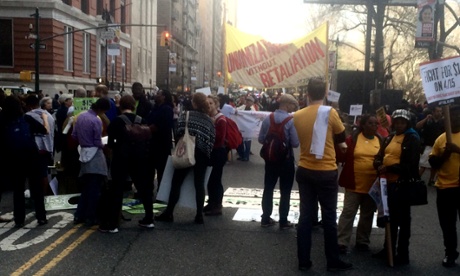
As workers gather in Columbus Circle in New York City the atmosphere is almost jubilant.
#FightFor15 #NewYork pic.twitter.com/ymrTLkc0FD
— Abby Gugu Banda (@AbbyGuguBanda) April 15, 2015
Here is a look at some of the signs we saw today:
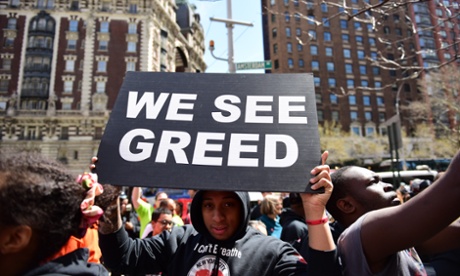
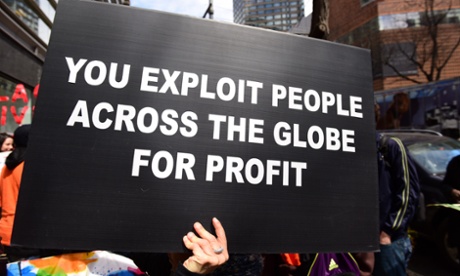
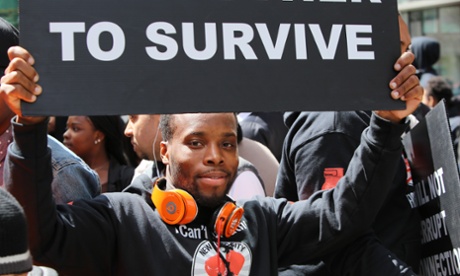
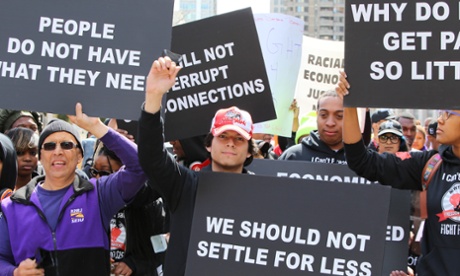
What would happen to small businesses if the minimum wage was raised to $15 an hour? The Guardian’s Ucilia Wang tried to find out:
“Labor is 30% of my overhead. A 50% increase in minimum wage would raise it to 45%. It’s already tough to offer a business to the community and keep my head above water. Honestly I’d go under with that kind of increase,” a coffeeshop owner who asked to remain anonymous said.
Some low-wage workers are aware of the danger that a higher minimum wage could pose to their jobs.
“I don’t think I’d like to see minimum wage increase that much because labor cost is such a high expense for so many coffeeshops and restaurants that I think the long-term effect will be more detrimental,” Becka Hare, a barista at Love coffee shop in Santa Monica, California, told Wang.
Meanwhile, back in New York:
Folks gathering now central park west. 59th and upwards. #FightFor15 pic.twitter.com/Ji5zqWnqww
— Colin P. Ashley (@colinpashley) April 15, 2015
Central Park West closed to accommodate #FightFor15 #FastFoodGlobal protest in #columbus circle #nbc4ny pic.twitter.com/CK2jWNFV3D
— Andrew Siff (@andrewsiff4NY) April 15, 2015
My colleague Amanda Holpuch, who is on the ground, reports:
Three blocks on Central Park West have been cleared for the rally, though the pens are about half full. The rally officially started at 4pm, but workers are still trickling in.
On the streets near the rally, some demonstrators are canvassing building workers with fliers about the movement.
When we spoke with her earlier today, SEIU international president Mary Kay Henry said that she was going to be at the University of California campus in Berkeley later this afternoon.
“It’s - for me – the representation of how the student movement is infusing this economic movement,” she said, pointing out that students from about 170 US campuses were expected to participate. “That’s a new dimension to the Fight for $15 and the union that we haven’t seen before.”
Henry has just completed a tour of six colleges, which took her through St Louis, Boston, Los Angeles and Chapel Hill, North Carolina.
“I saw students everywhere on fire to fight for their future and link arms with these workers who were being underpaid to change this low-wage economy,” she said.
Zharia Harper, working at McDonald's while in community college! Read her story at http://t.co/rGtMeCu9Mv #FightFor15 pic.twitter.com/yDQE2lL0y2
— Mary Kay Henry (@MaryKayHenry) April 15, 2015
Folks gathering at Oscar Grant Plaza to start the #Fightfor15 march from #Oakland to #Berkeley. #RaiseTheWage pic.twitter.com/q9zXgDYUNJ
— California Nurses (@CalNurses) April 15, 2015
The Guardian’s Zach Stafford is reporting live from Chicago, where students at the University of Illinois are holding their own protest for Fight for $15.
Protestors are beginning to arrive outside of UIC Student Center East #FightFor15 pic.twitter.com/3KOZoQSQLU
— Zach Stafford (@ZachStafford) April 15, 2015
"Get up, get down! Chicago is a union town!" students chant before march into the UIC Chancellor's office #Fightfor15 pic.twitter.com/LjXfN3crwj
— Zach Stafford (@ZachStafford) April 15, 2015
March has swelled to hundreds of people chanting, "What do we want? 15! If we don't get it shut it down. #Fightfor15 pic.twitter.com/Du8lJPr766
— Zach Stafford (@ZachStafford) April 15, 2015
Protestors are now heading towards UIC Chancellor's Office with 2000 signatures demanding $15 minimum wage on-campus #FightFor15
— Zach Stafford (@ZachStafford) April 15, 2015
Here is another dispatch from the Guardian’s Amanda Holpuch, who is reporting live from Columbus Circle in New York.
The rally has begun under the shadow of Trump Tower. Workers have been marching all over New York City and are pouring into Columbus Circle.
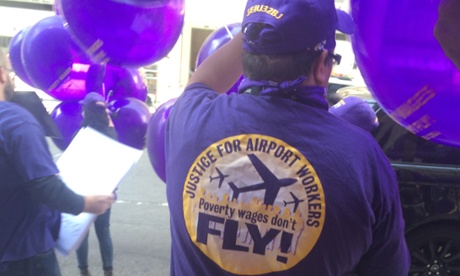
The airline workers walked from 42nd Street to Columbus circle on 59th Street, carrying large purple balloons past tourists and other union members who were on the job but who cheered in support.
Juan Chapman, an airport worker, began his address to the crowd in Spanish. “Cuando luchamos, ganamos” (“When we fight, we win”).
Homecare and healthcare workers, hotel workers and 32BJ #fightfor15 https://t.co/tyayGudjhV
— Amanda Holpuch (@holpuch) April 15, 2015
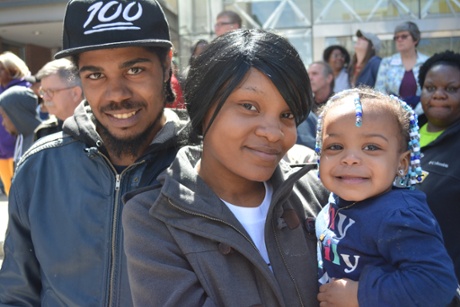
Among the first-time protesters out on the streets today was Tashayla Harper, 19, who lives in Milwaukee, Wisconsin, and works for McDonald’s.
Harper earns $7.25 an hour. Since she works for a corporate store, she is eligible for the $1 raise that McDonald’s announced two weeks ago. Despite her eligibility, Harper and her family joined today’s Fight for $15 protest: “We went to a Mayfair Road McDonald’s to strike in front of their store and let them know that we are not going to stop until we get $15,” she said.
Harper said her one-year old daughter Ky’lah, who came along, inspired her to join the campaign.
“I work and I only make $7.25 and that little money goes on my daughter, I never have enough for myself. My daughter inspired me to join the movement,” said Harper, who relies on food stamps to supplement her income.
“It’s at the point where I can’t even afford my own house, because I don’t make enough. I rely on those food stamps every month.”
Right now, Harper, her daughter and her boyfriend live with her boyfriend’s grandparents.
The question of the day is whether workers from McDonald’s franchise stores have or have not joined the protest.
As my colleague Steven Greenhouse reported, employees at 12,500 franchisee-operated restaurants who were passed over by the company’s wage increase plan were infuriated. As a result, many planned to join the Fight for $15 protests for the first time.
“I felt like it was unfair – I didn’t understand why we weren’t treated the same. At every McDonald’s, workers do the same work and wear the same uniform. So I didn’t understand why I wasn’t getting a raise like everybody else,” said Brandy Lucas, a $7.30-an-hour worker at a franchisee-run McDonald’s in Greensboro, North Carolina, who was planning to strike for the first time.
“There is clearly no widespread, organic evidence that employees of any fast food franchises are walking out of their jobs on their own volition and these planned protests are the last thing business owners and the US economy need during this still fragile, uneven economic recovery,” Steve Caldeira, president and CEO of the International Franchise Association, said in a statement.
“Franchised businesses, particularly quick service restaurants, provide good, entry level jobs and career opportunities for millions of Americans.”
There are about 12,500 franchisee-operated McDonald’s restaurants in the US, accounting for about 90% of total stores. McDonald’s has said that it does not determine wages set by its more than 3,000 US franchisees.
Kathryn Slater-Carter, who previously owned a McDonald’s franchise store, told the Guardian that even if franchisees wanted to raise their employees wages, many of them can’t afford to. Why? Because of the high costs of running a business. In addition to the regular overhead costs, franchisees pay a 3-5% royalty fee to McDonald’s, another 5% for advertising, and some also pay rent to McDonald’s. For Slater-Cater, that rent was about 12.5%.
“We tried to move [our employees] along wage-wise as well as we could,” said Slater-Carter. “Obviously when McDonald’s controls most of your pricing, we were left with less than 20 items on our menu – out of 100 – that we were able to set prices on. Everything else was mandated either through nationwide dollar menu or through local advertising co-op mandates. Your hands are pretty well tied.”
A recent poll of McDonald’s franchisees conducted by Janney Capital Markets revealed that the franchisees’ six-month outlook for McDonald’s US business was more negative than at any time in Janney’s 11-year survey history.
“McDonald’s system is broken,” one franchisee wrote, according to CNBC. “They talk menu reduction to help our people, simplify our menu for customers – but add products to help sales and it does not work. We will continue to fall and fail.”
McDonald’s told CNBC that less than 1% of its franchisees were surveyed for that report.
“We value the feedback from our franchisees and have a solid working relationship with them,” said its spokesperson.
The Guardian’s Amanda Holpuch is marching with the workers through Manhattan. Her latest dispatch:
Cleaners, airport workers and security guards have assembled outside a McDonald’s on 42nd street in Manhattan to support other low wage workers attempt to get a higher wage.
Stephanie Williams came down after her shift as a security guard. She makes more than $15 per hour, but believes it is important to support workers who make less than that.
“I know if I was making $15 an hour, I wouldn’t be able to take care of my children,” she said.
Williams said she always wanted to help fight for workers rights, but had to take care of four children.
“I’m very optimistic that the minimum wage can be raised, they have the money,” Williams said, while gesturing towards McDonald’s famous golden arches logo.
Workers entered the McDonald’s, chanted for about two minutes, then left.
Rosa Gittens is a 32BJ member who joined the protest to support fast food workers.
“We need help all the food employee workers, every one who works should be able to pay their bills,” said Gittens.
She said it would’ve been impossible to raise her kids at a $15 per hour wage.
“If they cannot pay, our community is struggling,” said Gittens.
On march to Columbus Circle, we ran into another McDonald's take over group. 24-hour store closed atm. #FightFor15 pic.twitter.com/XV8xL7taj0
— Amanda Holpuch (@holpuch) April 15, 2015
He might have yet to endorse Hillary Clinton, but Bill de Blasio, mayor of New York, has come out and endorsed the #Fightfor15 campaign.
Our City will continue to #FightFor15 because the minimum wage must keep up with the cost of living.
— Bill de Blasio (@BilldeBlasio) April 15, 2015
New York City public advocate Letitia James also weighed in on the issue.
Over 1/3 of wage-earning NYers make under $15/hr - meaning millions of hard-working NYrs are unable to pay for basic necessities #FightFor15
— Letitia James (@TishJames) April 15, 2015
Their tweets come day after New York City comptroller Scott Stringer released a report, which found that increasing New York minimum wage to $15 an hour would put “$10bn into the pockets of nearly 1.5 million workers,” and would “boost consumer spending, lessen the burden on social assistance programs, and benefit students.”
Some of the findings - highlighted by the Gothamist - are:
- “Workers in food services, retail trade, and home health care ... would see average weekly wage increases ranging from $113 to $149 by 2019.”
- “The $15 minimum wage would reduce the number of New Yorkers who spend more than half of their income on rent by over 90,000.”
#RaiseMinimumWage: See how people in each borough will benefit if we #Fightfor15. pic.twitter.com/pwXXeIp1gu
— Scott M. Stringer (@scottmstringer) April 14, 2015
The SEIU union’s efforts to unionize low-wage workers have not been well-received by trade organizations such as the International Franchise Association. Steve Caldeira, the IFA’s president and CEO, issued a statement earlier today calling the Fight for $15 protests a union-funded public relations stunt.
The National Labor Relations Board (NLRB) recently held a hearing looking into whether McDonald’s should be named as a joint employer with its franchisees.
“If McDonald’s is found to be a joint employer, that could make it jointly liable if franchisees illegally fire workers for backing a union, violate safety laws or cheat workers out of overtime. McDonald’s says its franchisees are independent business operators who face minimal interference from the parent company,” reports Steven Greenhouse for the Guardian.
According to Caldeira, SEIU efforts to unionize fast-food workers and the NLBR hearing are intertwined.
“The SEIU can claim that the goal of these protests is to increase wages for workers,” he said in a statement. “Unfortunately, the victims of the NLRB’s overreach will be the workers, which these paid protests are supposedly designed to help, and the elimination of opportunities for aspiring employees and entrepreneurs to own franchise businesses. By terminating local control of franchise businesses through an expanded joint employer standard promulgated by a pro-union government agency, the only winners are union leaders and the policymakers beholden to them.”
The press release issued by the IFA went on to state that SEIU has spent $18.5m in 2014 on its Fight for $15 campaign, “an increase of nearly 56.4% or close to $6,696,000 from 2013”. A recent analysis by the anti-union non-profit group the Center for Union Facts found that SEIU had paid $1.3m to Berlin Rosen, a public relations consultants firm that has been handling press for the Fight for $15 protests.
On 1 April, Politico reported:
BerlinRosen, which has played a key role in media operations tied to Fight for $15 — and which McDonald’s intends to subpoena in connection with the NLRB joint-employer hearings — received $1.3 million from SEIU. (For those keeping score, SEIU paid BerlinRosen $848,000 in 2013 and $393,000 in 2012.) The Economic Policy Institute, a liberal think tank, collected $150,000 from the SEIU in 2014, and the National Employment Law Project, a labor law nonprofit, received $135,000. Morning Shift checked all the Center’s calculations, and they’re correct.
The Guardian spoke with Mary Kay Henry, international president of the SEIU, earlier today after she left a Fight for $15 protest in San Francisco.
When asked if the Fight for $15 campaign was worth the funds, she said: “Oh yeah.”
There is not a price tag you can put on how this movement has changed the conversation in this country. It is raising wages at the bargaining table. It’s raised wages for eight million workers. I believe we are forcing a real conversation about how to solve the grossest inequality in our generation. People are sick of wealth at the top and no accountability for corporations.
She said that today’s actions by workers show that Americans are ready to hold government and the corporations accountable “to make sure that when you work hard, that you can feed your family and lead a decent life”.
“That’s really, really important fight and we intend to win it,” she said.
Updated
The Guardian’s Amanda Holpuch has caught up with another group of workers in New York City.
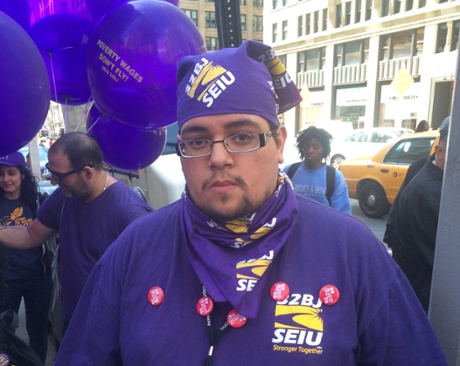
A small delegation of airport workers affiliated with the Service Employees International Union (SEIU)’s 32BJ branch is waiting in the lobby of British Airways’ office to speak with a company representative in the hope that the corporation will push the businesses it contracts with to increase wages and give workers benefits.
LaGuardia airport security guard Juan Chapman is one of the organizers for airport workers in the Fight for $15 campaign. He works for a company called Aviation Safeguards, which pays him $10.10 per hour.
Chapman has been supporting his wife and daughter on this wage for two years. His top concern is getting benefits.
“It’s really hard,” said Chapman. “I’m tired of going into a store and asking: ‘What do you have on sale and what do you have on clearance?’”
Santiago Walbert is a baggage lead for Prime Flight at LaGuardia Airport and is also an organizer for airport workers. He also works as a security guard, but that combined with the $10.10 per hour he makes at the airport is not enough to support his wife and six kids. He also helps support his mother and sister, who do not have jobs.
“$10.10 is not going to take care of that,” Walbert said.
He claimed that employees who are trying to unionize and fight for higher wages are being harassed by Prime Flight management.
Before the group entered the office building, about 50 airport workers and 32BJ staffers carried large purple balloons through the windy streets of midtown Manhattan before gathering across the street from the headquarters of One World Alliance, the coalition of airline companies that contracts the businesses that employ the demonstrators. They remained outside while the delegation waited in the lobby of the building, whose security guards are also part of 32BJ.
Organizers have been told that all British Airways executives are “out to lunch”.
Updated
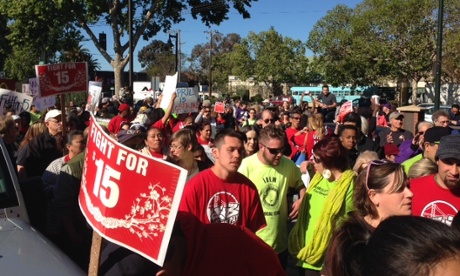
The Guardian’s Ucilia Wang has left San Francisco for Oakland, where she says the protest is “much larger and rowdier”. The demonstration there began with a march to a McDonald’s in the Temescal neighborhood of Oakland. The protestors chanted “Oakland is a union town” while they marched.
Inside the McDonald’s, they chanted “Come on out! We’ve got your back!” A few McDonald’s workers then stepped out from behind the counter/kitchen.
Robert Reich, former labor secretary under Bill Clinton, showed up to speak at the rally. Inside the McDonald’s, he said, “The fight for $15 minimum wage is a fight about dignity. It’s a fight that all of us have a deep stake in. It’s a movement for civil rights. The movement for the $15 minimum wage is a fight for the soul of America.”
Then a McDonald’s worker who walked off her job began to speak - Sandra Roman, 34, a mother of four. She spoke in Spanish and a woman next to her translated her words to English:
“I’m joining the fight for $15 and a union. I want everyone to know that when the minimum wage went up [in Oakland, it went up to $12.25 from $9 in March of this year], they took away many of my co-workers’ hours. If I get sick and call in, I get suspended. That’s why I want to join the union. I want to be protected.”
Three McDonald’s workers from this shop walked out of their job mid-shift.After an hour inside the store, the protestors left, chanting, “I believe that we will win!”
Outside, a worker from another McDonald’s in Oakland - Guadalupe, 39, who did not want her last name used - said that she used to be able to work 40 hours a week. Now it was unpredictable, though she could still work over 30 hours, she said. She makes $12.25 now, the minimum wage that went into effect in Oakland last month.“We deserve a livable wage. It’s not just about fast food workers but also home health workers and teachers. Raising the minimum wage to $15 will help a lot,” she said.
In March, Sabaah Jordan, an organizer with Black Lives Matter in New York, explained why the campaign against police killings of African-Americans was intertwined with the Fight for $15:
Black Lives Matter must stand in solidarity with the Fight for $15 because the same fast-food workers, the Walmart workers, the airport workers, the home health aides and the child care workers who are fighting for $15 are the same black and brown people who are vulnerable to unchecked violence in the hands of the police.
These issues are completely connected. It is a part of the systematic exploitation of black and brown people in this country and it’s gone on for too long. If these corporations want to show that black lives truly do matter, they must grant workers $15 - a livable wage - and the right to a union.
Robert Ascherman, a student organizer at NYU, was at the Upper West Side McDonald’s during the die-in.
“Shouts of ‘We can’t breathe on $7.25’ from the Black Lives Matter movement were heard,” he told the Guardian. According to him, the demonstration spanned a number of blocks, and was “quite jubilant” as protesters chanted: “If we don’t get it, shut it down.”
The protesters were joined by members of the Retail Action Project, who stopped to protest at a nearby Zara store before making their way to the McDonald’s.
Happening now - @ZARA on 66th & Broadway. #FightFor15 pic.twitter.com/ulB6b7TVtR
— allynn umel (@AllynnUmel) April 15, 2015
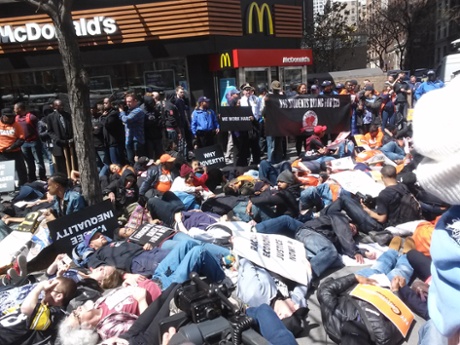
As we mentioned before, Black Lives Matter activists are joining low-wage workers in today’s protests. A group of them have just staged a die-in in front of McDonald’s on Upper West Side in New York. (h/t Kayla Epstein)
BREAKING: die-in in front of a McDonald's in NYC! Economic justice is racial justice! #FightFor15 #BlackLivesMatter pic.twitter.com/QPY531zgSN
— Fast Food Forward (@FastFoodForward) April 15, 2015
The Center for Story-based Strategy, a consulting organization that trains activists, has released a short video in support of Fight for $15 campaign.
This Wednesday, 15 April tens-of-thousands of people are joining the #FightFor15. This inspiring organizing for $15 an hour wage and the right to form a union without retaliation got us thinking: What is the story McDonald’s is telling us? What is the story that works for workers?
We think it is time to #ChangeTheMcStory.
(h/t Dominic Rushe)
Workers striking in front of a McDonald’s in Chicago just made some new friends:
Brinks armored car workers who just walked off the job to join the strike. #FightFor15 pic.twitter.com/xyodR6oyWT
— Aaron Cynic (@aaroncynic) April 15, 2015

$15.00 an hour I was earning after being five years with the same company and that was in 1985, and these people think they are worth that much for working in a job anyone that flips burgers at their cook-outs in the weekends can do. Get a life and an education.
Like many commenters below the line here, there are some who believe that certain jobs don’t warrant $15 an hour in pay.
When Seattle announced that it was raising its minimum wage to $15 an hour last June, we asked some of opponents of the move to share their reasoning with us.
This is what Marcel Porter from Barstow, California had to say:
I have no problem with the government raising the minimum wage, but to $15? Let’s be serious. I live in a small town called Barstow, California. If the minimum wage was raised to $15 an hour, it would kill our small businesses. The local neighborhood corner store would be obsolete. A lot of jobs just aren’t worth paying that much. Could you imagine a McDonald’s employee making that much money per hour to cook fries?
Don’t get me wrong, if the cost of living rises, so should minimum wage. Most business raise their prices, but not the employees pay. Right now my wife earns minimum wage working as a hallway monitor for my son’s elementary school. I love her to death, but even she knows $15 an hour for that job is just too much. I think minimum wage should be in the $10-11 range and it should depend on what industry you’re in.
What do you think? Let us know in the comments below.
It’s not just fast-food workers who are marching in the streets today. Joining in the early morning protest at a McDonald’s in San Francisco were healthcare workers and adjunct professors, reports Ucilia Wang:
Karen Joubert is a nurse, a Fight for $15 organizer and a vice president of representation with the northern California chapter of the Service Employees International Union, SEIU.
“When you pay someone a decent wage, it helps him to get better healthcare and take care of his family,” she said. “Many of our members who work at fast food restaurants are not college students. They’ve worked there for 12, 15 years. They are working three jobs so that they can raise a family. We want to see them get better wages.”
Rob Hugel is an adjunct professor at the California College of Arts, where he teaches the history of graphic design, typography and propaganda (three different classes). He lives in the Mission district and came out to support the protest because, he says, making a decent living has become harder for teachers like him. Colleges are increasingly hiring more adjunct professors, who get short-term contracts and need to work certain hours and meet other conditions to get healthcare. He doesn’t get paid for the hours he spends preparing for class. He gets semester-to-semester contracts.
He makes more than $15 an hour but says, “everybody in the temporary and low-wage work need to stand together. It’s our right to be treated fairly. Schools are increasingly picking up the corporate management model. I get a contract only a few weeks before a semester starts. There’s very little job security. It’s low pay. It’s lunch money.”
As the day of action takes off, representatives from both sides of the debate are weighing in.
Richard Trumka, the president of the AFL-CIO (the biggest union federation in the US), has issued the following statement:
Today’s actions by tens of thousands of workers significantly advance a raising wages agenda that gives every worker a chance to achieve the American Dream.
The voices of Walmart and fast food workers have shown the power of collective action in standing up to corporate greed and a system that for far too long has only benefitted those at the very top.
While some wages have been raised, there is much work to be done, and workers will continue to speak out until wages are fair, conditions are improved, and every voice is heard in the workplace.
While some wages have been raised, there is much work to be done, and workers will continue to speak out #FightFor15
— Richard L. Trumka (@RichardTrumka) April 15, 2015
Earlier this week, Trumka spoke to my colleague Steven Greenhouse about the fight for $15 and his plans to push Hillary Clinton, now the official presidential frontrunner for the Democratic party, on the issue of low wages.
“I find Hillary a wonderful, independent woman who is very, very smart,” Trumka said. Then in an unmistakable effort to nudge her to the left, he added: “There are people like that I wouldn’t necessarily vote for if their policies are bad. It’s about policy. It’s about what are you going to do to raise wages. It’s about what are you going to do to change the rules to help everybody and not just those at the top.”
Back in January, Trumka told the Guardian that “Democrats, Independents and Republicans are going to have to answer that question for the American workers”.
The Guardian’s Ucilia Wang has been watching a protest in San Francisco that began earlier this morning.
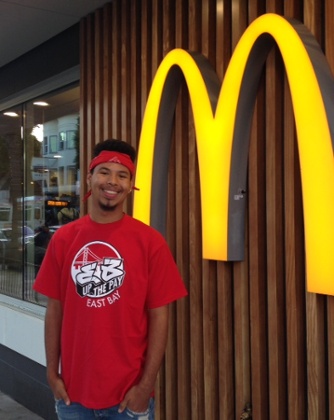
Isaiah Mitchell, 19, works as a cook at a Jack in the Box in San Leandro, California, while going to a community college. He makes $9 an hour, the state minimum wage. He crossed the bay to join the protest at the McDonald’s in the Mission neighborhood today.
“I’m here to fight for $15 and a union. We deserve a better wage and working conditions. It can be dangerous in the kitchen. It’s so hot, and there’s a lot of rushing to get food to the window. We don’t get set hours. It fluctuates each week,” he said.
Updated
In an emailed statement, a McDonald’s spokesperson told the Guardian that its US stores would remain open on Wednesday even as some of its workers join the Fight for $15 strike.
We respect people’s right to peacefully protest, and our restaurants remain open every day with the focus on providing an exceptional experience for our customers. Recently, McDonald’s USA announced a wage increase and paid time off for employees at its company-owned restaurants and expanded educational opportunities for eligible employees at all restaurants. This is an important and meaningful first step as we continue to look at opportunities that will make a difference for employees.
It’s important to know approximately 90% of our US restaurants are independently owned and operated by franchisees who set wages according to job level and local and federal laws. McDonald’s does not determine wages set by our more than 3,000 US franchisees.
Since the workers employed by these franchisees have been excluded from the wage increase, they are expected to join today’s strike.
Things are kicking off in San Francisco, where it’s about 7 am right now.
My colleague Ucilia Wang reports:
About three dozen protestors showed up bearing banners and signs and went inside the McDonald’s in the Mission neighborhood of San Francisco. They occupy most of the front counter, chanting slogans such as “Fifteen dollars and a Union!” and “All day all night, 24 hours fight fight fight!” Behind them, a bright menu sign showing breakfast sandwiches says: “May the rest of your day be as good.”
San Francisco action underway with allies and workers #fightfor15 pic.twitter.com/Al7on5CZnt
— EB Fast Food Workers (@FairFastFood) April 15, 2015
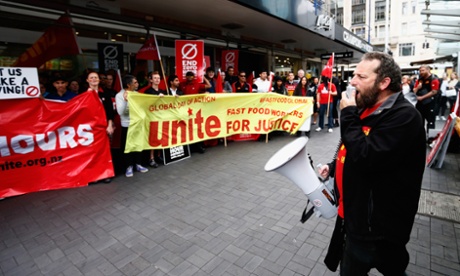
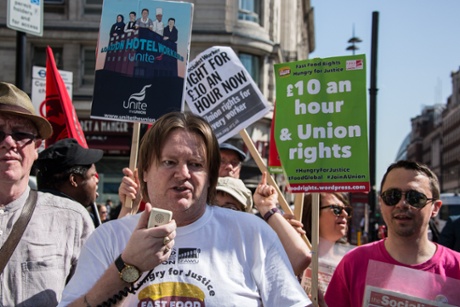
In addition to the protests in the US, workers in 123 cities in 35 countries were expected to join the demonstrations in the first worldwide coordinated strike.
“Workers occupied a McDonald’s in Glasgow, stormed a McDonald’s restaurant in Sao Paolo and blockaded a McDonald’s in Paris, holding a six-meter long sign that read, ‘Stop Social Destruction and Tax Avoidance’,” organizers said in a statement.
The world-wide protests were coordinated by the International Union of Food Workers.
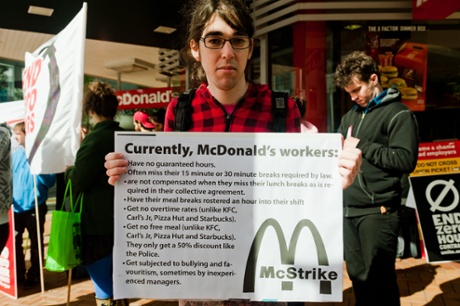
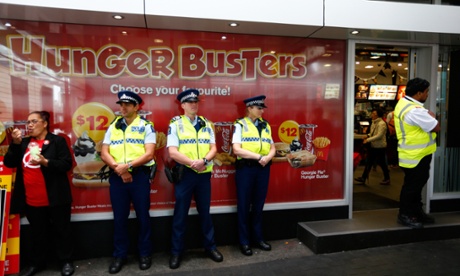
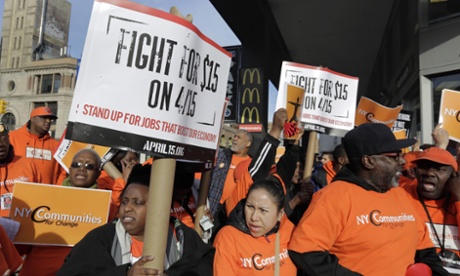
Here is a look at some of the protests so far:
New Zealand
UK
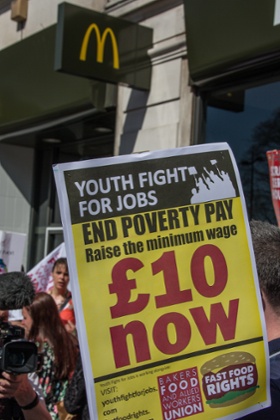
And an early start in Boston
Boston workers took to the streets on Tuesday in order to avoid protesting on the second anniversary of the bombings at the Boston Marathon, according to the Boston Globe.
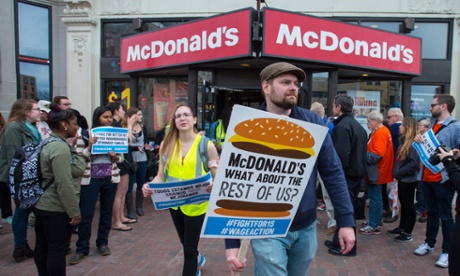
Brooklyn
Updated
Sabrina Johnson, 23, lives in Boston and has three jobs. She earns $9.57 an hour at Chipotle, $10 at the airport and $13.88 as a home health aide. My colleague Tom Pietrasik spent a day with Johnson and Edith Figueroa, who works at both Starbucks and Dunkin’ Donuts, to find out why the two have joined the Fight for $15.
Good morning and welcome to our live coverage of a day of national protests by fast-food workers and allied service industry employees: the Fight for $15.
The sun had barely risen in New York this morning when more than 100 workers gathered at an intersection of Flatbush and DeKalb Avenue in Brooklyn. More workers arrived, walking down the street and out of the nearby subway station. As more than a dozen New York City police officers looked on, the group of workers walked down the block to a nearby McDonald’s, stepped off the sidewalks and blocked the intersection. A marching band to their left struck up.
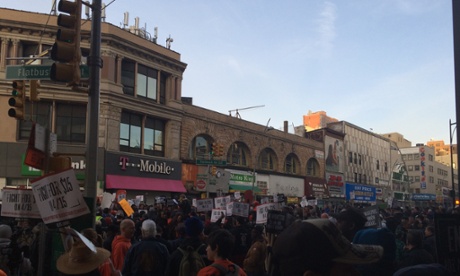
Up the block, a lonely worker remained watching a pile of boxes full of Fight for $15 signs.
The protests in Brooklyn were just the beginning of what the activists say will be their biggest day of action yet. Workers are expected to strike in 236 US cities.
Here is bunch of signs waiting for more workers #FightFor15 pic.twitter.com/cn4UbAxB09
— Jana Kasperkevic (@kasperka) April 15, 2015
“On Tax Day [today], fast-food workers from Pittsburgh to Pasadena will walk off the job, while adjunct professors, home care, childcare, airport, industrial laundry and Walmart workers will march and rally in what will be the most widespread mobilization ever by US workers seeking higher pay,” organizers said in a statement.
The workers will also be joined by Black Lives Matter activists protesters against recent police killings of African Americans.
The protests come just weeks after employers like Walmart, Target and McDonald’s said they would raise the wages of their employees and pay more than the federal minimum wage of $7.25.
The workers say that that is not enough and continue to demand a “living wage” of $15 an hour.
“Everyone just wants to survive and work happily. Fifteen dollars and union is what any fast-food worker needs,” Darius Cephas, who works at a McDonald’s in Boston Massachusetts and earns $9.25 an hour, told the Guardian. “I am not saying that everything will be better, but it will be livable. It will be manageable.”
Guardian reporters will speak with protesters today in New York, Chicago, Los Angeles and elsewhere. Follow here for all the latest updates.
Updated








You dont deserve 15 an hour for a burger or similar job there are people who are either certified or have a degree that make less than that and they worked to improve themselves you havent so you need to make less than they do.