
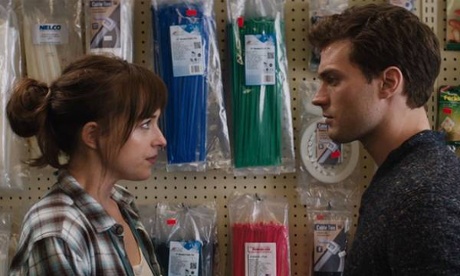
The winner
Fifty Shades still has the global scene trussed up, but dramatic plunges from its opening weekend – -73% in the US (one of the largest falls on record) and -57% overseas – suggest that it has already exhausted its core audience, the EL James faithful, let alone any casuals pulled in by the furore. Strong repeat business looks beyond Sam Taylor-Johnson’s adaptation, which was cautiously praised as an effective damage-limitation exercise given the shortcomings of the source material. Universal played a blinder on the publicity front, with blanket coverage everywhere contributing to the mammoth, and in many ways historic, opening. The only comparable international debuts for original (to cinema) material are 2012 ($165.2m) and Avatar ($164.5m), both very different kinds of film; you have to go a long way down the list before you find anything similarly centred in human drama. Prospects-wise, Fifty Shades is no Avatar, which did a game-changing six consecutive $100+ overseas weekends - this is strict box-office wham-bam-thank-you-sir.
Chinese puzzles
The game-changer the industry is waiting for – Hollywood gnawing its cuticles – is the Chinese blockbuster. The true, eastern-produced, internationally successful Chinese blockbuster. Huayi Brothers’ 1st-century BC action epic Dragon Blade, which dragooned John Cusack and Adrien Brody alongside Jackie Chan presumably to boost its foreign prospects, only shows tentative signs of progress on that front. Topping the Chinese new-year weekend box office, its $18.7m opening day compared favourably to the last major attempt at a domestically produced crossover, 2011’s The Flowers of War, which was directed by Zhang Yimou and took $24m in its first four days; already up to $50m on a five-country, mostly south-east Asian drop, Dragon Blade looks a good bet to pass Flowers’ lifetime $94m total.
But the new film seems to have learned nothing from the debacle surrounding its predecessor, which, despite the interest generated by star Christian Bale and a $100m budget that is still a Chinese record, did almost no international box office. There is almost no global awareness of the $65m Dragon Blade, no confirmed US release – and not even a single English-language review available at the time of writing on the internet. Which makes you wonder what the point of hiring western talent was in the first place, other than trophy value for an industry seeking wider validation.
Explosive Chinese box-office growth hasn’t yet translated into an evolution in its commercial thinking on the global stage. The rest of the new year lineup – old-school crime comedy From Vegas to Macau 2, heritage fantasy Snow Girl and the Dark Crystal, bestseller adaptation Wolf Totem, reality TV-sourced sequel Dad, Where Are We Going 2?, contemporary airline drama Triumph in the Skies, family film Emperor’s Holidays, all big enough hits to register on the global rankings – shows a healthy proliferation on the fast-developing domestic front. But it’s almost completely divorced from the country’s arid international-focused offerings. Even if Dragon Blade gets a significant global release, it looks from the trailer to be a tired variant (featuring a meeting between Han dynasty troops and the Romans), directed by Hong Kong journeyman Daniel Lee, on the period action spectaculars that secured China’s biggest successes a full decade-plus ago: Crouching Tiger, Hidden Dragon ($213m global box office, but it had heavy involvement from Sony), Hero ($177.3m) and House of Flying Daggers ($92.8m).
No one has managed to balance the competing demands of a film that has strong Chinese appeal yet can also excite audiences further afield. Hollywood – with the long-gestating The Great Wall, directed by Yimou, due for release in 2016 – is still trying. It’d be nice, and probably healthier for global film diversity, if the Chinese industry solved this conundrum itself – but it’s going to take more than keeping Adrien Brody on speed-dial.
Interview terminated
With little new happening on the conventional Hollywood front this week, now’s an opportune moment to examine something unconventional. December’s controversy over Seth Rogen and James Franco’s North Korea-baiting comedy The Interview is ancient history – but how did Sony’s salvage job of a mixed theatrical/VOD release work out? Superficially, fairly well; $40m in VOD rentals by late January shattered the previous record for an online release - $14m for 2012 Richard Gere thriller Arbitrage. On top of $11m and counting in theatrical, then the studio look to have at least clawed back a sizeable $44m budget (with, of course, lessened P&A costs). But what was trumpeted as “digital-first release” counts as part of what would have been Sony’s home-rental take on The Interview anyway – and surely early online availability for such a high-profile title surrendered a portion of that revenue stream to piracy. The real story here is the almost total wipeout of theatrical box office. The Interview has taken $6.1m in the US, but could have expected $45-60m in normal circumstances. The scattershot international rollout has blunted its impact, especially with it available online: it opened at a sorry 432K in the UK and 430K in Australia (Pineapple Express, another Rogen-Franco pairing, debuted at $2.4m and $1.1m respectively in 2008). Tepid reviews for the film itself reinforced the feeling that the real drama – Hollywood being chewed over in the maw of geopolitics – had already played out elsewhere.
The rest of the world
We’ve already pored over the Chinese new-year contenders. In South Korea, where it’s also holiday season, the second Detective K film was holding fast at the top on its third weekend; the wildly successful postwar immigrant saga Ode to My Father, the country’s second highest grossing local film ever, made a reappearance, too. That put it at 23rd globally, just ahead of Shaun the Sheep, Aardman’s latest, now on $17.8m and building up steam on its long global rollout – watch this space for a longer breakdown. Other than that, just a couple of continental comedies faced off against Hollywood’s finest: in Germany, Traumfrauen (technically a Warner Bros local production) clocked in 25th globally with its story of three Berliners’ love lives, while France’s answer to Hot Tub Time Machine, Bis, opened at No 3 locally and 28th on the worldwide chart. In this version, the cellar stairs rather than the jacuzzi are the conduit back to the 1980s. Take the day off, scénaristes de la République.
The future
Post-After Earth, Will Smith has been already busy deflating box-office expectations for con-man romance Focus, downsizing it as a return to character-driven material in a raft of recent interviews. Nevertheless, it co-stars the ascendant Margot Robbie, and opening in the UK, US and lots of eastern Europe and south-east Asia from mid-week, should just about be noticeable on international radar. And Big Hero 6, which has discreetly been hauling itself up the all-time animation ranks, will be looking to finish inside the top 20 on the back of its final overseas release in China this frame: it’s currently up to $546.2m, at 26th between the first Despicable Me and Puss in Boots.
Top 10 global box office, 20-22 February
1. Fifty Shades of Grey, $91.3m from 59 territories. $410.6m cumulative – 68.3% international 31.7% US
2. Kingsman: The Secret Service, $50.5m from 55 territories. $153.7m cum – 56.3% int; 43.7% US
3. Spongebob Squarepants: Sponge Out of Water, $37.4m from 45 territories. $201.2m cum – 37.8% int; 62.2% US
4. (New) Dragon Blade, $33m from 5 territories. $50m cum – 100% int
5. American Sniper, $30.2m from 56 territories. $428.1m cum – 25.3% int; 74.7% US
6. (New) From Vegas to Macau 2, $29m from 4 territories. $39m cum – 100% int
7. (New) Snow Girl and the Dark Crystal, $17m from 1 territory. $26.5m cum – 100% int
8. (New) Wolf Totem, $14m from 2 territories. $27m cum – 100% int
9. Jupiter Ascending, $12.6m from 67 territories. $114.5m cum – 65.5% int; 34.5% US
10. Detective K: Secret of the Lost Island, $12.5m from 1 territory. $23m cum – 100% int
• Thanks to Rentrak. Some of this week’s figures are based on estimates; all historical figures unadjusted, unless otherwise stated.


.jpg?w=600)









