Confirmation that Fifa paid $5m to the Football Association of Ireland to keep it quiet over threats of legal action in the wake of the Thierry Henry handball incident on one level appear an amusing diversion from the more serious matter of the collapse of the House of Fifa at the hands of US federal investigators.
The one thing this marriage of tragedy and farce had been missing was the involvement of John Delaney, a man who – to put it politely – divides opinion among his nation’s football supporters, pays himself an annual salary of €360,000 and this year was forced to apologise after being filmed singing rebel songs in a pub.
On closer inspection, however, it becomes clear the payoff rather neatly encapsulates one of the great contributory factors to Fifa’s existential crisis. It may tell us quite a lot about the way the FAI does business but it also cuts to the heart of Fifa’s issues.
The complete lack of transparency, Sepp Blatter’s tendency to treat Fifa’s money as his own, the hope that throwing money at a problem will make it go away – all became endemic under a model that was built by João Havelange and multiplied under his successor as the World Cup money rolled in.
Amid the febrile atmosphere and national Irish despair in the wake of the hand of Gaul incident, Blatter gave a press conference in South Africa before the draw for the 2010 tournament and joked about how the Irish wanted to become a “33rd team”.
That too was typical – Blatter acting as if it was he alone who could make up the rules as he went along (see also his longstanding opposition to video technology followed by a Damascene conversion following Frank Lampard’s 2010 ghost goal).
According to Delaney’s self-aggrandising account, that was one of the factors that contributed to his fury in a later private meeting (“expletives were used”) and resulted in Blatter paying $5m (or €5m, depending on who you believe – that they can’t even agree on that is telling) to make him go away.
The fact that the payment was kept completely quiet, and the later rush to explain it away as a loan for a stadium that was later written off, also speak volumes of the rotten state of Fifa’s culture.
Blatter tends to see Fifa’s income as his own to disburse as he wishes. It is why he stands up at Fifa congresses and announces special multimillion-dollar “bonuses” to the national associations in the manner of a game-show host, rather than dispensing development funds in a sensible, well-audited manner.
It is why he ensured he spent his 17 years as president, and many of those before as general secretary, in a blur of perpetual motion – whizzing around the world on a private jet to open facilities in the developing world as though he alone was responsible.
And it is why, 40 years after he started working at Fifa, we still don’t know how much he is paid. Reliable estimates put the figure north of $10m a year for a man whose private jets and five-star hotels are charged back to Fifa.
When Fifa’s finance director, Markus Kattner, was asked why this was still the case, he said bluntly it was because “we don’t have to”. Fifa claims its salaries are in line with other “global companies”, overlooking the fact it is supposed to be a not-for-profit guardian of the world’s most popular game rather than a plc.
The tone of the statement rush-released by Fifa after Delaney’s radio interview was also rather familiar. The suggestion the money was supposed to be for a new stadium had echoes of the use of “development funds” or “legacy projects” as shorthand for the don’t ask, don’t tell payments to accounts controlled by people such as Jack Warner and Chuck Blazer.
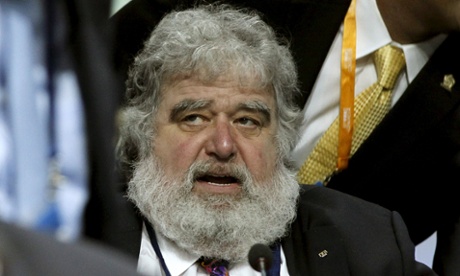
They then applied a similar approach to the associations under their control – remember the bundles of $40,000 Warner attempted to dole out on behalf of the Qatari presidential challenger Mohamed bin Hammam in 2011 that were his eventual undoing – and so the contagion spread.
Fifa’s explanation also recalled the convoluted explanation for why $10m that was due to be paid to the South African FA for the organisation of the World Cup was rerouted to a bank account linked to Warner.
Or the high-handed way in which Jérôme Valcke, the Fifa secretary general who is under extreme pressure on a range of fronts including that South African payment and his links with the disgraced former Brazilian football overlord Ricardo Teixeira, dismissed concerns over his recent decision to hand the lucrative US TV rights to the 2026 World Cup to Fox without a tender. In true Fifa style, that was a bodged fix intended to square off another crisis of its own making – Fox, the Rupert Murdoch-owned broadcaster, already held the rights to the 2022 World Cup and was furiously threatening legal action over the switch of the tournament to winter due to Qatar’s oppressive summer heat.
Going further back, you may look to the bundles of World Cup tickets handed out to the people such as Warner, the lightly audited trails of “development” funds and the sublicensing of TV rights (for $1 in Warner’s case, although Fifa disputes this) that could then be flogged on at a profit as well documented by Andrew Jennings and others.
In recent days, as the outgoing Blatter has taken to posting politburo-style photographs of his energetic return to the office even as his empire collapses around his ears, Fifa’s statements have begun to resemble the deranged ramblings of a guilty man caught out several times too often. Who knows what other skeletons will now come tumbling out of the expensively upholstered closets in Fifa HQ?
Guardian Live: Future of Fifa - can it get better or Blatter?
The Guardian will be debating the future of Fifa on 10 June with Ian Prior, Marina Hyde and Owen Gibson