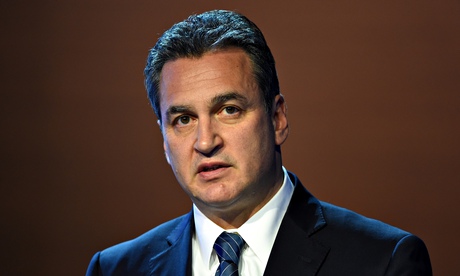
The Fifa ethics chief investigating the bidding process for the 2018 and 2022 World Cups has issued a call for greater transparency and a wholesale culture change among its leadership.
Michael Garcia, head of the investigatory arm of the international ruling body’s independent ethics committee, has delivered his report into the chaotic and controversial process that saw Russia and Qatar awarded the 2018 and 2022 World Cups, to its adjudicatory arm headed by Hans-Joachim Eckert.
Along with several members of the executive committee, Garcia has called for the 430-page document to be published in full. But the Fifa president, Sepp Blatter, has said the decision will be left to Eckert, who has indicated that only his summary will be made public.
The issue sparked a row at Fifa’s executive committee meeting in Zurich last month between those members who wanted it to remain secret and those who wanted it published.
Speaking at an event in London to an audience of US lawyers, Garcia said the two key elements to restoring public trust in Fifa within football and among the public at large were transparency and the culture fostered by its leadership. “The investigation and adjudication process operates in most parts unseen and unheard,” he said. “That’s a kind of system which might be appropriate for an intelligence agency but not for an ethics compliance process in an international sports institution that serves the public and is the subject of intense public scrutiny.”
In a coded attack on Blatter’s style of leadership and the cronyism that has characterised his 16-year tenure as president, Garcia said that a wholesale culture change was required to reinforce the rule changes made in the wake of a series of corruption scandals in recent years. “An ethics committee – even a serious, independent ethics committee backed by a strong code of ethics – is not a silver bullet,” said Garcia, a former US attorney for the southern district of New York.”What is required is leadership: leadership that sends a message that the rules apply to everyone; leadership that wants to understand and learn from any mistakes or mis-steps the ethics committee may have identified; leadership that makes it clear to everyone – ‘This is what we’ve set up the ethics committee to do, this is why they do it, and this is what they’ve done’,” he said. “It’s that kind of leadership that breathes the life into a code of ethics. Because true reform doesn’t come from rules or creating new committee structures. It comes from changing the culture of the organisation.”
Garcia drew a distinction between the International Olympic Committee’s behaviour in the wake of the Salt Lake City scandal, which he said helped restore faith in the organisation, and the way the NFL has mishandled the Ray Rice case. “The value of transparency is evident from the experiences of other sports organisations. Where there have been transparent and open proceedings those organisations have been able to move forward,” he said.
Garcia said football officials could be compelled to give evidence under threat of suspension and praised the scope of his powers to launch and conduct investigations. But he admitted that without the power to seize evidence or subpoena witnesses he relied on an “honours system”, underlining the need for a culture change imposed from the top down. “My investigations rely largely on a sort of honours system. Co-operation is required but without subpoena power, it can be difficult to assess the quality of someone’s compliance with a given request, he said. “And yet, to the credit of many within the sport, we have received substantial co-operation in providing information and producing documents from a variety of sources.”
One of the major challenges faced by Garcia during his 18-month investigation was that he was unable to compel those no longer involved in football, such as the banned former Asian Football Confederation president Mohamed bin Hammam, to give evidence.