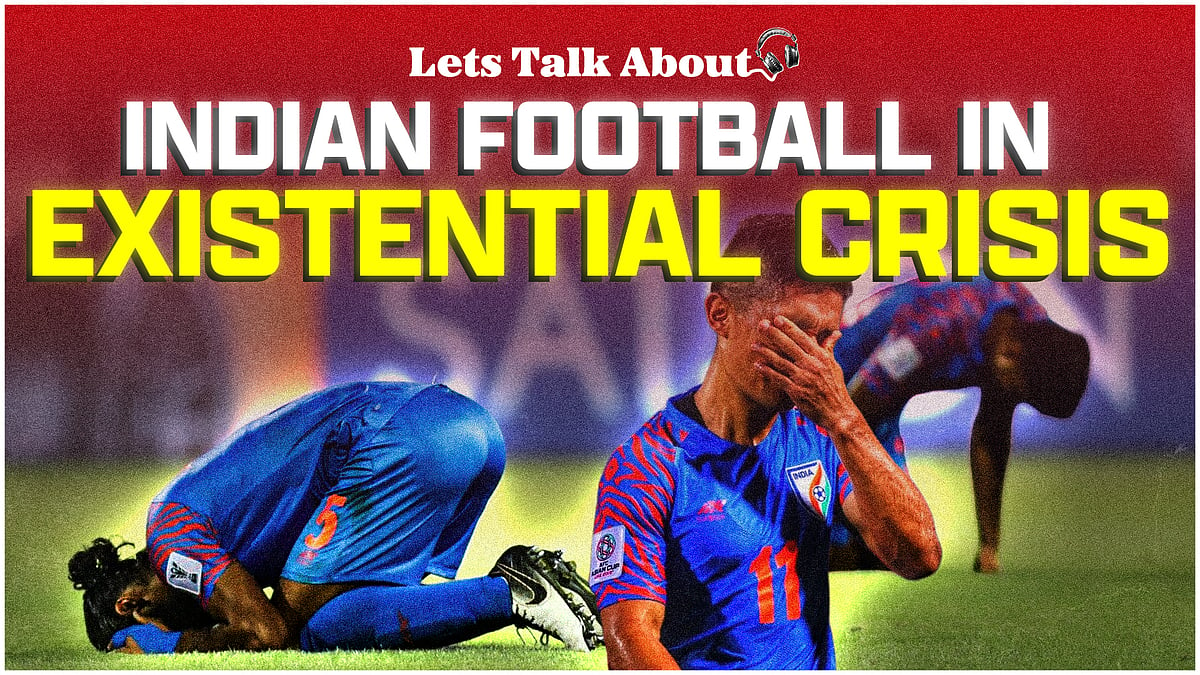
As the 2026 FIFA World Cup wraps up, this episode turns the lens on the domestic game – and finds it in crisis. In the latest episode of Let’s Talk About Indian Football, Abhinandan Sekhri speaks to Johnson K, founder of Sportfolio Productions and creator of an independently produced documentary series on India’s regional football cultures, about why the beautiful game here can’t get out of its own way.
Most Indian players are staring at contract uncertainty as clubs baulk at committing long-term to a league whose future is anyone’s guess. Abhinandan lays out a familiar chargesheet too – federation mismanagement, overpaid “prima donna” players, and a shortage of grassroots coaching – as reasons Indian football struggles to hold its own against the international game fans watch on television.
The conversation turns to why some cities sustain fierce football loyalty while others can’t fill stadiums despite thriving grassroots leagues. Fans in Kolkata, Kerala and Bengaluru show up in large numbers compared to Mumbai and Delhi because, according to Johnson, you’re not just going there for the football, you’re going there for the story. Ultimately, it’s identity, not just footballing quality, that draws crowds.
The two also take aim at scheduling negligence, particularly for youth and women’s football, which is played in blistering afternoon heat, and compare the ISL’s threadbare shoulder programming with Doordarshan’s more thoughtful coverage of the second-division IFL.
Watch this interview.
Let’s Talk About: Indian Football Ft. Johnson K
[00:00:00] Sting: This is a News Laundry podcast, and you're listening to Let's Talk About
[00:00:10] Intro: FIFA World Cup 2026 is coming to an end. The champions will celebrate. The rest of the world will start preparations to come back stronger. But what about India? Will we and our football federation and the rest of us once again forget the game until the next World Cup? If nothing changes, we'll miss 2030, then 2034, 2038, and you get the idea.
So what's stopping India from competing at that level, and what must change for us to even qualify? Let's find out by speaking to people who know or should know
This is Let's Talk About Indian Football
Joining us in this episode is Johnson, founder of Sportfolio Productions, a sports media collective in Mumbai and London. He's a storyteller who highlights how international football connects with Indian fans, and how India tells its own football story.
[00:01:14] Abhinandan: Let us first introduce, introduce you to our guest today, Johnson K.
Right, so other than being a filmmaker, Johnson, you have worked in an administrative capacity in lots of sports or sports marketing companies, so you understand licensing, um, rights, viewership, the logic behind the entire ecosystem, uh, which is a very valuable part of making any sports league or ecosystem sustainable, right?
[00:01:46] Johnson: Yeah.
[00:01:47] Abhinandan: Uh, now first of all, let me just talk about your films, your series. Your f- first season covered five regions, so region-wise you've gone over this. Uh, it's an independently produced and privately funded documentary series. You have, you know, a lot of confidence. People don't want to watch football, and yet you think they'll watch a documentary about football
[00:02:12] Johnson: I think that's, that's a standard reaction from most people in the community and, and outside. Um, Indian football culture or other... Indian football in general is something that, uh, I think it, it goes beyond logic for me- Mm ... uh, having, like, obviously been a part of it as a player myself. Uh, it's something I grew up on.
My grandfather, who played back in the '60s and '70s, he would tell me stories about Indian football, uh, being played across the country, about teams from Kolkata coming to Mumbai and playing in the Rovers Cup. So these were stories that really enamored me as a child. And, uh, when I was a kid myself, uh, I was a ball boy for the now-defunct Mahindra United.
So it was a very core childhood memory that, uh, I was a part of when Mahindra won the title. And ever since then, it's kind of been, uh, a story of more pain than, than, uh, joy when it comes to Indian football.
Mm
uh, but as a professional, uh, this was something that I'd been working on for a few years and I had been speaking to other friends in the media that as we're making all of this amazing culture stories on, in, on the football market in India for international rights holders, when there's no shortage of, uh, like, you know, good stories in, in India itself.
And no one has actually gone about, uh, sort of talking about the nuances of what football means to people in different states. It's very similar to food, where it keeps changing every time- Mm ... every, like, 50, 100 kilometers, but no one's actually, uh, taken the time and effort to go and explore that, uh, diversity, and that's, that was the idea.
Uh, we started writing it. We started taking it out to agencies, to, to different platforms, to brands- Uh, like you said, uh, Indian football has just become something that nobody wants to touch, uh, like, you know, with a pole. Uh, and I don't know. There's no other explanation other than the fact that thankfully we had a very good team who was very passionate, and there were a few people who believed in the potential of the idea, that, uh, we spent two years trying to make it, and then another year trying to, uh, actually get it published, uh, before ending up in, uh, the decision where we took that we'll probably publish it ourselves, make it as, uh, like, you know, accessible as possible to the people who actually want to watch it.
[00:04:30] Abhinandan: Right. Uh, and for those of you who are interested in watching it, the links to, uh, Johnson's films are in the show notes. You can press on that link and access his film.
[00:04:40] Promo: What makes Indian football so unique?
Two years ago, we set out to find the answer to this question And we found ourselves on the adventure of a lifetime One that would take us deep into the heart and soul of our football culture. Where do our players really come from? What stories lie buried in our football heritage? One team, one dream.
Where are we breaking through? And where are we falling behind? Most importantly, how big can we dare to dream?
Indian football.
These questions led us across the country. I am the wizard, my ancestry gods, the people bound to wake up as inflation evolves. They're still hating them bombs, families torn apart.
They will get what they want 'cause people don't get the point of it all and no one revolves. Social credit reports, there is no end of divorce, only crystals the courts. So if you picking the course, be sure to pick up a source, picture the noise, picking the flick of the flickering boy. Uncovering hidden gems in unexpected places.
Imagine, imagine, imagine. This is our journey. This is our story. This is Indian football like you've never seen before
And once you do, super! You'll fall in love with it
I'm your host, Pranay Singh
and welcome to Traveler's Guide to Indian Football
[00:06:33] Abhinandan: Johnson, since you are right now making a film, so you do research, you observe, you are an observer of this football culture. Yeah. So while in season one we had a lot of coaches, we had people in administration, we had people who have been Indian players, current and past, who are running professional academies.
Yeah. Uh, I think yours would be a very interesting take as just an observer-
[00:07:00] Johnson: Yeah ...
[00:07:01] Abhinandan: who loves football, and has a legacy kind of memory or a family legacy of football passion. What do you make of the terrible situation we are in right now? And interesting that you should talk about rights and watching football c- uh, while we're recording this in middle of May.
Uh, India and China still have not come up with any sort of agreement with FIFA- Yeah ... on the World Cup, uh, telecast rights, uh, to the last research that I had. Uh, I think China's CCTV has offered 20 million and FIFA- Yeah ... is demanding 300 million. I don't know if India even has an offer. Uh, back in the day Doordarshan would take whatever feed they want and used to just start playing it.
Yeah. Uh, now, and of course you couldn't mess with Doordarshan. Now since no one has bought it, they will not be able to steal the feed off anybody. Do you know where that will end up? And what is your macro, you know, zoom out view of why is Indian football in such a miserable situation?
[00:08:12] Johnson: Um, so I'll get to the Indian football question probably, uh, at, at the end.
Uh, starting with the FIFA rights sc- scenario, I think you're on point. Uh, Chi- CCTV have just made, uh, a bid that, uh, is way well under what FIFA's expectations were. But, uh, I think just from a more media perspective, it kind of was expected, or rather you, you did see this coming, uh, especially from the timings perspective, uh, when it comes to East Asia and non-participating East Asian countries, uh, of which, uh, like India is, is a part of.
And it- between India and China, the timings aren't conducive. Uh, if the timings are not conducive, it becomes a bigger challenge, like, you know, for, uh, any broadcaster to, to sort of really put their, uh, trust and money behind. And I think what, uh, like, I mean, what ... The situation we've ended up in is that FIFA priced it at a certain point for both China and India's markets.
Uh, that scared away quite a few investors, and now we've gotten so far in the, uh, in the process where I think what, what you said is right. I think Doordarshan probably looks the likeliest destination for it from an India point of view. And, uh, China-
[00:09:25] Abhinandan: But they'll have to pay. But they'll have to pay this time.
[00:09:27] Johnson: Yeah, exactly. So they, they, they would have to pay. I don't know what they would be doing with the programming. Uh, they've done a pretty decent job, to be fair, with, uh, the Indian Football League.
[00:09:37] Abhinandan: Mm-hmm.
[00:09:38] Johnson: That's the second division, in terms of programming. So unlike the ISL, at least they have a studio show.
They've got Arjun Pandit, Pradim Reddy, Richard Hood, and like some other really, uh, learned gentlemen about Indian football come and talk about the game and, and, and, and, uh, and, uh, do analysis. Uh, the FIFA World Cup would be very interesting how they would go about programming if it does end up with Doordarshan, which it looks most likely.
Um, but yeah, I think coming from a, a wider Indian football perspective, um, we are currently, like you mentioned, at the end of May. Uh, it is desperately dark times, uh, and I, I wouldn't like to, uh, sort of sugarcoat it in any other way. Uh, a majority of Indian footballers will be out of contract within a month's time Um, and this is footballers across the board.
Yeah. So this is your national team level players, players who have just broken into the team, players who are just midway through their careers. Um, I... understandably, clubs do not wanna commit to longer-term contracts because the, the roadmap for the sport itself is so unclear.
[00:10:41] Abhinandan: Right.
[00:10:42] Johnson: Uh, we're talking about...
And, and, and I, and I quote Ravi Pushkar when I say this, "We're talking about 15-year deals, but, uh, we don't know what the next 15 days would look like, uh, like in Indian football." And I think that is where we are at from, uh, just a, a macro lens where there is great interest, there is, like, you know, uh, Indian, Ind- the Indian market really does love watching football.
Um, but administratively we are in a position where we don't even know 15 days from now whether certain clubs who are currently in the top flight would exist. Uh, there's a lot of questions about their existence-
[00:11:18] Abhinandan: Hmm ...
[00:11:18] Johnson: uh, coming up, especially as the league is coming to a close. So while you have, like, you know, the viewership and the potential, you also have this existential crisis that we are going through, uh, which puts the average Indian football fan in a very, uh, confused place.
Uh, and I think you can... Uh, we got a taste of that yesterday at the Kolkata derby. Uh, so we were at the Kolkata derby trying to speak to fans about, okay, this is the first time East Bengal and Mohun Bagan are playing against each other, being in positions one and two. Hmm. They're level on points. Uh, the winner most likely goes for the title, and yes, there's a lot at stake, but the fans, while they are doing this as part of tradition, while they, while they turn up, they turned up in 62,000 numbers, uh, at the Salt Lake.
Wow, that's great. There was a, there was a sense of, uh, uncertainty, which is not just among the players, but it spreads among the fans, too. Because yeah, we're going for this game that could decide the title this year, but we don't know really what the league is gonna look like next year. Next year. So- Uh,
[00:12:18] Abhinandan: did...
On this derby that you... Since you were there in Kolkata and you said 62,000 people showed up to watch it, so it was ticketed or was it like Delhi that no one is gonna buy a ticket so it's just free?
[00:12:29] Johnson: No, in Kolkata it is ticketed. It is ticketed. In Kolkata, like for, uh, forget about the other games, this game in particular, I think Mohun Bagan, East Bengal will always draw crowds.
And like I said, uh, like there was more at stake this time, so people did turn up. There was, like, you know, that, uh, that overwhelming swell of support from the city.
[00:12:49] Abhinandan: Hmm.
[00:12:50] Johnson: Uh, and I think the sad part was that while people were so excited for this game, there was that sense of uncertainty that really clouded everyone's enthusiasm a little bit because nobody really knows what the league is gonna look like 15 days from now.
It ends in a, in a week- Mm-hmm ... but beyond that, uh, the roadmap is a little
[00:13:09] Abhinandan: unclear. So let me ask you again, uh, since you traveled at least five states, and you'll probably travel more, um, talking to fans, exploring football culture in different states and how it changes. In season one I spoke with coaches, I spoke with administrators, I spoke with players.
So I got the following list of things that ailed f- Indian football from the problem with the supply. I mean, we'll get to- Yeah ... the demand side later. The demand re- the demand being the fans and how much they wanna consume or attend matches. The supply side, what I got was Indian, uh, professional football players are overpaid prima donnas.
Um, there's no reason that they should be getting two, three, four crore contracts. There's- Mm-hmm ... they're not, you know, they're not that great. Uh- Mm-hmm ... that was told to me by a coach. You probably watched season one.
[00:14:02] Johnson: Yeah.
[00:14:03] Abhinandan: Uh, one I got is the problem is our central administration. They really mismanage it.
There are allegations- Yeah ... of corruption, there are allegations, all sorts of allegations, which I can, quite honestly, it's true for pretty much any sporting body in India. Yeah. Uh, then I got that we're just not good enough, and I tried that myself. I said that during that podcast also. There was one evening when I was watching on a weekend, and I think I had, uh, Punjab FC or Mohun Bagan or some fun playing each other.
On one channel it was Man City and Liverpool on the other, and I was flipping. I mean, it's, it's like watching children play and a- adults. You're not gonna watch that football when you can watch the other one. I mean, the, uh, the... one of the games, the, the Premier League game was in its, I think, 70th minute or 80th minute- Mm-hmm
and these guys are in their 30th minute. And, uh, they were already moving like they're about to collapse and die, whereas those guys are still moving full speed. Uh, I understand the weather plays a role or whatever, but- Yeah ... just as a viewer, why would I watch that? Uh- Yeah, yeah ... s- uh, then I had got, um, coaching is a problem.
We just don't have enough coaches of that caliber. Um, weather, grounds, all these things. You as someone who's observed the fans, the culture, can you give us some demand side problems? Why is there not enough demand that people say, "We want this. We want this to be fixed."
[00:15:32] Johnson: Um, I think the, the best I can explain this is basically you look at the pockets in which, uh, uh, sort of attendance and football fandom in terms of engagement from a local fan activity is at its highest, and you see where it struggles.
Um, so in Kolkata, like I mentioned, the derby draws in 60-plus thousand people, even, even right now, like, with everything considered. That's because, um, it's passed down, right? It's legacy. It... You don't support East Bengal or Mohun Bagan because you watched the game as a child, and that is what, like, you know, sort of converted you.
You watch it because that's all you know, uh, that's all your parents know, that's what your parents have told you, uh, because their parents have told them. So it's something that is inherited. Uh, I think similarly what you find is in Kerala, where, okay, Kerala Blasters is, is a more recent, uh, uh, sort of, uh, representation of football, the love for football in that state.
But the love for football is again passed down through generations. Uh, you've been, like, you know, your parents, your grandparents have been watching, uh, FIFA World Cup, watching different international teams. So when your team comes around, Kerala Blasters, you get a- an outlet to pour that into. And I think from a supply point of view, from a fan point of view, that is where you see the highest physical engagement, you see the highest attendance.
The places it struggles is when it is competing with, uh, competing for people's time in, in a crowded ecosystem. So like in a Mumbai There is actually no reason why the Mumbai Football Arena, uh, which is one of the smallest stadiums in the country, uh, should go anything like, you know, other than, like, sold out every ga- every time the, uh, the, the team plays there.
It's a s- it's a stadium that is located in the c- in the middle of the city. It's in Andheri. Uh, it's very well connected by the local, the metro. Uh, tickets aren't as expensive as like, you know, any of the other sporting or musical events over there. Then it becomes a matter of, uh, basically is the product premium enough or is the product reaching out, uh, to the kind of right audiences?
And this is where, like, you know, I want to use the Mumbai example to illustrate this. There's no shortage of people playing football in Mumbai, right? Mm. I grew up in Mumbai. Uh, when you're a school kid, uh, in Mumbai, the Mumbai S- School, MSSA, the Mumbai School Sports Association conducts football, uh, competitions from the categories of under eight to under 16.
So I'll, like, just explain it with my example. When I was a 13-year-old, I would play 16 league games for my school in the first division.
[00:18:12] Abhinandan: Hmm.
[00:18:13] Johnson: Uh, I w- on top of that, I would play two cup games, uh, two cup tournaments, which would be about eight games if you're lucky on, on both sides. And then you'd play local tournaments which is your, uh, like, you know, in the, in the neighborhood you're growing up in or the gymkhanas that are around your school.
In total, a 13, 14-year-old in Mumbai plays close to 35, 40 games of school football. Now, the difference between that 14-year-old playing 40 games and the 16-year-old who's out of school looking for a club, uh, trying to play semi-pro, trying to play weekend games is stark And when you have a football culture where you have these many practicing players, why is the stadium going, like, you know, empty?
I think that is the, the gap that- Hmm ... the premium product needs to bridge. Especially when if you have people who are passionate about the sport, who are playing the sport, those are the people who should be in the seats in the first place.
[00:19:08] Abhinandan: Hmm.
[00:19:08] Johnson: The way we do that, in at least, uh, like what we've tried to do, is give the, give the audience, or rather give the Indian football fans something to bite into, like, beyond the game.
See, there's nothing that a fan can affect, or rather, uh, you can, like, it directly affect immediately on the pitch. Right? I think the, the coaches mentioned, uh, the playing style, uh, the lack of coaches from a grassroot level. And what you pointed out with the Premier League and the ISL is a very valid concern.
Uh, imagine you're a guy in Mumbai and you have to choose between watching Liverpool at a screening or going to the Mumbai Football Arena and watching Mumbai City. You would only do that if there is something that invest- that you've invested in with the Mumbai Football Arena or Mumbai City Football Club.
[00:19:54] Abhinandan: Hmm.
[00:19:54] Johnson: And that only happens when there is storytelling that makes you feel part of it. Uh, that is why- Mm-hmm ... Mohun Bagan East Bengal fans go to the derby. Mm-hmm. That is why Kerala Blasters go for, uh, Manie Farida. But there's a
[00:20:05] Abhinandan: story there, and that is ... I guess that is what they don't understand. Exactly. But, you know, um, when you said that a 13-year-old girl gets to play over 35 odd games, I have observed in Delhi, uh, the tournament scene.
While sure, even here you get a decent number of games, the quality of the ground-
[00:20:25] Johnson: Yeah ...
[00:20:26] Abhinandan: the season you're playing with, the, you know, at 12 o'clock in the afternoon in May and June, uh, it's criminal. Um, I don't think there's any point making kids play those games. And when the trials happen for the state, if the trial is day after tomorrow, you'll get the mail tonight, "Oh, by the way, it's day after tomorrow."
Yeah. So no one can plan for anything in the summer. If you're not in town, too bad, you've missed the trial, go to hell. Yeah. It is a disgrace how it's held.
[00:20:51] Johnson: Yeah.
[00:20:52] Abhinandan: Uh, so just the fact that you get to play so many games, but this is how the rest of it works- Does it serve any purpose just playing games for the sake of games?
Does that help at all?
[00:21:05] Johnson: I, I think from a development point of view it is detrimental. I agree with you. Like, I mean, you play in really terrible grounds, you play in the really terrible conditions. Uh, what I was trying to say is basically from a more, uh, audience development- ... point of view, right? Mm. Like, for, for a, for a club like SC Delhi or for Mumbai City FC, uh, that is your primary audience that you should be getting into the stadium, like, you know, one way or the other.
That is the... That's the first, the top funnel of your, uh, audience that you should be marketing to. For example, the kids that are playing, not all of them is, uh, not, not... Most of them aren't gonna make it professional. Uh, that's, that's just the reality of it. However, they have a already l- higher sense of, uh, interest in football, which should be basically what you convert into making them your fans because you're the team that represents their city.
And I think that is where, like, you know, uh, urban cities like Mumbai and Delhi are still working their way to it. You see a great example of this in Bangalore, right? In Bangalore, Bengaluru FC, uh, like, I mean, even though their stadium's not entirely, like, you know, sold out- Mm ... but they turn up in huge numbers.
Urban city where you have- And why do you think that is?
[00:22:17] Abhinandan: Why does Bangalore have that culture?
[00:22:19] Johnson: Because they have this amazing story that they have narrated and, and like, that everybody who turns up at the Kanteerava has bought into. Uh, you've been on this journey with Bengaluru FC as a fan, right? Like, even though you may be somebody who's working in, in, in like IT or someone who's working in the corporate or, or any other space, you've been on this journey with Bengaluru FC where you've been there when they were in the I-League, when they were playing at the Bengaluru Football Stadium.
Now that they are in the ISL, you've seen the title, you've seen, like, you know, the struggles. And you see Bengaluru FC embody the people of the city, uh, on and off the pitch. So they do storytelling every time there's a new kit. They, they're, they're connecting with people with indigenous, like, you know, uh, occupations.
Hmm. That's interesting. Hmm. And, and I think that is why people from Bangalore, whether they're not native or, or, or not, they, they buy into that identity. That story becomes a part of them. So when you want to go to the stadium, you're not just going there for the football, you're going there for the story.
And I think that is, like, so from a fan perspective, that is what, uh, most fans want. And you actually really need, when, when you are looking at the football on the pitch, you need to have something more than just that, that actually draws you to the stadium or draws you to the television set even, for that matter.
[00:23:36] Abhinandan: That's very interesting perspective. Well, maybe the team management s- watching can take this into account and plan their strategy accordingly. Uh, now coming to the bits about, um, you worked in f- IPL as well, right?
[00:23:56] Johnson: Yeah.
[00:23:57] Abhinandan: So, in IPL what, what was the kind of work that you did?
[00:24:03] Johnson: So it was very similar to the kind of work that I eventually did with the ISL.
So at the IPL, we... At, in 2015, 2016, we were building social media, uh, the channels and the community for both IPL and ISL teams.
[00:24:16] Abhinandan: Hmm.
[00:24:16] Johnson: What I realized was with IPL, you don't really need to do much. Uh, I mean, cricket is such a behemoth, and it takes up so much of the oxygen in the room, that you do the tiniest bit and you will get like, you know, uh, sort of unparalleled rewards for it.
So with the IPL, uh, it's, it's a question about like, you know, being selective, whereas with the ISL it's a question about being seen, uh, in, in terms of the audience's eye. Um-
[00:24:45] Abhinandan: I
[00:24:45] Johnson: see ... and I think that is the biggest difference, where you're not really, you're not really c- trying to connect with the fan to bu- to get them to get to the stadium or to make them buy tickets.
You're connecting with the fan from an IPL lens to keep that fan, like, you know, attached to you as a club, as a, as a team, as a franchise, and that can be done in multiple ways. That can be done, like, you know, without much effort because cricket is such a, a massive deal.
[00:25:12] Abhinandan: I see. So you've... I mean, I see you've worked in Europe.
Um, you worked with an agency that held the rights to Chelsea, Real Madrid, Sevilla, Arsenal. You worked with cricket. You worked in making these films. Purely from a... And, you know, as media professionals, I guess to some extent we both have an understanding of making shows that people would like to watch. Um, because that was- Mm
my mandate as a producer for about 15, 20 years of my life Do you think on that aspect that, you know, leave the football aside, we've discussed it. I'll be discussing more of it- Yeah ... with all sorts of coaches, players, administrators. From the point of view of making it more watchable or more interesting to viewers, um, what would your recommendations be?
And secondly, I mean, maybe I'm missing something. In fact, this morning I was just cribbing on the way here, and this is not a one-off today. Regularly when I'm coming to office, Delhi has these... Which is great. Of course, it wasn't that this government didn't introduce it, the previous government had introduced it, to clean the streets.
You know, it's this vacuum- Mm-hmm ... brush thing.
[00:26:27] Johnson: Yeah.
[00:26:28] Abhinandan: Now, you know, I had recently traveled to, uh, Italy for a conference. Uh, I traveled to Germany a few months ago. I traveled to UK. Uh, and because I wake up really early and usually go for a walk or a run or something, like really early in the morning, all the street cleaners are there.
They're cleaning up the streets. So before all the traffic comes out, they've done and gone. Because they have these slow-moving trucks that are going around cleaning stuff. In Delhi, peak hour on Outer Ring Road is when the truck is going and cleaning at five kilometers an hour. So there's a huge jam. I mean- I don't understand why it can't be done at 4:00 or 5:00 in the morning.
Similarly, a football game for 14, 15, 16-year-old kids, must they play at 12:00 in the afternoon at 47 degrees? Um, is there, like, some major logistical issue? Will, you know, someone die if the match happens at 6:00 in the morning? So from the point of view of that experience, so the player experience or even the
I'm not gonna sit and watch a game at, you know, 12:00 in the afternoon. I'm not interested. I'd, I'll pass out. I'll, you know, have heatstroke. Even, uh, Narendra Modi could not fill a rally in May in 20- uh, last year when he was having el- uh, election campaigning. So am I missing something? Are we just idiots?
Or, like, it's just make it four hours earlier. Why does that not happen?
[00:27:50] Johnson: Uh, I, I think it's just negligence. Like, if I had to be very blunt about it, like, you know, organizing, especially age, I mean, youth games at that time. Uh, 'cause what you just said, there's no, there's no reason why it can't be played earlier in the morning.
Uh, there's no reason why it can be, can't be played a little later in the evening.
[00:28:09] Abhinandan: Hmm.
[00:28:09] Johnson: Uh, that time slot that you spoke of, like, you know, 12:00 to 3:00, uh, it, it, it's a horrible time slot to play at any age group. Uh, it's a horrible time slot to play at any level, uh, like amateur or professional. And I, I feel like it's only in India you see that time slot that often, whether it is, uh, like an under 14, under 16 game, or until a few years ago, even the AIWL, the premier division of women's football in the country.
Hmm. Uh, I mean, the women were playing, like, on Astroturf surfaces, uh, at, like, 3:00 in the afternoon. Wow. 40-plus degrees where the, the boots are melting. Yeah. And this is not something, like, I'm making up. This is the actual, like, you know, firsthand- Yeah, I've seen that ... stories of the players themselves. Um, I don't really understand, uh, uh, like, you know, why that happens other than the fact that, like, nobody's actually, uh, like, paying attention to these things or they're just negligent to the point where it's being done just for the sake of being done.
And that, I think, is the biggest problem when it comes to organizing these games, uh, from a, uh, from a player and a, and a participant point of view. Uh, because if you don't really feel like your organizers care about, uh, you- Mm ... the basic, like, you know, necessities that you need to perform, uh, then that really hurts your motivation.
Uh, imagine you're a, you're a professional women's player who's been waiting all year for her premier division, uh, season, and you're playing, playing at 40 degrees where- Yeah ... the boots are melting. Uh- Yeah ... it's- Why would
[00:29:37] Abhinandan: you play? Yeah. And from a programming point of view, making it more watchable other than the timing, um, what would your inputs be to just make that production more viewer-friendly?
[00:29:50] Johnson: Uh, I think even, like, from a progra- programming point of view, that, that slot doesn't work, right? That slot is terrible. I mean- Hmm. Sure ... uh, not only are you losing out your peak audiences at either end, it's also the time slot where, uh, you are not actually gonna get your active engaged view- uh, audience- Mm
viewer. You're gonna get people who are passively viewing this. Sure. Uh, your school kids are, are also going to not be a part of it.
[00:30:14] Abhinandan: Hmm.
[00:30:14] Johnson: So it just... It's a bad decision all around when you, when you think of, uh, especially that afternoon slot From a programming point of view, and this is more of like sort of a personal opinion, I think the, the ISL under FSDL Reliance, uh, they did like, you know, a re- they did a decent job of really, uh, lifting the floor of, uh, programming in Indian football.
[00:30:37] Promo: Hmm.
[00:30:37] Johnson: Uh, so from what it was before, um, and, and I, I, I mean, no criticism to what Zee did, uh, previously. I think for the time it was really good. Uh, but over the last 10 years, the audience got used to a, a certain level of broadcasting and programming when it came to the ISL. Uh, with the chaos that was surrounding this year, I think FanCode, uh, who are the current broadcasters of the ISL, uh, they did whatever best they could.
However, their strategies d- has, has been directed more towards social media. What that does is basically for the viewer sitting back home, right? When you're watching this and you're looking at empty stadiums or you're looking at, uh, like one football is not being, not really that great on the pitch, and second, you're seeing the stands empty.
It really makes you question that, why am I tuning in? Uh, why am I still watching this game when you have Liverpool City happening on the side, where not only is the football great, but you're actually seeing people in the stadium really enjoy it. Uh, so there is a kind of a FOMO effect when it comes to that too, uh, 'cause the derby did that yesterday.
[00:31:40] Abhinandan: Hmm.
[00:31:42] Johnson: You know, the derby created that impression where, oh, if I was not... If I'm not there, I'm so glad that I'm watching it. The last 30 minutes, you could see the craziness in the stadium. You could see East Bengal and Mohun Bagan going all out for it. It makes you feel like, yes, I wanna watch this. Empty stands don't really help with that, and I think that, again, a bigger problem, a lot more, uh, cooks, like, you know, to sort of have to play their part for that.
But I think this in, in its entirety makes a, a, like, you know, a, a bad, a bad soup altogether. You know, you have empty stands, which is because for some reason you haven't engaged with the football fans in that culture, uh, to that point. Uh, from a broadcast point of view, you're, you're showing a football game that isn't of the highest level, and there are empty seats.
That doesn't really create a great impression. And on top of all of that, with, uh, the ISL this year, there isn't any shoulder programming either. So if I want to munch on conversations in and around the game, the only thing I'm left with is to go to social media and find a content creator who has spoken about Mohun Bagan, East Bengal-
[00:32:48] Abhinandan: Hmm
[00:32:49] Johnson: or any of these, uh, conversations. You look at how it could be done at a, like, very, like, sustainable level with the second division this year. Mm-hmm. So the Indian Football League, the second division, uh, that's on Bro- on Doordarshan this year. They've got a halftime show. They've got a pregame show. They've got Arjun Pandit, they've got, uh, Pradyum Reddy.
They've got coaches, they've got former players who are there, uh, and presenters who understand Indian football talk about Indian football from a very, uh, like, firsthand point of view. So when I'm watching the Mizoram derby, uh, which is for the first time ever that it's happened in Indian football between Aizawl FC and Chanmari, I actually get to hear Pradyum break down why these kids from Mizoram are so technically good.
Hmm. Why the game is so much faster when they play against each other.
[00:33:36] Abhinandan: Hmm.
[00:33:37] Johnson: And that really makes you feel like you wanna know more. So I think it's a balance of basically intriguing the fan who's watching back home to want to want to be a part of it in the stadium or to want to know more about the game that is happening.
When that doesn't happen, when the fan doesn't wanna be in the stadium, it creates a, like, sort of poor product overall, uh- Sure ... which is why we are struggling right now.
[00:34:01] Abhinandan: Right. Thank you so much, Johnson, for this conversation, for making the time. Again, I repeat to my viewers, you can watch his documentary films.
The links are in the show notes below. There'll be a short promo during this show as well. And, uh, more power to you, and I hope to see, uh, more of what you do have an impact on Indian football. And for those of you watching, if you know anyone who can make things better, let's try. Let's all work together to try to make Indian football at least respectable in the world.
Thanks, Johnson.
[00:34:31] Johnson: Thank you. Thank you so much, Abhinandhan.
[00:34:36] Sting: Thank you for your subscription. You're changing the world by changing the way news is funded. For the smoothest News Laundry experience, download the News Laundry app. It is the best way to listen to our paywall podcasts.
And you'll also get access to all free News Laundry shows. Keep us ad-free and subscriber-funded.
Help us grow. Tell people who listen to you to pay to keep news free. Subscribe to News Laundry. Keep journalism independent.
Newslaundry is a reader-supported, ad-free, independent news outlet based out of New Delhi. Support their journalism, here.