With the Guardian’s unstoppable rise to global dominance** we at Guardian US thought we’d run a series of articles for newer football fans wishing to improve their knowledge of the game’s history and storylines, hopefully in a way that doesn’t patronise you to within an inch of your life. A warning: If you’re the kind of person that finds The Blizzard too populist this may not be the series for you.
** Actual dominance may not be global. Or dominant
Italy v England is ... One of the grandest international fixtures, between two footballing superpowers.
And the more realistic view, taken by everyone outside England, is ... In fairness, it is a big game with a long and storied history. But the dynamic of the rivalry is best viewed through the prism of Italy’s four World Cups and one European Championship. The Azzurri – a reference to Italy’s azure shirts – are without question a member of the international football elite, alongside Germany, Brazil and Scotland [editors, please check]. England, underachievers with just the one World Cup, are very much a second-tier nation in that respect.
It’s a thin line between success and failure, though. Both countries’ rolls of honour might look a little different had the insular buffoons running the English game in the 1930s been a bit less sniffy about Fifa and their new-fangled World Cup. They didn’t enter the first three tournaments, and Italy were victorious in two of them, in 1934 and 1938. These wins didn’t stop the English claiming they were the best team in the world anyway, and would have won at least one of those trophies had they deigned to enter. So when the teams met in November 1934 for a summit meeting at a muddy Highbury, it was on!
The teams had already met, for the first time, in May 1933 at the grandly titled Stadio Nazionale del Partito Nazionale Fascista in Rome. The game ended 1-1, Cliff Bastin of English champions Arsenal cancelling out an early goal by Giovanni Ferrari of Italian champs Juventus. There clearly wasn’t much of a gulf in quality, and with pride at stake and arguments very much still to be resolved, the return in London a year later would prove a highly fractious affair.
The game would come to be known as the Battle of Highbury. “Possibly the Italians were bewildered at the beginning of the struggle,” reported the Manchester Guardian. “They may have been nervous. They may have had a slight attack of football fright.” And perhaps with good reason. Within 120 seconds of kickoff, their influential midfielder Luis Monti – who had reached the 1930 World Cup final with the country of his birth, Argentina, then won the thing four years later as a naturalised Italian - had his ankle broken by a no-nonsense challenge from Ted Drake. English forward Eric Brook meanwhile started the match in some style. He saw a first-minute penalty saved by Carlo Ceresoli. (“The cohorts of Italy cheered and Englishmen wondered what sort of a goalkeeper was this leaping acrobat,” reported this paper.) He then made up for the miss in double-quick time, with goals in the third and 10th minutes. Drake made it 3-0 a couple of minutes later. It was a whirlwind start, and Italy were all over the shop. World champions? These?
But Italy fought back, and not just figuratively. Giuseppe Meazza scored two goals in four second-half minutes, and would have had a hat-trick were it not for the crossbar. “The Italians were very excitable,” reported the referee after England held on for a signature 3-2 win. Injuries outnumbered goals. England captain Eddie Hapgood suffered a broken nose, Ray Bowden could barely walk on an injured ankle, Drake had his legs “shred to ribbons”, Brook needed an x-ray on his arm, and Jack Barker required strapping on a hand. Ceresoli meanwhile had taken an awful whack in his trouser arrangement, and arrived at an FA banquet that night looking pale and queasy, taking great care not to swallow too hard.
The Italian press considered their embattled team a “platoon of gladiators”. The FA were less circumspect, and for a while considered pulling their representative side out of all international matches. But they eventually calmed down, perhaps realising that for better or worse, the Battle of Highbury was a match for the ages. In fact, it’s probably the single most famous match ever staged at the grand old stadium, which is saying something seeing Arsenal played there for 93 years.
Italy were still reigning world champions in May 1948, when England again anointed themselves as Unofficial World Champions after another memorable victory. This result was more comprehensive and less controversial, a 4-0 win at the Stadio Communale in Turin. Stan Mortensen, Tommy Lawton and Tom Finney, twice, were the goalscoring heroes, and this was one of the great England teams - Stanley Matthews and Wilf Mannion completed perhaps the country’s strongest five-man forward line ever. But the Italians were no slouches either, their team containing seven of the dominant ‘Grande Torino’ side destined to perish in the Superga air disaster 353 days later.
England were magnificent, although whether they deserved to win by *four* is a moot point. Mortensen scored early, after which Italy pushed the visitors back with extreme prejudice. Romeo Menti and Guglielmo Gabetto both tucked the ball past England keeper Frank Swift - who would be killed in the Munich crash of 1958; this really was an ill-fated collection of stars - but the goals were ruled out for offside. Gabetto then saw a shot cleared off the line by Laurie Scott, and began pummelling the ground in impotent frustration. Matthews dribbled up the other end to set up Lawton. Two-nil after 24 minutes, against the run of play. And still Italy weren’t done. According to the report in the Guardian, Swift then made five spectacular saves during the period before half-time, three of them in one frenzied attack, the legendary Valentino Mazzola at one point heaving into view carrying the kitchen sink.
The second half continued in the same vein. Italy pressed and pressed, but became increasingly weary. Their startled players found themselves being revived by jets of water dispatched from a soda siphon by double World Cup winning manager and wannabe barkeep Vittorio Pozzo. But England hit them with a sucker punch, and one of the great counter-attacking goals, Swift throwing out to Scott, who found Mannion, who in turn fed Lawton, who finally slipped the ball forward for Finney to round Valerio Bacigalupo for the third. Finney scored again to make it four, and would later claim the result to be the high-watermark of England’s efforts, 1966 included. England had certainly impressed the knowledgable home crowd, some of whom went home under the mistaken impression that Matthews, the flash bugger, had at one point whipped out a comb to style his hair mid-dribble! Turns out he was just wiping a bead of sweat off his brow, a terrible shame, the mundane truth a hammer blow. Print the legend.
But how about them English, huh? Unofficial world champions! Sadly the claim rings a little hollow with the benefit of hindsight. Italy may have been technically reigning champs, but their second title had been won a full ten years earlier, the war having got in the way. And England would thoroughly embarrass themselves at their first World Cup in Brazil two years later, the USA and Joe Gaetjens snapping everything into shameful perspective. Italy had a shocker too, rocking up on a cruise boat all fat and bloated, but they at least had the excuse of not wanting to fly in the wake of Superga, which among its 31 victims had claimed the aforementioned Bacigalupo, Gabetto, Menti and Mazzola.
On to the 1970s, and the next meaningful action between the two countries, who were drawn together in the qualifiers for the 1978 World Cup. The backdrop to those qualifiers was the 1976 Bicentennial Cup, ostensibly a friendly tournament to celebrate the 200th anniversary of the USA’s declaration of independence, featuring England, Italy, Brazil and - *fuck yeah!* - Team America. The cup is best remembered for a rumble between the English and the Italians at the Yankee Stadium in New York which would certainly have benefitted from the attendance of some World Police. Italy were brilliant in the first half, Francesco Graziani of Torino scoring two and going close with another couple of efforts. But England turned it around completely in the first eight minutes of the second half, Mick Channon scoring twice, Phil Thompson once, Trevor Brooking pulling the strings. It was on! Again!
Italy lost the nut. Graziani clattered into Tony Towers. Giancarlo Antognini repeated the trick on the same player. Mauro Bellugi pestered Brooking in the roughhouse style. Phil Neal had his leg split open. In the last minute, Giacinto Facchetti thought he’d forced an equaliser, but it was disallowed because Fabio Capello had barged keeper Joe Corrigan to the floor. “Facchetti came off the ground at a run when the goal was disallowed,” recalled England defender Dave Clement, “and after going for the referee he took a swing at Mick Mills. I dived in to push him away but his mind had gone. He was so mad with frustration that he threw a couple of punches at me. Luckily they weren’t very good ones, and I was able to move my head out of the way. Fachetti moved off, but one of our fellows told me later that another Italain was getting a great big gob of spit ready to aim at me. I’m glad he didn’t get around to it.” Much good all this effort did for either team. For the record, Brazil topped the four-team mini-league, with Team America - starring various NASL types including Pele, Giorgio Chinaglia and Bobby Moore - trailing in last.
Italy had their revenge for that 3-2 defeat when the World Cup qualifiers came round. They won 2-0 in Rome, and though they lost the return fixture by the same score at Wembley, did enough in the other matches to make the 1978 World Cup at England’s expense on goal difference. The game at Wembley was another brouhaha. Kevin Keegan loosened the teeth of moustachioed nutcase Romeo Benetti, a foolish move for which the Juventus midfielder promised payback in full. He was as good as his word, settling the balance with one of the most gloriously cynical fouls of all time. Keegan - whose face had already been warmed up by Marco Tardelli’s meat-tenderising elbow - slid a gorgeous pass down the inside-right channel to send Brooking in to seal the 2-0 win. With all eyes on Brooking as he went about his business, Benetti arrived with perfect comic timing to clean Keegan out. A work of obscene genius, the darker side of Italian football in its purest form.
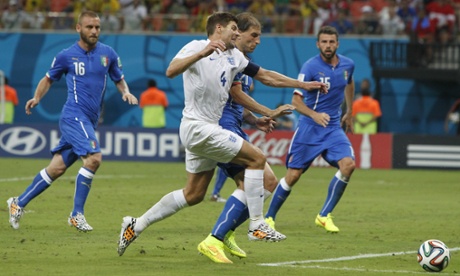
There have been more recent meetings, and England have not had the best of them. Tardelli scored the only goal when the teams met at Euro 80. Italy beat England into third place at the 1990 World Cup, a game mainly remembered for Roberto Baggio stealing the ball off a dozing Peter Shilton on the veteran keeper’s last outing in an England shirt. Andrea Pirlo made a jigging Joe Hart look utterly preposterous during a penalty shoot-out in the quarter finals at Euro 2012. And Mario Balotelli’s header was the difference in Manaus at the World Cup last summer.
England’s most memorable result against Italy during the last 37 years, then? Forget a couple of friendly wins in 1997 and 2012; the best one was a draw in Rome in October 1997 which saw Glenn Hoddle’s side pip the Italians to automatic qualification for the following year’s World Cup in France. Payback for 1977, then, and yet a performance one suspects Italy will have secretly admired, too. The game ended 0-0, a resolute display of defensive brilliance, a tactical masterclass, a job executed with chilling efficiency. What had to be done, was done, no more, no less. As Italian as it gets.