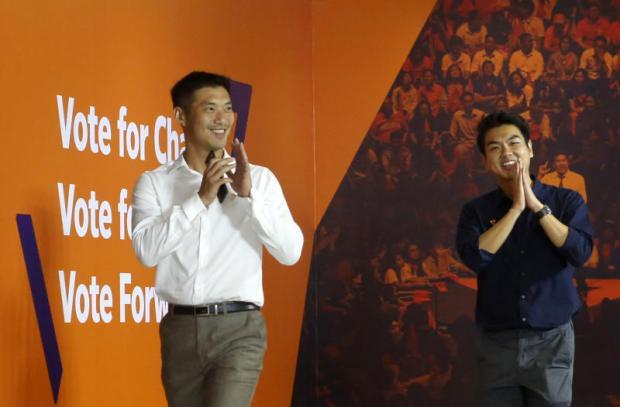
The achievement of the Future Forward Party (FFP) in the March 24 general election is phenomenal, if not unprecedented.
For a new party which is barely one year old, winning over six million popular votes out of a total of 38 million, which translates into about 80 parliamentary seats, and coming third after the pro-regime Palang Pracharath and pro-Thaksin Shinawatra Pheu Thai parties is extraordinary.
Although there are no details about the age groups of those who cast ballots for the FFP, it is believed that a large portion of young voters, including first-timers, voted for the party.
So, what attracted the younger generations to the party?
Surapong Suebwonglee, a former key member of the disbanded Thai Rak Thai Party, the predecessor of the Pheu Thai Party, explained that this is in line with a global trend -- that of younger people identifying with new parties and politicians.
He cited other "new faces" who have made an impact on the international scene in recent years, such as Emmanuel Macron in France, Justin Trudeau in Canada and Pablo Iglesias in Spain.
The FFP's successful debut is similar to the extraordinary achievements of the Thai Rak Thai Party of Thaksin Shinawatra, Palang Dharma Party of Maj Gen Chamlong Srimuang and Prachakorn Thai Party of the late Samak Sundaravej when they first entered the political landscape more than two decades ago.
The Thai Rak Thai Party won a landslide victory with its 30-baht universal health care scheme and other populist policies while Prachakorn Thai and Palang Dharma roundly defeated the Democrats, the long-time election champions in Bangkok.
But Mr Surapong said that Thai Rak Thai would not have succeeded with the same old policy platforms if it had contested the March 24 election because Thai society has changed considerably.
The younger generation in Thailand today is under heavy pressure from competition and new technologies such as AI (artificial intelligence), blockchain and the Internet of Things, as well as unequal access to opportunities.
These reasons go towards explaining why many young Thai voters chose the FFP, with its promises of changes and policies which differ from its older rival parties, such as an end to military conscription, rewriting the constitution and placing the military under civilian control.
The youthfulness of the party's three main public faces, namely leader Thanathorn Juangroongruangkit, secretary-general Piyabutr Saengkanokkul and spokesperson Pannikar Wanich, may also have attracted young voters.
Here are a few social media posts highlight the enthusiasm of first-timers ahead of the election: "My daughter is returning to Lamphun from Bangkok to vote for the FFP," wrote Angkhana Malagul.
"Daughter is very excited about voting. She asked which party I will vote for. I told her I will vote for Khun Thanathorn," wrote Orawan Jina.
Movie producer Yutthalert Limpaparb said he wanted to know what the most important issues were in the minds of young people when they voted for the parties or politicians of their choice. He added that he tried to find out the answers as he filmed Mr Thanathorn and Mr Piyabutr on the campaign trail.
However, the FFP fever seems to have an ugly side, which appears to have been overlooked by most people -- the anger and hostility of its loyal supporters towards the older generation who disagree with the party's stance regarding the high institution. The perception of the monarchy of its secretary-general, Mr Piyabutr, who refers to it only in the most deliberately academic terms, is both unacceptable and deplorable to many Thais.
An academic has pointed out the many hostile or hateful comments from the so-called "Orange Guards" (orange is the party colour) against the party's detractors which, he said, does not bode well for Thai society, which usually treats its elders with respect.
Despite his impressive success in running his family's business, Mr Thanathorn is still considered "green" due to his lack of political experience. The party's policies to substantially cut defence spending, bring the military under civilian control and end conscription may strike a chord with young voters, but may also hit a bump, most likely incurring the wrath of the military, if they are implemented too quickly.
After all, running a country is more complicated and difficult than running a family business.
Veera Prateepchaikul is former editor, Bangkok Post.