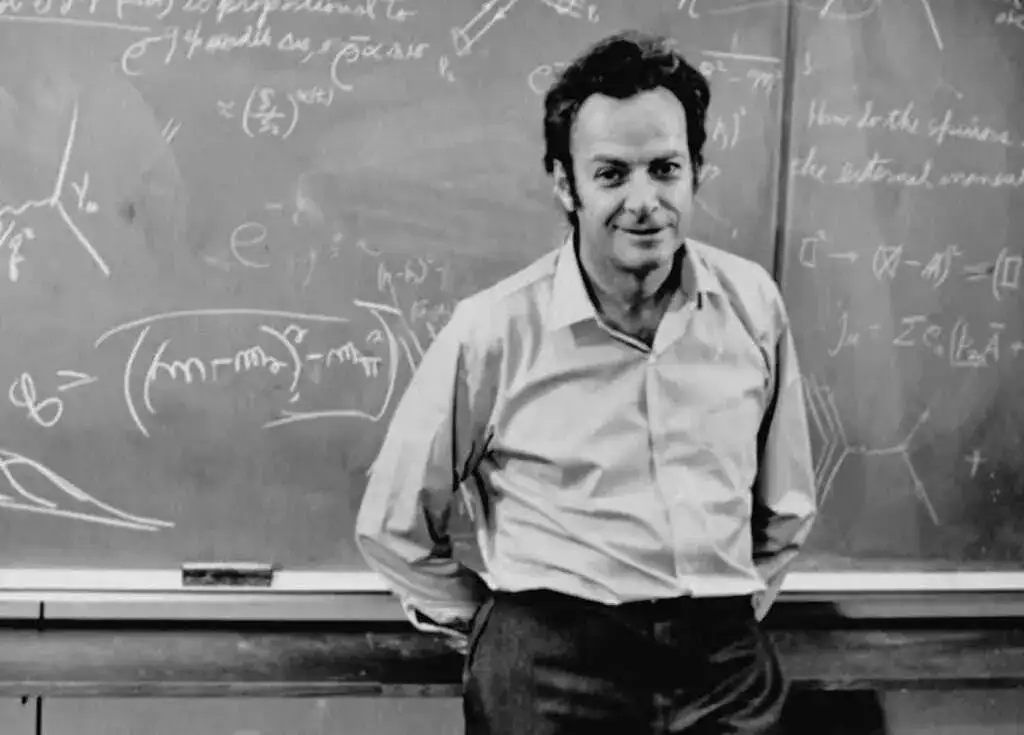
Richard Feynman’s thinking habit was not based on memorizing more facts. It was built around understanding ideas from their roots. The legendary physicist believed clarity came from breaking difficult concepts into simple pieces. His approach showed that intelligence grows through curiosity, patience, and honest questioning. Many people see genius as a rare gift. Feynman viewed it differently. He believed strong thinking came from a disciplined relationship with learning. His method focused on removing confusion instead of collecting complicated information.
Feynman’s career proved the strength of this mindset. He contributed to quantum physics, worked on major scientific projects, and received the Nobel Prize in Physics in 1965. Yet he often described himself as someone who simply loved figuring things out. His greatest advantage was not just knowledge. It was his ability to rebuild knowledge. He approached problems with fresh eyes. He questioned assumptions. He searched for the simplest possible explanation.
How the Feynman Technique became Richard Feynman's secret weapon: A different definition of genius
Most people imagine genius as some innate, almost magical gift. Feynman saw it differently. To him, sharp thinking was less about natural talent and more about a disciplined relationship with not-knowing. Rather than collecting impressive-sounding information, he focused on stripping away confusion until only the essential truth remained.
What made his approach famous was its refusal to accept hollow explanations. If an idea sounded sophisticated but didn't actually make sense when explained plainly, Feynman treated that as a red flag, not a sign of depth. Every concept had to pass one test: could it be explained in simple terms?
His career backs this up. He played a major role in quantum physics, contributed to significant scientific projects, and won the 1965 Nobel Prize in Physics—yet he often described himself simply as someone who enjoyed figuring things out. His edge wasn't just what he knew, but his willingness to take knowledge apart and put it back together in his own words.
First principles thinking as a tool for clarity
At the core of Feynman's method was starting from scratch. Instead of accepting an explanation at face value, he'd dig into why something worked the way it did. This is the essence of first-principles thinking: cutting through assumptions, traditions, and borrowed opinions to get at basic, foundational truths.
He applied this whether he was tackling advanced physics or picking up an entirely new skill. One of his core beliefs was that overly complicated language often masks a shaky understanding—someone who truly grasps an idea should be able to explain it in plain terms.
Curiosity was the engine behind all of this. Feynman constantly asked the questions other people skipped over, approaching problems like an explorer hunting for connections nobody else had noticed. The result was a kind of intelligence that wasn't about knowing everything, but about knowing how to learn anything. This is why the "Feynman technique" is still widely used today—students use it to test whether they actually understand material, professionals use it to sharpen communication, and leaders use it to cut through difficult problems.
Why this still matters today
In a world overflowing with information, opinions, and noise, Feynman's habit feels more relevant than ever. The skill of separating real understanding from surface-level chatter has become essential.
His core lesson was that genuinely understanding something matters more than appearing smart—and that the two are often confused. People who can explain a hard idea simply usually understand it far better than those who hide behind jargon.
This mindset also fuels innovation. Breakthroughs tend to happen when someone questions an assumption everyone else took for granted, or looks at a familiar problem from a fresh angle. Applied to business, science, or everyday decisions, this habit pushes people past easy answers toward a sturdier foundation for creativity and problem-solving.
Richard Feynman was born in 1918 and later became one of the twentieth century's most influential physicists. He played a critical role in developing quantum electrodynamics, a breakthrough that earned him the Nobel Prize in Physics in 1965. Yet his greatest contribution for many people may not be his scientific discoveries. It may be the way he thought.
Whenever Feynman encountered a new concept, he asked himself a simple question: "Can I explain this clearly?" If the answer was no, he knew he did not truly understand it. Instead of hiding behind technical language, he searched for simplicity.
Feynman's real legacy isn't just his scientific work—it's this approach to the world. He proved that genius isn't necessarily about having a faster mind; it's often about building better habits of thought. The Feynman thinking habit endures because it reframes learning as discovery: real knowledge starts the moment we stop pretending to understand and start asking better questions.