Fetuses whose mothers smoke during the pregnancy cover their faces and touch their mouths more frequently, a pilot ultrasound study published in medical journal Acta Paediatrica revealed this week.
The pilot study of 20 pregnant mothers, conducted at Durham and Lancaster universities in England, was designed to find out how fetuses react to smoking. Previous studies have shown that smoking can cause complications during pregnancy.
Fetuses of smoking mothers had a 58% increase in mouth movement and 69% increase in touching their mouths, the study found.
As fetuses get older, their movements should normally decrease, but the higher rate of mouth movement among fetuses of smoking mothers suggests that their fetal central nervous system may not develop at the same rate as in fetuses whose mothers do not smoke.
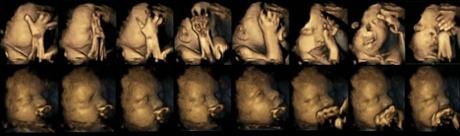
In the scans released with the study, fetuses of the smoking mothers appear to be almost covering their faces.
“Fetal facial movement patterns differ significantly between fetuses of mothers who smoked compared to those of mothers who didn’t smoke,” said lead author Dr Nadja Reissland of Durham University’s Department of Psychology.
Our findings concur with others that stress and depression have a significant impact on fetal movements, and need to be controlled for, but additionally these results point to the fact that nicotine exposure per se has an effect on fetal development over and above the effects of stress and depression.
A larger study is needed to investigate specific effects, said Reissland, who hopes to replicate the study with 60 smokers and 60 non-smokers.
The researchers looked at 80 ultrasound scans of 20 fetuses. Scans were taken at 24, 28, 32 and 36 weeks of pregnancy. Four of the 20 mothers smoked an average of 14 cigarettes a day. The other 16 mothers were non-smokers. All fetuses were born with no obvious health issues.
“Technology means we can now see what was previously hidden, revealing how smoking affects the development of the fetus in ways we did not realize. This is yet further evidence of the negative effects of smoking in pregnancy,” said Brian Francis, professor at Lancaster University and co-author of the study.
About 10% of pregnant women said they smoked during the last three months of their pregnancy, according to Centers for Disease Control and Prevention. Smoking during pregnancy has been led to other complications including miscarriage, premature birth and problems with placenta.
Fathers who smoke are not off the hook. Future studies should look at how fetuses react to their fathers’ smoking, researchers said.