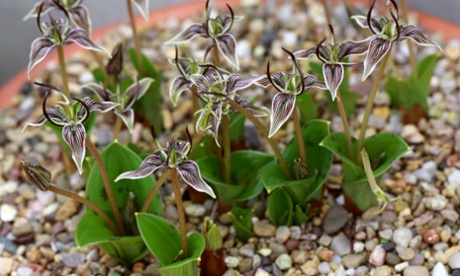
Bigelow’s fetid adder’s tongue sounds like something straight out of the pages of a book on witchcraft, or an ingredient in a spell in a Harry Potter story. It sounds made up, but it definitely isn’t.
It is certainly magical and appears each year as if from nowhere. One day you look and there isn’t anything there; the next, there is a clump of the most exquisite deep purple and cream-striped flowers surrounded by vivid green leaves spotted with maroon. What’s more, it appears in February in the darkest spot in the garden where little else seems able to grow.
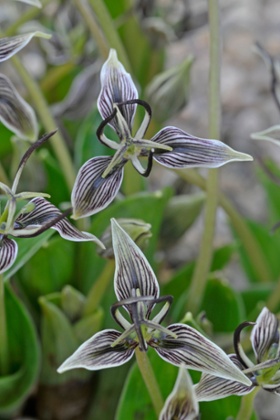
It’s got some more magic up its sleeve too and this lily relative’s botanical name, Scoliopus bigelovii, helps explain why. Its species name tells us that it was named after American botanist and physician Jacob Bigelow, but it is the name of the genus, Scoliopus, that tells us more about the plant itself. The word is derived from the Greek for curved (“skolios”) and foot (“pous”), and refers to the way that the stem that leads to the flower (a pedicel) curves over the leaves after flowering to deposit its seeds safely on the floor.
It is at this point that the magic really happens. The seeds have a sweet, fleshy part called an elaiosome. Ants in California’s redwood forests, where the fetid adder’s tongue grows, can’t resist this nutritious snack. They carry the seeds away from the parent plant, eat the elaiosome and bury the seeds deep underground. This ensures they are out of the way of both the forest fires that sweep through in summer and the hungry rodents that like eating the seeds.
What of its common name? It is fetid because if you get up close and personal with one, your nose probably won’t enjoy the experience. It has an amazing secondary reproductive strategy that leads to the name adder’s tongue. When it flowers, it also puts out double-pointed runners (stolons) that allow it to clone itself. If that isn’t magic I don’t know what is.
In the garden it likes a deep acidic soil in dark shade, as does its closest relative, Scoliopus hallii. Plant it very early in the autumn and forget about it. Doing so gives it time to settle in before coming into growth, which can happen as early as December. You need to forget about it to experience the magic.
It is plants such as this that keep me interested in the world’s flora. With a life cycle that is so intriguing, it rivals that of any large mammal or exotic bird. What’s more, you can grow it in the garden and watch its amazing story unfold each year with your own eyes.
• Robbie Blackhall-Miles is a modern day plant hunter’s propagator and gardener. He is personally interested in ancient families of plants and blogs about these on his website Fossil Plants. He also tweets as @fossilplants.