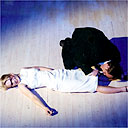
In the course of its journey from screen to stage, this celebrated Danish film has undergone a profound sea-change. Thomas Vinterberg's prize-winning movie, made according to the minimalist Dogme 95 principles, was a searing exposure of a particular family tragedy. This Polish stage version, directed by Grzegorz Jarzyna, is more of a metaphor for the slow, inexorable workings of guilt and responsibility.
What is curious is that the story, the structure and even much of the language remain the same as in the film. Once again we see a formal family gathering to celebrate the 60th birthday of an industrial magnate called Helge. And, as before, the stuffy, black-tie ritual is overturned by the revelation from Christian, Helge's eldest son, that he and his sister were regularly raped as children by their bullying father. Christian even goes on to suggest that Helge was directly responsible for the suicide of another daughter. But it is left to the closing scene to determine whether the accusations are the product of Christian's fevered imagination or an expression of literal truth.
Or so I felt in the movie. The extraordinary thing about Jarzyna's production is the sense of doom that hangs over proceedings from the start. Jan Peszek's Helge is a brooding, solitary, withdrawn figure, who clearly nurses some secret guilt. When, in the course of the dinner, Christian offers his father a choice of two colour-coded speeches he could deliver, you feel that Helge sub-consciously chooses the one that will inevitably lead to his own destruction. The sense of a pattern working itself out is reinforced by the measured pace and the constant use of a child's spinning top which, as in Chekhov's Three Sisters, comes to symbolise an implacable sense of fate.
In fact, one of the delights of the stage version is how many associations it conjures up. Vinterberg's film has a documentary vividness and is about what it's about. But Jarzyna's production, with its two long tables laid out at right angles, brings to mind not just Chekhov but a whole range of Shakespeare plays: Hamlet obviously, with its theme of buried family secrets, but even more specifically, Macbeth, with the sense of a ceremonial banquet thrown into disarray through the intrusion of ghosts from the past. Underneath the growing panic there is also a wonderful sense of stillness about this production. You see it not just in Peszek's penitential Helge but in Andrzej Chyra's troubled Christian who, like his father, introspectively broods long before he speaks.
Festen was a fine film. But this production, presented by the London international festival of theatre, shows that on stage it becomes an even richer metaphor for the workings of destiny and guilt.
· Until November 2. Box office: 020-7863 8000.