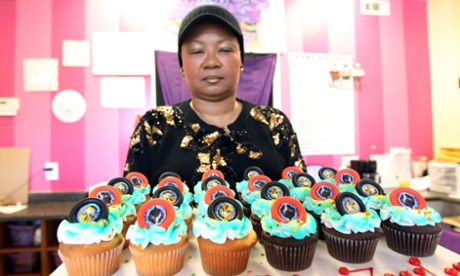
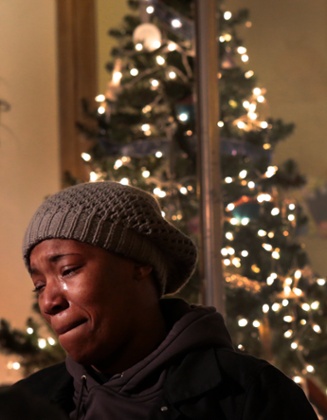
Less than 24 hours after the announcement that a grand jury would not indict officer Darren Wilson for the shooting death of unarmed black teen Michael Brown, Queen Greene stood on the border of Ferguson, Missouri, watching a man board up the shattered window of her beauty salon. A handful of women sat around her – mostly family and friends – to show their support.
Greene, 35, is pregnant with her fourth child and had seven employees at the salon, which was destroyed in a fire as rioters swept through the city streets. Two of her former employees have already taken jobs elsewhere. She can’t re-launch her business until she hears back from her insurance company, and worries her other employees will soon join them. “Then I’ll really be starting again from scratch,” she says.
She and her husband are approaching the holidays with trepidation. “I don’t know how much of a holiday we are going to have,” Greene says. “This takes half of our income.”
Stories like Greene’s are scattered across the Ferguson city limits. Every single one of the six businesses on Greene’s block has been destroyed by fire, closed down until further notice. The beauty supply at the other end of her block is unrecognisable after it burned to the ground.
Business owners and their employees in and around Ferguson are facing life-altering financial losses as a result of property damage to their storefronts from looting and burning that followed the Michael Brown decision. Donations and support have flooded in, they say. But it may not be enough. There is unfinished business here: internal rifts, anger, and the question of what will happen when the dust settles.
At least 25 structures and 27 businesses in Ferguson and the adjacent areas were damaged by fire in the days following the news Darren Wilson would not be indicted, the Ferguson fire department confirmed Monday. Official figures have yet to be released. These numbers do not include structures damaged by means other than fire.
But even those businesses that have not been damaged are facing heavy financial losses. One block away from Greene, all businesses but for one barber shop, which suffered fire damage and has closed, were left intact by the unrest. Owners say business was down by as much as 50% – on a steady decline since August.
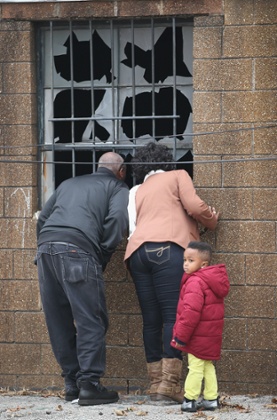
One bar, which could easily have fitted 150, was open, but only serving two customers late afternoon on Saturday – and preparing for an early close.
Linh Nguyen, the 39-year-old owner of a nail salon, says business was uncommonly slow for a weekend. Customers have become scarcer since the August shooting and initial unrest, Nguyen says. Her three employees have had their hours cut as a result, and one recently quit.
A few doors down, Tymica Jones, 40, says all of her four hair salon employees have had to resort to finding part-time jobs outside of the industry in order to compensate for their slashed hours in the last four months. The holiday season will not be the same for her and her family this year, she says, adding it would be a great opportunity for her two nine-year-olds to be taught the value of things and restraint.
“We are going to cut back this year. Things have changed,” Jones says.
Mike Marley is a 29-year-old barber who is using Jones’ salon space after the barber shop he worked in was burned down. Business for him has dropped 40% since Michael Brown’s death in August. Many of his regulars do not have his number or know where to find him.
His personal income has fallen sharply. The father of two has been making “big time sacrifices” to make rent and pay household bills, forfeiting expenses such as maintenance and weatherproofing his car, and furniture he needed for the house. He has also been forced to give up his passion: new shoes. He says cutting back is something he’s happy to do so that he can still afford to treat his sons – who are 5 and 8 – on Christmas.
“I am not going to be able to give them everything that I want, but I’ll focus on the main things. My oldest son wants a laptop for school. That’s going to be the main thing I give,” Marley says.
Less visible Ferguson residents running moneymaking enterprises from their homes have also faced severe financial hardship in the last few months.
Gloria Taylor, a 33-year-old mother of four, who runs a daycare from her home, lost three of her clients in the months following Michael Brown’s shooting. Parents were worried for their children’s safety.
Last week, during the protests that swept the city, police sectioned off swaths of Ferguson. Taylor felt it immediately: not a single one of the remaining five or six children who attend her daycare showed up.
“That’s a lot of income for us,” says Taylor, whose husband, a chef at Longhorn, also lost income when his restaurant in nearby Florissant was temporarily closed for a few days after the unrest.
Suddenly, Taylor is counting every cent. “Thirty or forty cents spent or saved on grocery shopping makes a difference,” she says.
The two Fergusons
There are two Fergusons. The city is 67% black and 29% white. While Taylor and Greene work in the part of town where minority-owned businesses stand, there is another, upscale Ferguson across the tracks.
The more upscale Ferguson is the business district where business owners are mostly white. It’s the part of town where the police station stands. Holiday decorations line the streets and a large, lit sign mounted above the main road reads, “Season’s Greetings”.
This Ferguson is surviving while the other one suffers. The business owners are almost aggressively promoting a positive message for the town. Yet there are worries here too.
“Diversity is why I came here and diversity is why I stay,” says Beth Thompson, who has been the owner of Cose Dolci, a boutique bakery known for its biscotti, for the last eight years. Her shop has been left intact, but she worries.
Thompson, who employs four people, says support has been overwhelming in the last few months. New customers have compensated for those customers who have been lost due to fear.
As a reporter interviews Thompson on the day before Thanksgiving, a man comes in and tells her that at the end of the day, he will buy up everything she hasn’t sold and take it down the road to first responders.
“So that you can have a fresh start after Thanksgiving,” he says.
“Sometimes being the race that’s on top – the Caucasians – you don’t see everything that’s going on with everybody at the bottom,” says Cathy Jenkins, who co-owns the restaurant Cathy’s Kitchen in the business district, and says she has very friendly relationships with white and black neighbours alike.
Together with her husband, Jenkins is one of the only black business owners in the upscale part of town. She has been welcoming protesters in her establishment since August and sending food down to them when they are not able to make it in.
Jenkins, who also owns a craft industry chemicals company based in Ferguson, agrees with the calls for change screamed out during demonstrations.
“I’ve lived in Ferguson almost 23 years and I have been stopped by the police in my twenties, thirties and forties. And each time I have been asked where I’ve been going. But I live in Ferguson. I’m going where I want to go. I’ve never gotten a ticket and I have white neighbours. It’s the authorities that have to catch up.”
Jenkins’s solidarity did not go forgotten. Protesters during last week’s night of devastation successfully locked arms in front of her store to stop looters from destroying it. The memory of this brings proud tears to her eyes.
Donations flood in
Such displays of generosity have buoyed business owners. An “I love Ferguson” initiative – selling t-shirts, yard signs, and stickers – began in August to promote a better image of the town. Proceeds raised from the registered 501c3 nonprofit all go to help local small businesses affected by the unrest.
The movement has now morphed into a physical shop, which raised $15,000 between August and last week. The money has been divided up between 20 businesses, says Sandy Sansevere, a 55-year-old Ferguson retiree who volunteers in the shop.
Since the big night of looting and burning on November 24, generosity has gone through the roof: checks have started flowing in for $2,000 and $10,000 each, Sansevere said.
Online donations
Many individual stores have resorted to online funding campaigns on gofundme.com.
Queen Greene, the salon owner expecting her fourth child, has already raised $10,000 out of a total goal of $19,000.
Another business, Natalie Cakes and More, which was vandalised last week, has already raised upward of $260,000 – well over owner Natalie DuBose’s target of $20,000. Donors are scattered across the country and world.
Missouri governor Jay Nixon announced last Friday that $625,000 in zero-interest loans would be made available to small businesses affected by unrest through a Small Business Relief Program.
But, even with such generosity, regional mobilisation and hope, internal rifts and anger – placed on protesters, looters or police, depending on perspectives – remain present.
Two views on the past, separated by race
Many business owners in Ferguson can’t let go of the feeling that the destruction could have been avoided if federal authorities had done more to protect residents during the unrest, which had been widely expected.
Greene is adamant – as were most of the black business owners and black Ferguson residents I spoke to – that the extensive destruction that happened in Ferguson following St. Louis County prosecutor Bob McCulloch’s announcement Darren Wilson would not be indicted, was yet another example of the failure of the state to protect black people’s interests.
“I think the National Guard should have been there,” Greene says. “Why was it everywhere else, except for in the heart of the problem? We were hit the last time. That beauty supply was hit every time they’ve had riots, so why weren’t they there to protect it, knowing it was going to get hit again?”
Greene has marched with other residents, demanding justice for Michael Brown. Inside the “I love Ferguson” shop, volunteer Sandy Sansevere has another take, which stresses a united community with no race issues.
“We’re all good. And then you have a select group of people who choose to be divided. That’s not how we live,” Sansevere explains, echoing many white people’s portrayal of the town. “If only we could keep the riff-raff out,” she continues, referring to the looters.
While “I love Ferguson” yard signs decorate many front lawns on the white side of Ferguson, they are rare sights on the black side.
Indeed, there is a broad understanding within the black community that although supporting local businesses is a great venture, the “I love Ferguson” movement is seeking to promote an unrealistic image of a perfectly harmonious community.
This portrayal does nothing to help with underlying issues and complaints from black residents.
Next steps
Residents say Ferguson is trying to rebuild and look to the future. The business community is at the center of this, as a focus on helping businesses has brought unlikely allies together and temporarily silenced divergent opinions.
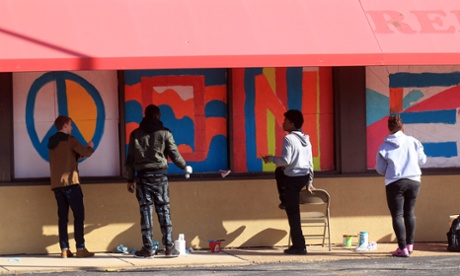
Flocks of volunteers – many of them white outsiders – have been coming into the area in the last week to paint colorful messages of hope and peace on boarded-up businesses. Some say they disagree with the non-indictment, others quietly express warm wishes of support and backing for law enforcement.
“Stay safe,” has become a parting greeting for residents, visitors and reporters alike.
As the late afternoon light disappears, employees at still-functioning businesses that have had to be boarded up for insurance purposes say they have become fearful, feeling more at risk of potential robberies. The wooden boards mean they cannot see who is coming into the stores.
And yet the perception of what it means to stay safe is very different according to who you are in Ferguson.
One white middle-aged housewife, visiting Ferguson with her husband and daughter to patronize businesses and help paint storefronts, said a revealing goodbye.
“But actually don’t worry,” she says to a white, female reporter. “There’s so much police here now, I am sure you are safer here than anywhere else.”
Her words perfectly capture the ongoing divide – in Ferguson, the police represent safety for some, and angst for others.