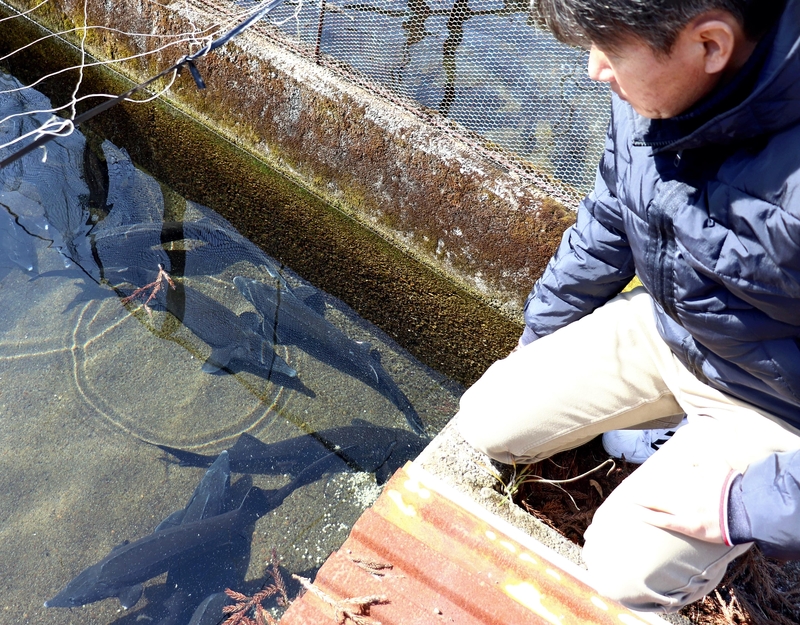
In an attempt at boosting caviar production, Shingu Station of Aquaculture Research Institute, Kindai University, has launched a test program to try to ensure that its sturgeon all become female.
Located at the end of a winding mountain road about a 20-minute drive from Shingu, Wakayama Prefecture, the station spread out about 30 water tanks with fish swimming leisurely in them over its vast grounds. Its largest tank is about half the size of a school pool.
Shingu Station was relocated from Mie Prefecture and opened in 1974. Since then, they have cultivated freshwater fish such as amago trout and ayu sweetfish using water drawn from the nearby Takada River.
Since 1995, the station has been raising sturgeon, the fish that produces one of the world's top-three delicacies -- caviar, but it wasn't until 2008 that the station first succeeded in collecting and selling their roe. About 250 cans, each containing 30 grams, were shipped in the current fiscal year so far. And since 2017, the university has been working with students to obtain roe more efficiently. By optimizing the fish feeding process, they want to ensure that an entire adult population of sturgeon is made up of only roe-producing females.
According to Toshinao Ineno, director of the station, the testes and ovaries of sturgeon begin to develop about six months after the fish hatch. They conducted a 2-year experiment in which 150 juveniles with immature reproductive organs were fed a diet supplemented with female hormones to see if the proportion of females increased.
When fed with regular feed, the male to female ratio stands at about 50/50. But when 45 of the 150 hormonally supplemented sturgeon were randomly selected, a reproductive organ test showed that all 45 were female.
"A juvenile fish that would have turned out male if it had been given normal food became female under the influence of female hormones," Ineno said. In the future, they will examine whether these females have the ability to spawn.
A major hurdle to the project is that the government does not allow female hormones to be used in fish feed, thus caviar raised by this method cannot be sold.
Starting last year, Shingu Station launched a similar experiment in which the researchers feed Japanese catfish natural ingredients similar to the female hormones found in soybeans. If the experiment yields positive results, the station plans on using the feed on their sturgeon and aims to apply this method for commercial use in future.
There were in the past sturgeon populations in Hokkaido and other parts of Japan. However, environmental degradation in part led to their extinction. There have also been many accounts from around the world that the overfishing of sturgeon due to the high demand of their caviar has caused sharp population declines.
"If we can efficiently feminize [sturgeon] via their feed, we will be able to collect large amounts of caviar while protecting sturgeon in their natural habitats. I want to contribute to the prevention of their extinction through the establishment of technologies," Ineno said.
Read more from The Japan News at https://japannews.yomiuri.co.jp/