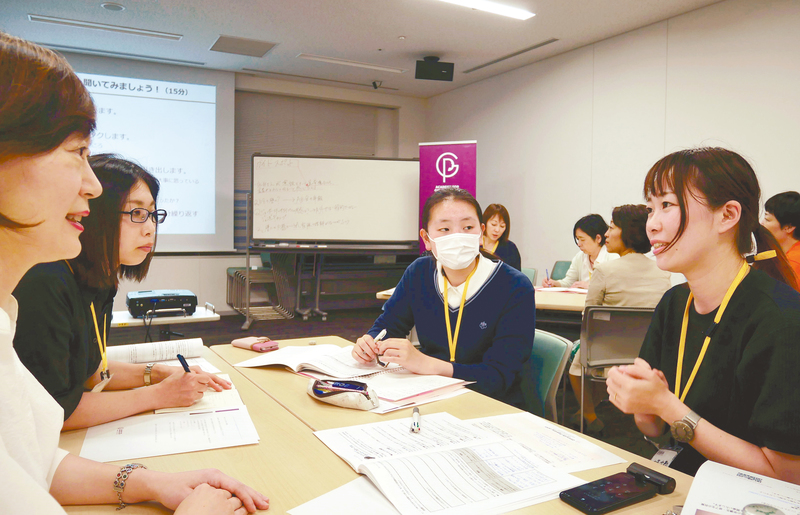
Schools dedicated to the training and support of female politicians are thriving. An increasing number of their graduates are running -- and winning -- in unified local elections, indicating that these schools are playing a vital role in nurturing female assembly members and Diet lawmakers.
One evening in late May, there were gasps of surprise among about 15 young women attending a class in Tokyo on nurturing political leaders.
"Next time, you will each deliver a three-minute speech. Think about your motivation for getting into politics and the policies you will champion," the teacher said. "We'll also film your speeches."
Despite being startled by this announcement, some of the attendees, who included high school students, university students and company employees, smiled as they took notes about the upcoming project.
The course is run by the Academy for Gender Parity, a general incorporated association set up in spring 2018 by Sophia University Prof. Mari Miura and others with the aim of boosting women's participation in politics. So far, a combined 55 people have participated in the academy's lecture courses and summer training camp.
Of this number, five ran in the 2019 unified local elections, with four winning seats. Two women also plan to stand as candidates in this summer's House of Councillors election.
In spring 2018, a group seeking to increase the number of female assembly members in Fukuoka was so alarmed by the dearth of such politicians that it established the "school of politics for women." Seventeen women aged in their 30s to 50s participated in classes to consider regional issues and observed the city assembly.
Attendees also learned how to give polished speeches and dress to create a favorable impression. Seven of the 11 school attendees that ran in the unified local elections were successful.
The growing demand for such schools has been fueled by the Law on Promotion of Gender Equality in the Political Field, which came into force in May 2018. The introduction of this law was accompanied by wide media coverage of Japan's lack of female Diet members and assemblywomen, and women interested in politics and a career in this arena have stepped forward.
The fact that 2019 is a year featuring multiple important elections -- the unified local polls and the upcoming upper house election -- also appears to have been a factor.
As well as grooming these women for a career in politics, some groups also offer financial assistance to female candidates.
The Akamatsu Private School of Politics & Economics, which is for women and opened in 2014, had 53 students in its first batch, and currently has 74 enrollees. The school's main strength stems from its students attending lectures by Diet and corporate high-flyers and being able to interact with them.
The political organization Woman in New World, International Network (Win Win) operates the school. Since this spring's unified local elections, Win Win has provided 200,000 yen to women planning to stand as candidates. This money is paid only to women who attended the school and are registered members of Win Win. So far, seven women have received the financial assistance.
"The financial hurdles are high for a woman running in an election," said Tsumie Yamaguchi, chief director of Win Win. "Providing financial assistance is essential if we're to increase the number of female politicians, even by just one person."
According to Gakushuin University Prof. Kaori Shoji, an expert in U.S. politics, nongovernmental organizations in the United States increase the number of female candidates by teaching them how to compete in elections and providing financial assistance.
"In Japan, places where women interested in politics can get together are gradually increasing, but these are still early days," Shoji explained. "Ideally, political parties should nurture and support female candidates, but they do little more than open schools where attendees hear speeches from public figures. The process for women to receive official endorsements is also unclear.
"The gender equality law has come into force, so if there are more places for learning about politics, such as centers for women across the nation, I think the number of female politicians will increase."
Numbers still low
Female candidates performed well in April's unified local elections, but the overall proportion of women serving as assembly members remains low.
In mayoral elections for cities except government ordinance-designated cities, a record high of six women were elected (including victory by default). In city assembly elections, 1,239 women won seats, edging the previous record of 1,233 set in 2003. The city of Tarumizu, Kagoshima Prefecture, made headlines by electing its first city assemblywoman since the city was established in 1958. However, women accounted for only 18 percent of all successful candidates in these city assembly elections.
Read more from The Japan News at https://japannews.yomiuri.co.jp/