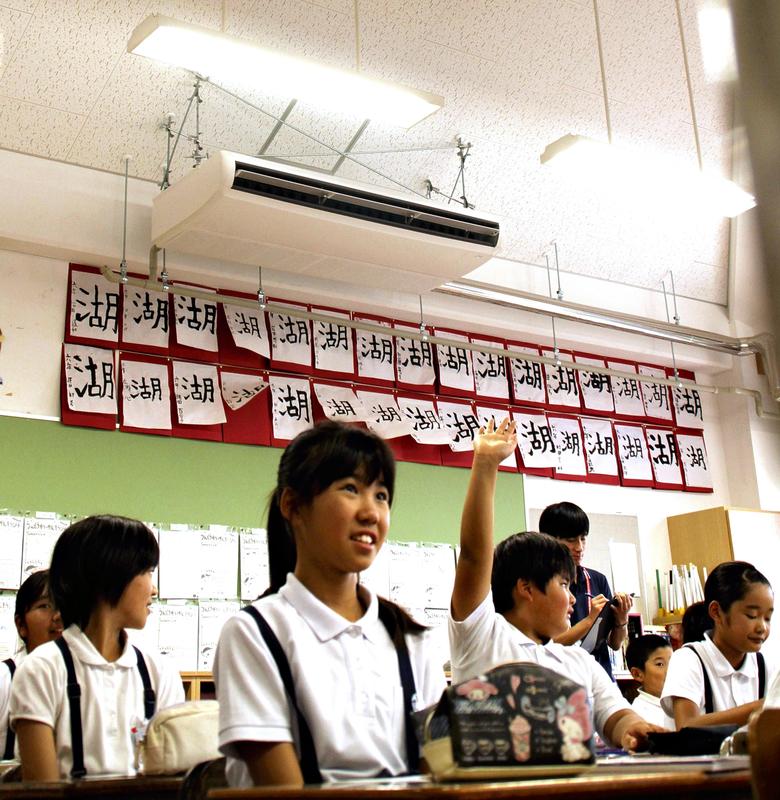
Air conditioners have not been installed in many public elementary and junior high schools around the nation, even though the central government allocated 82.2 billion yen (760 million dollars) last fiscal year to have them in place by this summer, in a bid to prevent heatstroke among students.
The Education, Culture, Sports, Science and Technology Ministry submitted a notice to boards of education across the country to take steps before the arrival of the scorching summer heat, such as moving up summer vacation. Some local governments that are behind in installing air conditioners at their schools are starting summer vacation earlier than usual.
This nationwide effort was triggered by an incident last July in which a first-grade elementary school student in Toyota, Aichi Prefecture, died from heatstroke after returning from a field trip. The boy's school did not have air-conditioning.
In October last year, the central government included 82.2 billion yen in an extra budget to cover one-third of the expense of installing air conditioners in classrooms at all public elementary and junior high schools, kindergartens and schools for children with special needs.
According to The Yomiuri Shimbun's survey of 52 local governments in prefectural capitals and government-designated cities, 19 such governments -- including Sendai and Chiba -- were unable to install air conditioners at all of their public elementary and junior high schools by this summer.
Some governments have high installation rates, such as 99.9 percent in Saga, 99.7 percent in Hiroshima and 64.9 percent in Tsu, but many others are at less than 30 percent, including none in Toyama, 0.1 percent in Morioka and 1 percent in Shizuoka.
Tokyo and major cities including Osaka have a 100 percent installation rate, according to an education ministry survey conducted in September last year.
Asked the reason for the delay, the Toyama board of education replied, "It's difficult to book installations, as it can only be done on weekends." The Hamamatsu board of education said, "It's difficult financially because there are many air conditioners to be installed." The Hiroshima board of education said it has prioritized seismic reinforcement.
Fearing heatstroke among students without access to air conditioners, the ministry submitted a notice at the end of May to education boards across the country, directing them to take steps.
There are 165 public elementary and junior high schools in Chiba, with 2,555 classrooms, and the city has installed air conditioners in 9.6 percent of them. To prevent students from attending class in searing heat without air-conditioning, all the public schools in the city will finish classes on Friday and start summer vacation from Tuesday, five days earlier than the previous year.
The same approach will be taken in Seto, Aichi Prefecture; Tenri, Nara Prefecture; and Nabari, Mie Prefecture, by starting summer vacation one week earlier than usual.
Nagoya University Associate Prof. Ryo Uchida, who specializes in safety measures at schools, said: "Air conditioners in classrooms have changed from a luxury item to a basic need. They must be installed as soon as possible for equity of public education. The central government should actively provide financial support for operational costs after installment."
Read more from The Japan News at https://japannews.yomiuri.co.jp/