Peel off your Knope We Can bumper stickers, and put your bottle of Tommy Fresh back in the sock drawer. Parks And Recreation will soon be no more. Yet, as well as sadness at its passing, the show’s final season (which begins tonight on NBC, 8pm EST) provides an opportunity to celebrate its longevity. Parks And Recreation is TV’s great survivor, the series they couldn’t cancel. At the end of its current run the sitcom about a can-do governmental department in the fictional Indiana town of Pawnee will reach 125 episodes, surpassing not only the golden 100 number for syndication but also established comedy greats like Taxi, The Larry Sanders Show and Arrested Development.
Which is remarkable when you consider that it could quite easily have ended after six. The show’s truncated first season tested disastrously with focus groups. Critical reaction was, if anything, even worse. “Parks and Recreation: Less funny than Joey?” ran the headline of a scathing review from the Chicago Tribune’s Maureen Ryan, comparing the show unfavourably with NBC’s botched attempts at a Friends spin-off. Others, meanwhile, openly questioned the wisdom of renewing such a patently flawed series.
Looking back, it’s not hard to see why the show’s first run received such a frosty response. The pace is sludgy. The gag rate is low. The cinéma vérité style looks hopelessly derivative of The Office (which Parks And Rec was initially intended to be a sister show to). Most noticeably the lead character, Amy Poehler’s pollyanna-ish deputy parks director Leslie Knope seems small, sad and impossible to root for: mocked by her co-workers, browbeaten by her mother (a character we thankfully saw a lot less of in later seasons) and thwarted in her grand ambitions for her home town.
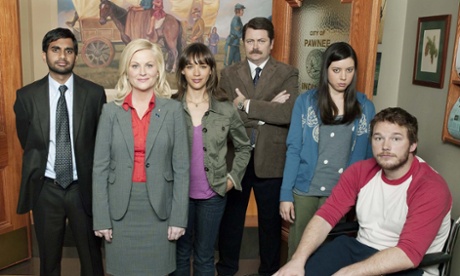
Then, suddenly, something changed. The show shook its cynical outlook. Leslie became likeable, her Panglossian energy coming off as noble rather than futile. Meanwhile, the formidable supporting cast began to assert themselves, from Nick Offerman’s gruff libertarian Ron – “Any dog under 50 pounds is a cat and cats are useless” – to Aubrey Plaza’s deadpan office assistant April and Aziz Ansari’s cheeky, wannabe-entrepreneur Tom. (Let’s also not ignore those two latecomers Adam Scott and Rob Lowe, who as Ben and Chris added a sense of direction to the show.)
At its best, when all of these chaotic forces were bouncing off each other – as in the terrific season two episode Telethon (Leslie binges on energy snacks and tries to marshal the graveyard shift of the Pawnee telethon) – the show was as zippy and fun as any comedy on television, network or cable. It became a mainstay in critics’ end-of-year lists. Poehler, Ansari, Offerman, Plaza and Chris Pratt became recognisable stars.
Yet, despite all this the show’s ratings remained frustratingly small, and you suspect that at a more stable network than NBC, Parks And Rec would have been cancelled long ago. Then again, perhaps a more stable network than NBC would have had a better idea of what to do with the show, providing it with a stronger lead-in than, say, the brilliant but decidedly niche Community. TV critic and avowed Parks And Rec fan Alan Sepinwall has suggested that the show might, like Arrested Development before it, prove more popular after it has concluded. Certainly you get the sense that the show could and should be able to get a larger audience than the one NBC found for it.
As it is, the delivery method of Parks And Rec’s final season perhaps sums up NBC’s attitude towards the show: it’s respectful enough to allow a 16-episode farewell run, but equally happy to burn those episodes off in double-bills on a Tuesday night, far away from the network’s once-vaunted (and now dead) Thursday-night Must See TV block. Still, let’s apply some Knope-style positivity to the situation: double-bills means an hour of Parks a week, rather than the usual half-hour. What’s more, those episodes look like being a fitting send-off, with guest appearances from departed cast members Lowe and Rashida Jones and an unusually bold storyline set two years in the future. As a slightly naive deputy Parks director once put it: go big or go home.