The US Justice Department has launched what is believed to be the largest investigation of a public official in Oregon’s history, over the corruption allegations that forced the resignation of Governor John Kitzhaber on Friday.
Within hours of Kitzhaber announcing he will leave office next week, federal investigators served state officials with subpoenas for a broad range of records related to accusations that his fiancée and Oregon’s “first lady”, Cylvia Hayes, influenced policy while receiving consulting fees from special interests. These are mostly related to contracts with groups promoting sustainable economic development and ecological issues while Hayes was also serving as an adviser to Kitzhaber.
The subpoena for documents to be presented to a federal grand jury include emails, memos related to drafting the budget and records related to 15 other officials including advisers, the governor’s lawyer and his secretary. It also seeks tax records amid reports that Hayes did not declare her earnings in full and details of the Oregon Government Ethics Commission’s ongoing investigation into the allegations.
Kitzhaber will be replaced on Wednesday by Oregon’s secretary of state, Kate Brown, who will be the first openly bisexual governor in the US.
At the end, Kitzhaber blamed his stunning fall, just weeks after he was sworn in for a record fourth term, on the newspapers and powerful political allies whose support rapidly fell away this week.
In calling an end to his 35-year career in Oregon politics, the former emergency room doctor complained of a public lynching by the press “with no due process and no independent verification” of a stream of accusations. But Kitzhaber said that he was even more troubled – “on a very personal level as someone who has given 35 years of public service to Oregon” - that so many allies backed away as his credibility dived with a series of evasions, half-truths and attempts to undermine an ethics investigation.
“It is something that is hard for me to comprehend - something we might expect in Washington DC but surely not in Oregon,” he said of the loss of support.
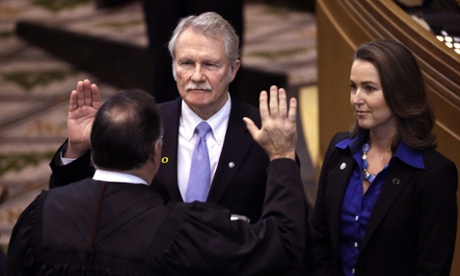
Much of Oregon’s political elite was relieved as Kitzhaber, who was renowned for wearing jeans and cowboy boots to formal occasions including his own inauguration in January, agreed to step down as the revelations piled up.
The first came in shortly before last November’s election when a Portland alternative newspaper, Willamette Week, revealed that Hayes was paid $5,000 for a sham marriage to an 18-year-old undocumented immigrant in 1997 to get him a “green card” allowing permanent residence in the US. They divorced five years later.
Hayes described it as a “marriage of convenience”.
“He needed help and I needed financial support,” she said.
Seeds of a poisonous scandal
The voters did not seem to mind and Kitzhaber was handily re-elected. But the Willamette Week also reported a story that contained the seeds of what has proven to be a more poisonous scandal for the governor as it revealed Hayes maintained a desk in Kitzhaber’s office from where she influenced policy while doing consulting work for a variety of special interests.
She was also representing herself as Oregon’s first lady while acting on behalf of groups such as the Demos think tank, which paid her $38,496( £25,000). It was promoting the use of the Genuine Progress Indicator (GPI) as a measure of economic development. Kitzhaber told state officials that it was to be used by the Oregon state government.
Kitzhaber’s state budget for the next two years includes a $200,000 grant to a climate group, Pacific Coast Collaborative. In 2013, Hayes was paid $60,000 by two separate non-profit organisations to promote the Pacific Coast Collaborative’s work.
Not long after Kitzhaber’s inauguration, Hayes revealed that she had been paid $118,000 by a Washington DC clean energy group while an adviser to the governor on clean energy policy, a fact she did not disclose to his office.
The contracts also appeared to be in conflict with public statements by Kitzhaber about Hayes’ role in his administration and “statements he has made in his annual ethics filings”.
Hayes was also accused of failing to declare some of her income for tax.
In love with eyes wide open
Kitzhaber held a press conference at the end of January at which he tried to ease the pressure by announcing that Hayes would no longer have any political role in his office. But the governor avoided several questions by reporters, saying it was up to Hayes to answer them and she was out of the country.
Asked if he was “blinded by love”, Kitzhaber said he was in love but with his eyes wide open.
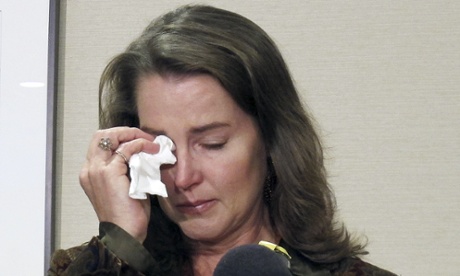
The governor’s evasive performance at the press conference worried some Oregon Democrats. Political support eroded further as it was revealed that while the governor was promising full cooperation with the Oregon Ethics Commission’s investigation of Hayes his office was also trying to restrict it by claiming that the de facto “first lady” was not a “public person” and therefore should not be subject to scrutiny. It was also revealed that the governor’s former communications director was dismissed for pressing for closer scrutiny of Hayes’s activities.
The Oregonian, the state’s most influential newspaper, which exposed many of the revelations, called on the governor to resign.
When Kitzhaber last week attempted to ease the growing pressure to quit by asking Oregon’s attorney general, Ellen Rosenblum, to investigate the claims, she told him she had already launched a criminal probe. Kitzhaber then retained a prominent Portland criminal defence lawyer.
With each new revelation, Democrats became increasingly aware that the political price of dumping the governor was far lower than continuing to back him. Under Oregon’s constitution, if Kitzhaber quit Brown would take up the governor’s post with no need for an election for nearly two years. If Kitzhaber stayed, the governor’s office and the legislature would be all but paralysed by months of ethics and criminal investigations with the possibility of further embarrassing revelations to come.
No political backing left
Support for Kitzhaber evaporated within days. Top Democrats in the Oregon legislature urged him to go. Kitzhaber wobbled on Wednesday, recalling Brown from a trip to DC as he apparently prepared to quit but then didn’t. Brown called the situation “bizarre and unprecedented”.
But it was apparent Kitzhaber had no political backing left. Oregon’s US senators, Ron Wyden and Jeff Merkley, praised the governor’s long record of achievements but said he was right to resign.
Brown, 54, and a lawyer, had little to say other than it was “a truly sad day for Oregon”.
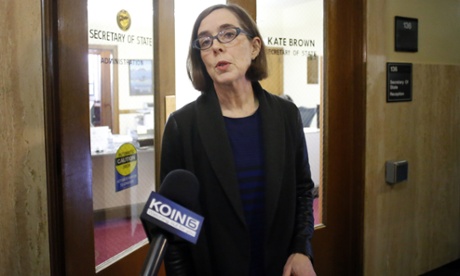
The leader of the Republican minority in the state’s House of Representatives, Mike McLane, told the Oregonian that he regards Brown as part of a liberal elite in a state split between cities such as Portland and deeply conservative rural areas.
“I have concern that Portland’s left, or liberal, interests have really risen in the state,” he said. “Oregon needs to be served by folks who have all of our interests at heart, not simply who attends the best restaurants in the Pearl District.”
Brown got her start in Oregon politics in 1991 when she was appointed to the state House of Representatives and worked her way through both houses of the legislature to become the Senate majority leader in 2004. Brown engineered domestic partnership laws in Oregon in the face of a then state constitutional ban on same sex marriage. She was elected as secretary of state in 2008.
Brown, who is married to Dan Little, publicly confirmed her bisexuality after it was revealed in a newspaper. She has said her parents responded to the news by saying it would have been much easier for them if she had said she was a lesbian.
“Some days I feel like I have a foot in both worlds, yet never really belonging to either,” she said.
One issue for Brown is what she does about the legacy of Hayes’s influence in the governor’s office, including the use of the GPI.
Kitzhaber still has the opportunity to make his mark before leaving office. He imposed a freeze on executions in 2011and has the authority to commute the sentences against the 33 men and one woman on the state’s death row.