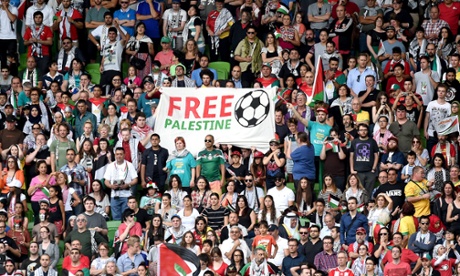
An internal push for federal Labor to articulate a more pro-Palestinian foreign policy stance has a strong prospect of success at the party’s looming national conference.
Advocates of reform say a form of words such as those adopted by last year’s New South Wales state Labor conference would now have the numbers to clear the ALP’s national forum in Melbourne in July.
Key elements of the right faction now support change, as well the industrial and “grassroots” left. Palestine used to be a preoccupation of the Labor left, but there has been a sea change in thinking in elements of the party’s right faction over the past few years, particularly in Sydney.
Labor’s changing disposition partly reflects domestic politics and outreach to community groups in multicultural Sydney – and also a sense of profound frustration with Israeli conduct concerning the expansion of settlements and aggression in the occupied territories.
But the Palestinian debate expected at this year’s national ALP conference is not a simple and straightforward numbers game.
While elements of the NSW right now support a shift in Labor’s position, and the left is locked in, creating considerable internal momentum around reform – the Victorian right, backed by powerful right wing unions, the Australian Workers Union and the Shop Distributive and Allied Employees’ Association, has thus far resisted even incremental change.
The Victorian right is the Labor leader Bill Shorten’s power base, and how the Palestinian debate ultimately progresses in the lead-up to July depends in part on how vigorously Shorten and his Victorian-led group resists a change of position, and how much the debate gets framed internally as a test of Shorten’s leadership.
The disposition of Shorten’s deputy, and prominent Sydney leftwinger, Tanya Plibersek, will also be critical.
The successful NSW motion in 2014 was drafted by the former NSW premier and federal foreign minister Bob Carr. It called on a future Labor government “to consult like-minded nations toward recognition of a Palestinian state”.
The Carr motion backed the two-state solution while noting the lack of current progress – and recognised explicitly that “a Middle East peace will only be won with the establishment of a Palestinian state”.
“The state of Palestine should be based on 1967 borders with agreed land swaps and with security guarantees for itself and Israel. If … there is no progress to a two-state solution, and Israel continues to build and expand settlements, a future Labor government will consult like-minded nations towards recognition of the Palestinian state.”
The current national Labor platform is passive on the articulation of Palestinian statehood.
“Labor is committed to supporting an enduring and just two-state solution to the Israeli-Palestinian conflict, based on the right of Israel to live in peace within secure borders internationally recognised and agreed by the parties, and reflecting the legitimate aspirations of the Palestinian people to also live in peace and security within their own state,” it says.
It is possible the national conference could seek to resolve the different views by allowing a motion to be passed supportive of Palestinian aspirations, but leave the party platform unamended.
Internal tensions over Israel and Palestine blew up spectacularly during the last period of Labor government. Carr had a bitter dispute with then prime minister Julia Gillard when she insisted that Australia should support Israel and vote against Palestinian observer status in the United Nations.
After a caucus and cabinet revolt, Gillard ultimately had to back down. Australia abstained from the UN vote.
There was yet more controversy when Shorten, soon after taking the Labor leadership, appeared to telegraph a shift in policy around the description of settlements in a major speech to the Zionist Federation of Australia.
Shorten remarked that “some settlement activity in the West Bank is illegal under Israeli law” when Labor’s policy was that the settlements are not in line with international law.
The departure from policy was put down to a mistake by Shorten.