A federal hearing into whether Oklahoma can resume lethal injections began on Wednesday, eight months after the prolonged and bloody death of Clayton Lockett brought a halt to executions in the state.
Oklahoma has revised its execution protocols but attorneys for 21 death row inmates claim that the new procedures are experimental and put their clients at risk of a “cruel and unusual” punishment that would violate the US constitution.
The state says its new plans and improved staff training make a repeat of Lockett’s botched death unlikely. It has scheduled two executions next month: Charles Warner for 15 January and Richard Glossip two weeks later.
Lockett’s execution on 29 April at the state penitentiary in McAlester took 43 minutes. Documents indicate the 38-year-old convicted murderer and rapist moaned and writhed on the gurney as medical officials repeatedly failed to place an intravenous line in his body. After at least 16 attempts over the course of an hour, a doctor tried to set a new IV line in Lockett’s groin area. It hit an artery, causing blood to squirt on to the doctor’s clothes.
The prison warden, Anita Trammell, called the scene “a bloody mess” according to a court filing. She said she was “sitting there thinking to myself I’ve never seen the cut down so I didn’t know how bloody it would be and I thought – I purposely did not get up to look because I – I didn’t wanna have a bad reaction to it.” When Lockett’s blood spurted, the doctor said he had to “get enough money out of this to go buy a new jacket”.
After about 15 minutes, prison officials drew blinds to hide events from the view of witnesses. Lockett continued trying to rise up and became “a little bit more aggressive”, a member of the execution team said. State officials then agreed to stop the execution but Lockett died from the effects of the drugs, an autopsy report found. No attempt was made to resuscitate him.
Court documents filed last week by the inmates’ attorneys indicate that staff training was inadequate or nonexistent, there was no contingency plan and that the prison was ill-equipped and had to borrow medical supplies. The doctor who inserted the IV line into Lockett said the prison’s needles were the wrong length.
In the build-up, Oklahoma – in common with several other states in recent years – struggled to source execution drugs. The process appeared to be less than thorough and scientific, with a senior official admitting that he researched one drug on the internet by reading “Wiki leaks” – presumably meaning Wikipedia.
“I did have a discussion with our medical director at the time and he said, ‘Yeah midazolam probably when administered will, will render sedation.’ And that’s all he would say,” said Michael Oakley, former general counsel for the Oklahoma Department of Corrections, who retired a week before Lockett’s death.
“Then, you know, I did my own research, I looked online, you know. Went past the key Wiki leaks, Wiki leaks or whatever it is, and I did find out that when administered, midazolam would administer, would render a person unconscious. That’s what we needed ... So we thought it was OK.”
Oakley said that said as officials searched for drugs there was “political pressure” to “get it done” because state attorney general is an elected role. The state amended its protocol a month before Lockett’s execution to give Trammell “sole discretion” as to which “lethal agent” to use, but the filing indicates that she played no part in the decision to switch from the hard-to-find pentobarbital to another sedative, midazolam.
One of the witnesses on Wednesday, a pathologist hired by Lockett’s attorney, said the witness statements corroborated his conclusion that Lockett was conscious during the execution.
“Mr. Lockett had been deemed unconscious but became conscious again,” Dr Joseph Cohen testified.
Lockett was executed using a three-drug combination of midazolam, vecuronium bromide and potassium chloride seemingly procured from a licensed pharmacist in Oklahoma.
Midazolam, a newcomer to the US execution landscape, was used in three highly problematic deaths this year: Lockett, Ohio inmate Dennis McGuire in January and Joseph Wood, who took almost two hours to die in Arizona in July.
Oklahoma governor Mary Fallin ordered an investigation following Lockett’s death which concluded that the inability to set up a successful IV access point was the single biggest failing. It did not address whether the continued use of midazolam was appropriate. Florida is the only other state to use midazolam in a three-drug protocol, and has done so eight times this year without problems on the scale of Lockett’s execution.
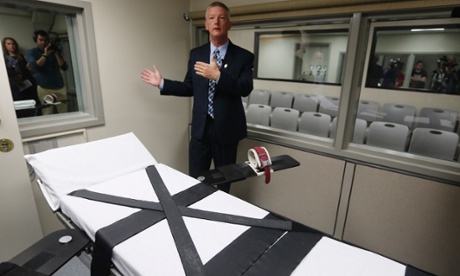
In October, Oklahoma issued new guidelines which allow for four possible lethal injection combinations. Two involve midazolam in a dose five times greater than was used for Lockett. The death chamber was renovated at a cost of $106,000.
In addition the number of media witnesses to executions was reduced from 12 to five. In August the Guardian was among plaintiffs who filed a lawsuit alleging that Oklahoma’s denial of public access to the full procedure of Lockett’s death violated the constitutional right to press freedom.
The court documents provide detail about the seemingly mundane and routine aspects to what proved a deeply abnormal procedure. The three unnamed executioners were driven to the state penitentiary in a van, putting on hoods when they were about three blocks away. One said he was typically paid $300 per death.
Information from the Associated Press was used in this report.