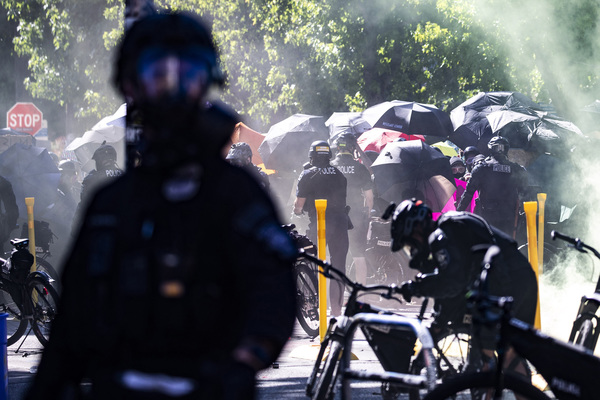
SEATTLE — A federal judge has found the Seattle Police Department in contempt of court for the indiscriminate use of pepper-filled "blast balls" and pepper spray during Black Lives Matter protests this fall, but also cited instances where police were justified in using force against demonstrators.
U.S. District Judge Richard Jones issued a 27-page order Monday in response to a motion by BLM Seattle-King County to find the Police Department in contempt of his earlier injunction preventing police from using force against peaceful protesters. Jones found a total of four "clear violations" of the injunction: one involving the use of pepper spray and the other three involving blast balls, a grenade-like device that explodes and spews pepper gas. It's a weapon the judge says raises serious issues with the court.
"Of the less lethal weapons, the Court is most concerned about SPD's use of blast balls, the most indiscriminate of the four" crowd-control weapons whose use he examined. "SPD has often hurled blast balls into crowds of protesters" when no immediate threat to the officers' safety or public property could be identified, the judge found.
At the same time, Jones highlighted four instances where officers' use of force complied with his order.
All the other instances cited in voluminous briefs and pleadings filed by BLM and the city's attorneys were too close to call one way or another, he said, which Jones said was not a good thing for the SPD.
In issuing the contempt order, Jones rejected the Police Department's argument that the department was in "substantial compliance" with the injunction and that it could not be held responsible for the actions of individual officers.
"Some might say that four clear violations — out of four days of protests and countless uses of less-lethal weapons — must surely be insufficient to 'vitiate' (spoil) the City's otherwise substantial compliance," Jones wrote. "But this is misguided."
The violations Jones found were more than mere technical violations of the injunction, which was issued after Jones found that SPD's use of tear gas, pepper-spray and other crowd-control weapons was unconstitutional and that the department had likely violated the rights of thousands of peaceful Seattle protesters in large, early demonstrations following the death of George Floyd on May 25.
Detective Patrick Michaud, a spokesman for the SPD, said the department would not comment on Jones' ruling because the litigation is pending.
SPD agreed to a number of restrictions intended to prevent further violations in an initial injunction, and then adopted refinements — including an agreement to not target reporters and medics — following rowdy and sometimes violent protests in June and July, including the abandonment by SPD of the East Precinct and the formation of the police-free Capitol Hill Occupied Protest, or CHOP, which crumbled following a pair of homicides.
The latest call for contempt involved the review of police actions at four protests during the late summer and early fall, and the department's use of four specific less-lethal crowd-control weapons — pepper spray, pepper balls, so-called "blast balls" and paint balls, which are used by officers to mark individuals seen committing crimes.
The protests Jones reviewed were held on Capitol Hill on Aug. 26 during a memorial for Summer Taylor, a BLM protester who had been struck and killed by a car during a freeway protest on July 4; a protest at the headquarters of the Seattle Police Officer's Guild, or SPOG, in the Sodo district on Sept. 7; and protests held Sept. 22 and 23 on Capitol Hill, one in response to a decision by a Kentucky grand jury not to indict the officers who killed Breonna Taylor in March.
Jones said SPD's use of pepper-balls and paint-balls — both deployed accurately from a shoulder-fired weapon — complied with his injunction in every instance he reviewed.
However, Jones cited one instance of a "clear violation" of his order regarding the use of pepper spray — at the Sept. 7 SPOG protests — and three instances where officers indiscriminately lobbed or threw blast balls into a crowd without being able to identify a specific threat. In two of those instances, he said the officers failed to report the use of the blast balls in their report.
At the SPOG incident, Jones related that an officer rode up behind a group of retreating protesters who were complying with orders to move out of the area.
"Yet, for no apparent reason, the officer sprayed them in the face with OC (pepper) spray," the judge noted, referring to police body camera and civilian video of the incident for review. "This was a plain violation of the orders." The officer, the judge noted, did not account for his use of the irritant in his use of force report.
"That the entire incident was brief and that the discharge of OC spray was minimal are irrelevant," Jones wrote. "It was a prohibited and needless action under the orders."
There were many instances where Jones said he couldn't be sure of the propriety of officers' use of force because of the chaotic nature of the events and unclear video from police body cameras and protesters' cameras and phones. Often it was not clear whether the officer faced the level of threat needed to use force, he said.
In others, however, Jones said officers acted appropriately. In one instance, during protests on Capitol Hill on Sept. 23, a protester struck an officer in the back of the head with a baseball bat. The officer deployed pepper-spray as he staggered back toward the police lines.
"This use was plainly permitted by the orders," Jones wrote.
It was the repeated, indiscriminate and untargeted use of blast balls that Jones said concerned him the most.
He cited one instance when he ruled the device was used properly — on Sept. 7 at the protests aimed at the police guild's headquarters south of downtown. In that case, officers deployed several blast balls in response to someone throwing a Molotov cocktail, which Jones said nearly struck another protester when it shattered and set the pavement ablaze.
Officers, he said, were responding to a serious safety threat and the balls were thrown into open spaces away from individuals, although near where the firebomb had been launched, in keeping with the requirements of the injunction.
However, Jones cited other instances where police misused the device. For example, during the Sept. 7 protest, Jones referred to an incident where police threw several blast balls into a large crowd after a glass shattered behind police lines. At least one of the officers in this instance failed to report his use of the device, the judge found.
On Sept. 27, as officers pushed protesters marching on Capitol Hill away from the East Precinct, Jones said an officer can be seen throwing a blast ball overhand into the crowd — they're supposed to be lobbed underhand — then turned away before it detonated. The judge said the officer's action "demonstrates a clear lack of care for whether the blast ball landed."