Banks across Japan are stepping up their efforts to help stamp out antisocial forces, with some even closing accounts belonging to members of gangster organizations without their consent, a Yomiuri Shimbun survey has revealed.
But can banks terminate accounts that gangster organizations have used to stash capital and launder proceeds of criminal activities? New steps targeting these accounts are gathering pace, but concerns also have been raised over whether the safety of bank employees can be guaranteed should gangs seek to retaliate.
About two years ago, a corporate lawyer for a regional bank in the Chugoku region received a phone call from a member of a gangster organization. "Don't we have civil rights?" asked the gangster, who had been notified that his bank account would be closed.
The lawyer spent about 15 minutes explaining that contractually the bank could shut down the account and the necessity of combatting organized crime syndicates. "There's no point talking to you," the gangster reportedly said before hanging up.
In December 2015, the bank started closing accounts that gang members had opened before the introduction of provisions aimed at eliminating transactions involving gang groups, entrusting the lawyer to oversee these procedures.
The bank had canceled 29 accounts through July 2017, when the Supreme Court finalized a Fukuoka High Court ruling upholding the validity of closing bank accounts based on such provisions. From July 2017 to the end of May this year, the bank closed another 15 accounts.
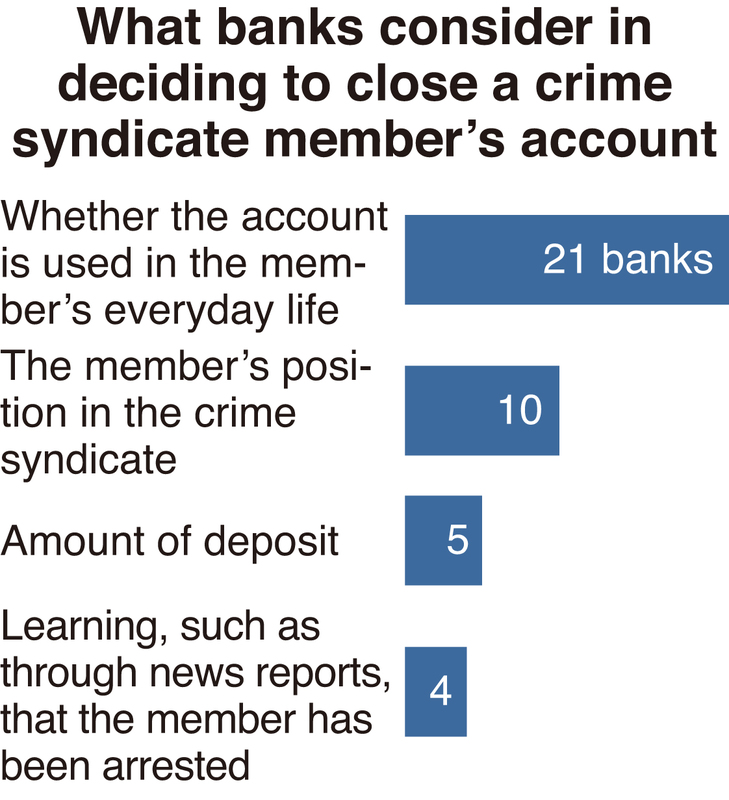
Since the ruling was finalized, the bank has even closed bank accounts that gangsters appeared to be using for their daily lives, after notifying the account holder one month before the day it was to be shut down.
The lawyer said that he has been involved in the closure of a total of about 150 accounts operated by several banks.
"The gangster organizations are resigned to what is happening," the lawyer said. "The top court's finalized ruling was apparently a decisive blow."
In October 2016, the Fukuoka High Court ruled that banks could, based on provisions aimed at eliminating organized crime, close accounts opened before the provisions came into effect. The Supreme Court upheld this view in July 2017.
The head and another senior member of Dojinkai, a designated organized crime group based in Kurume, Fukuoka Prefecture, were the plaintiffs in that case. They had demanded that the closure of their accounts by Sumitomo Mitsui Banking Corp. and Mizuho Bank Ltd. be confirmed as invalid.
The Fukuoka District Court dismissed the plaintiffs' demand. The high court also threw out their appeal, saying: "The objectives of provisions aimed at eliminating organized crime are to restrict the economic activities of antisocial forces and their activities to acquire capital, and to ensure the peace and safety of society for residents. If such an ordinance is not applied also to existing contracts, it would be difficult to achieve these objectives."
The ruling encouraged other banks to take action. An official at a regional bank in the Tohoku region said: "We had been closely watching what the courts would do. It is hugely significant that the ruling was finalized."
In September 2010, this bank introduced provisions to its deposit clause. The bank proceeded to close down accounts that it determined belonged to gangsters based on information including media reports on arrested gang members.
However, an account could be closed only if the account holder gave their consent. Consequently, the bank at times was forced to give up attempts to shutter accounts when a gangster refused to agree, the bank said.
After the Fukuoka High Court's ruling was finalized, the bank started applying it to accounts set up before the provisions were introduced and has shut accounts irrespective of whether the holder agrees. A gang boss currently has an account containing a hefty sum of money.
"We'll select more accounts that are subject to the provisions and close three or four each month," an official of the bank said.
Employees fear reprisal
The Yomiuri Shimbun survey also revealed many concerns about the safety of bank employees due to the crackdown.
"It places a huge psychological burden on our workers," a representative of a regional bank in Chugoku said.
Lawyer Tomonori Ishizuka, an expert on gangster organization countermeasures and a member of the Dai-ichi Tokyo Bar Association, said: "Compared with major banks, regional banks operate in a more limited area so it's easier for gangsters to recognize the faces of bank employees. In some cases, banks probably opt not to forcefully close accounts due to fear of reprisal."
Before closing gang-related accounts, one bank in the Kanto region asks local police stations to beef up their security presence. A regional bank in the Kyushu region requested that "the state and administrative authorities, including the police, craft a system to back up its efforts."
Lawyer Hitoshi Suzuki, deputy head of the Japan Federation of Bar Associations' committee on measurs against gangsters' intervention in business transactions and civil affairs, said: "The Supreme Court's ruling became a foundation for the banks' actions and gave them a tailwind. The time has come for banks to start targeting accounts set up before antigang provisions were introduced.
"If gangsters become unable to use their accounts and perform their activities, it could be a good chance for them to leave the gang. They can pay utility bills and other charges at convenience stores and elsewhere. If banks don't shut accounts gangsters use for everyday activities, stamping out organized criminal organizations will not proceed in a true sense."
Read more from The Japan News at https://japannews.yomiuri.co.jp/