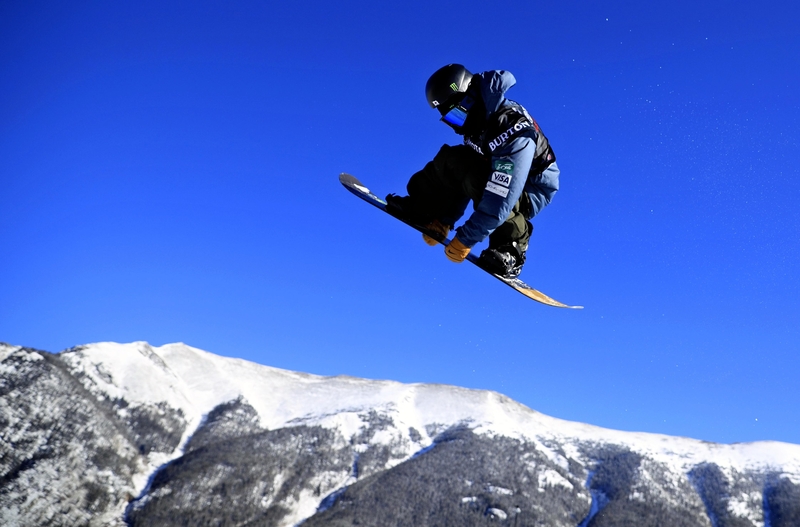
Just one centimeter. According to Ayumu Hirano's doctor, this was the margin between life and death in the massive injury the snowboarder sustained last March.
Hirano, who hails from Murakami in Niigata Prefecture, became the youngest snowboard Olympic medalist when he bagged silver at the Sochi Winter Olympics at the age of 15. He won at the World Cup in the men's snowboard halfpipe (see below) during the 2013-14 season, and enjoyed two more wins this season.
At an international event in the United States last March, Hirano attempted a double cork 1440 -- in which a snowboarder rotates twice in the air in a vertical position before rotating four times in a horizontal position -- but failed to land and slammed into the wall of the halfpipe. The damage he sustained to a left knee ligament and his liver entailed about two weeks of bed rest.
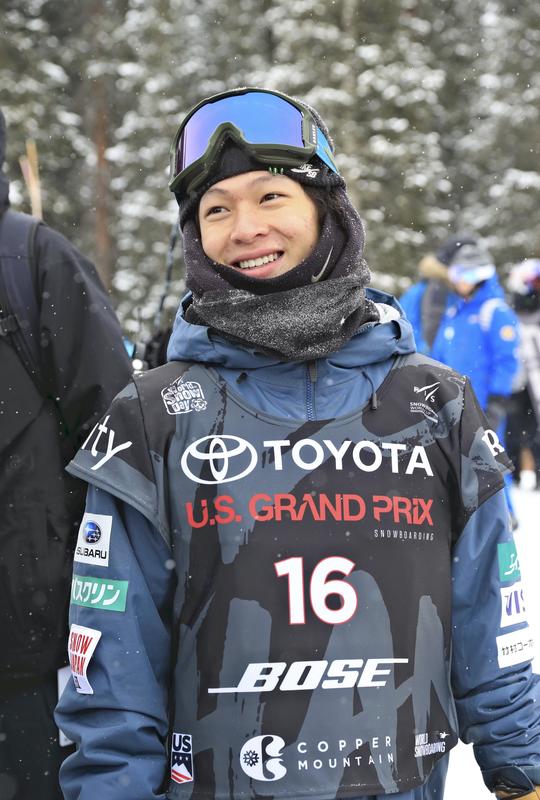
By May of last year, having returned to Japan, Hirano's liver had recovered to the point where it was no longer a hindrance to his daily life. However, his left knee still wouldn't function on its own. The painful rehabilitation process began, and Hirano got back on a snowboard with eight and a half months to go before the Pyeongchang Olympics at the end of May.
The injury kept Hirano from doing daily tasks and caused him to lose confidence.
"I've always had a snowboard strapped to my feet, so it felt like things were disappearing right before my eyes," he said. "It felt like everything I had been doing up until that point was gone. At the same time, my confidence got shaky and I felt weak. Time really seemed to slow down."
Hirano made a comeback in September last year, placing second at the season-opening event of the World Cup in New Zealand.
"I got a little bit of the knack back again," he said with a sigh of relief.
Copper Mountain in Colorado hosted the second event of the World Cup in December. Hirano came out on top in the first run of the finals -- and then he pulled off the same 1440 in the air that had put him in the hospital, in the second run.
Hirano had no fear. "I went into this tournament with my eyes set on the top, so I figured I'd just go for it," he said.
After a perfect landing, he built up speed again and completed a triple cork (rotation), followed immediately by a triple-and-a-half cork. The performance shot him past the United States' Shaun White, who has taken gold twice at the Olympics.
However, the snowboarding ace is not one to just put away his board after such a win. He had set his sights on stunning the spectators by landing two 1440 turns in a row on his third run.
While his second landing saw his backside hit the snow, meaning he couldn't get as many points as he had wanted, his dogged determination to compete aggressively led him to his second overall World Cup victory. His American fans gave him thunderous applause.
"I got hurt and had to deal with how hard it was to get over that kind of setback and mentally regroup," Hirano said. "I felt like the only way I could get over it was to believe in my goal. That goal is always to be far better than every other snowboarder, even when they are giving their all during competition.
"I feel like my snowboarding has finally come back to me."
Hirano won the third World Cup event of the season in China with a higher score than in the second event. "Obviously, I'm always practicing with the goal of winning in my head," he said.
X Games king
On Jan. 28, Hirano gained further momentum ahead of the Pyeongchang Games by winning the men's superpipe at the 2018 Winter X Games in Aspen, Colo., beating world halfpipe champion Scotty James of Australia.
Hirano was first after the second run and slightly above James, who has won two consecutive halfpipe titles at the world championships. In the third and final run, the teenager went for the win with a routine that included two double cork 1440 tricks in the early half. He scored 99.00 points to edge out James, who got 98.00.
It seems Hirano's overwhelming dominance on the snow will help him secure gold in the near future.
-- Snowboard halfpipe
A course on which snowboarders compete that resembles a pipe cut in half. Competitors go back and forth between the sides of the pipe, launching themselves into the air five or six times per run, on average. A quadruple 360-degree rotation in the air is called a 1440, with a plethora of variations, including going from a vertical position to a horizontal one.
Read more from The Japan News at https://japannews.yomiuri.co.jp/