Community leaders are refusing to counsel young Muslims vulnerable to being radicalised because they fear security agencies will target them as collaborators, a Sydney Islamic leader says.
“Two days ago I had a father who came to see me and he was extremely distraught by the fact that his son had quit working, grew a beard, and had been talking about world events and had a coloured view about what Muslims were subjected to,” Dr Jamal Rifi said.
“He sensed there had been a change in his son’s mentality and he wanted someone to engage with him. I approached religious leaders to see if they would speak to the son, but the leaders were fearful security agencies would see doing so as being an acquaintance to such behaviour rather than a preventive measure.”
Rifi said parents fearful their children were being influenced by terrorist organisations had nowhere to go for help. He was concerned that $13m in federal government funding allocated in October to fund community-based deradicalisation programs remained unspent.
Without such programs, opportunities to intervene and prevent vulnerable Australians from being influenced by extreme Islamists were being missed, he said.
“In the community, the fear families have of becoming a target of authorities if they say they are concerned for a loved one is very palpable and they feel powerless in how to deal with this,” Rifi said.
“They only hear about sledgehammer approaches to these young people by law enforcement and they fear their child will be locked up, interrogated and watched if they reach out for help at even their early stages of concern.”
The Attorney General’s Department, responsible for allocating funding for community deradicalisation programs, would not answer specific questions about how the $13m was being spent. In a statement, the department said the funds were committed “to countering violent extremism” as part of a program which “builds on the experience of previous work and international best practice”.
The government was committed to an early intervention program aimed at working with individuals “on the path to radicalisation or who have already been radicalised and to tailor intervention or deradicalisation programs to their particular needs”, the statement said, but it did not specify when these programs would begin, only saying programs “would be developed”.
News Corp reported on Friday that a 23-year-old Melbourne University student, Suhan Rahman, had joined terrorists in Syria, and had posted a photo online of himself with extremist Mohamed Elomar holding an AK47.
News Corp quoted Rahman’s father, Lutfur Rahman, as saying his son had brought “shame” upon their family.
The Australian federal police (AFP) would not confirm it was investigating the case but in a statement a spokesman said police were aware of “a number of individuals” suspected of travelling overseas with the intention of engaging in hostile activities.
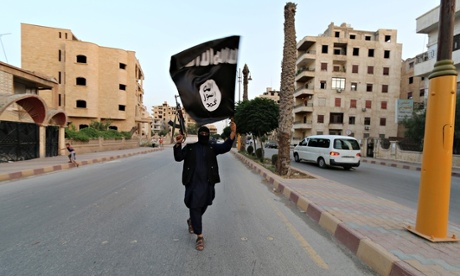
As of October, security agencies believed about 70 Australians were fighting among extremist groups in Iraq and Syria.
“Any Australian seeking to leave the conflict zones in Syria or Iraq is encouraged to contact family members or relevant authorities,” the AFP statement said. “Any person who is concerned that a family member or friend is radicalising toward violent extremism should contact the relevant authorities or the National Security Hotline.”
On Friday afternoon Victoria police confirmed they were investigating a specific threat Rahman made to an organisation via social media and that they had increased security at an undisclosed location.
“We are aware of a threatening comment posted to an organisation’s Facebook page,” they said in a statement. “This is being investigated.”
But experts say families want to intervene earlier, before authorities needed to be called.
In August, Guardian Australia revealed a government grant program which paid for community groups to engage with alienated Muslims did not have its funding renewed in the budget.
Associate professor Anne Aly, a research fellow in extremism at Curtin University who founded the group People Against Violent Extremism, said she had been trying for almost a year to get government funding for a family counselling program targeting alienated youths.
The program was based on a similar engagement program in Germany, Aly said, and while counsellors from that program had agreed to work with Muslim communities in Australia, there was no funding to bring them here and implement the service.
“We’ve asked the government for $1m over two years, but it doesn’t look like that will happen,” Aly said.
“This government has allocated almost $640m to counter-terrorism, but it’s all for military and law enforcement, and the $13m for the area we work in, community programs, is not being spent.
“Governments need to be smart about their approach to counter-terrorism – they can’t put all their time and funding into a hardline military and law approach.”
A strong deradicalisation program would identify a range of stages and methods for intervention, she said, from the first signs of behaviour change in a person to more radical changes in their world view.
“If they’re at the stage where they’re fully convinced that they want to go overseas and fight, it’s too late, and that’s when you do need law enforcement,” Aly said.
“But there are different stages of radicalisation that come before that and that’s where community leaders, programs and non-government organisations can help and intervene.”
Shahram Akbarzadeh, a research professor of Middle East and central Asian politics at Deakin University, said it was vital the government funded community deradicalisation programs as a priority, and such programs should be independent of government influence.
“This funding should not come with any strings attached,” he said.
“Communities need support, they need the leg-up by government departments via funding to carry out projects, but it is the community and the NGOs that need to decide where the funding should go and how they carry out their own projects.”
The government tended to place funding for projects aimed at building civic citizenship and engagement with Australian democracy on the backburner, he said.
“They put these programs behind projects with a strong security focus, but in fact these civic programs are the urgent ones that can act in a preventive fashion to stop the rise of radicalisation and deal with issues of alienation,” he said.