It was a growing sense of crisis over the collapse of medical services triggered by a surge in coronavirus infections that led Prime Minister Shinzo Abe to declare a state of emergency. He deemed it was necessary to raise public awareness of the need to prevent infection, while also aiming to avoid economic stagnation and social confusion caused by the declaration.
Close to the limit
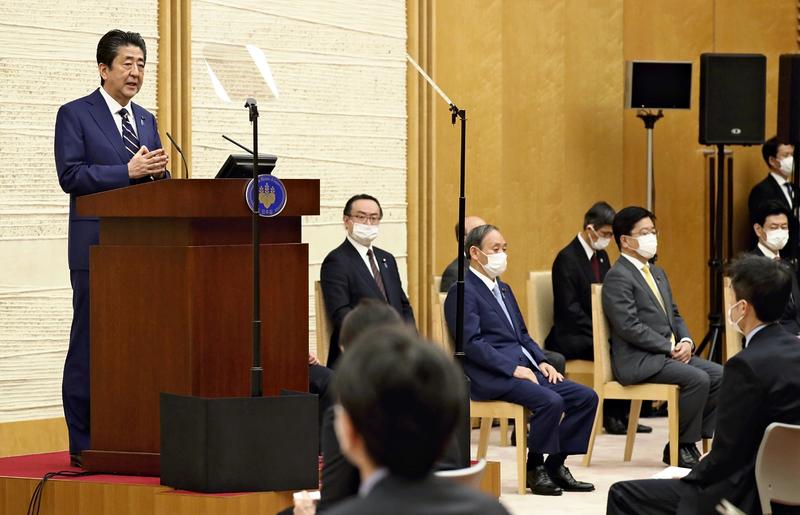
"The number of patients infected with the virus is rapidly increasing, mainly in urban areas such as Tokyo and Osaka. The number of hospital beds is obviously close to its limit. So, we have come to the conclusion that there is no time left," Abe said, explaining the reason for the declaration at a press conference on Tuesday.
At first, the prime minister had assumed that the declaration would be issued when the number of newly infected people in Tokyo reached 200 a day, and was carefully monitoring the situation. Although the daily number has not reached 200, the total number of infected people in Tokyo has rapidly increased, and calls for a declaration have been growing day by day.
Japan Medical Association President Yoshitake Yokokura visited the Prime Minister's Office on Friday and told Abe, "The medical field is in a critical situation, so we should take proper measures now."
With Tokyo Gov. Yuriko Koike and Osaka Gov. Hirofumi Yoshimura calling for strengthening their authority through the declaration, voices have been raised even within the Liberal Democratic Party with some senior members wondering, "Why has a declaration not been issued yet?"
The prime minister himself called presidents of major hotel chains and negotiated directly with them to accept patients with mild symptoms at their hotels. However, the spread of the virus was much faster than such his steps to secure the number of beds.
On Saturday, the number of daily infections in Tokyo exceeded 100 people for the first time. Abe then instructed Chief Cabinet Secretary Yoshihide Suga, economic revitalization minister Yasutoshi Nishimura, and Health, Labor and Welfare Minister Katsunobu Kato to follow procedures to issue a declaration.
In a meeting with Abe on Monday, Dr. Shigeru Omi, who chairs the government's advisory panel on measures to cope with the new coronavirus, presented the number of patients in Tokyo and told him, "At this rate, it will grow exponentially," according to sources.
Omi also said, "If a declaration enables uniting the pubic and leads individuals to make efforts to restrain themselves, we can overcome this crisis."
Abe agreed with Omi, saying, "We have to do it to protect the lives of the people," and clarified his stance to declare a state of emergency.
The government was expected to decide on an emergency economic package on the same day as the announcement of a declaration. That background gave Abe a push to declare a state of emergency, as this package could help ease the impact on small and midsize companies that are forced to suspend operations.
"We are determined to overcome this greatest post-war crisis together with the people by mobilizing every possible policy measure," Abe said, deliberately raising his voice at the press conference to stress his commitment to do his utmost to support small and midsize companies.
At the same time, he referred to the circles of mutual help that spread across the country after the 2011 Great East Japan Earthquake and said, "We are confident that we will overcome the virus and overcome the challenges of this emergency."
Split over private rights
At first, opinions within the government had been divided over a declaration, which includes restrictions on private rights.
Finance Minister and Deputy Prime Minister Taro Aso told his aides that the declaration would "bring the weak economy to a complete standstill."
Suga and Deputy Chief Cabinet Secretary Kazuhiro Sugita, who are in charge of crisis management, were also unfavorable toward the declaration, saying, "The number of infected people is limited compared to the population of Tokyo" and expressed fear that the declaration might cause panicked behavior such as a scramble to hoard food and supplies.
On the other hand, Nishimura and Kato called for an early announcement.
Nishimura -- who is in charge of a revised law on special measures, which were originally meant to deal with new strains of influenza, that authorizes a state of emergency -- leaned toward a stance of facilitating and enhancing of countermeasures by serving as a liaison between experts on infectious diseases and prefectural governments. Kato, meanwhile, had been concerned that the lack of hospital beds would deal an acute blow to the medical system.
The prime minister had originally planned to issue the declaration as soon as the special law went into effect on March 14. However, the number of new cases of infection in Tokyo had remained at around only 10 people each day as of mid-March, and Abe changed his policy to observe the situation for a while.
On March 20, the government announced a plan to reopen elementary, junior high and high schools from the start of the new semester, but a senior government official said such a move had "led to relaxing people's vigilance on the following three-day weekend, when many people went out to see cherry blossoms."
Dispel 'lockdown' rumors
In late March, the number of people infected with the coronavirus in Tokyo began to rise, prompting the prime minister to again consider issuing the declaration.
But Koike's remarks and actions became an unexpected obstacle. In response to the spread of the infection, Koike has repeatedly mentioned the possibility of a lockdown being implemented. One of Abe's aides said, "Ms. Koike has spread a false image that a declaration of a state of emergency will mean a lockdown, and that had kept us from moving smoothly."
In April, Nishimura and Kato were busy running around to explain via TV and other media that it was legally impossible for the government to impose a lockdown.
In its new basic policies decided on Tuesday, the government listed infrastructure such as electricity and gas, and media such as television and newspapers, as business to be continued, in order to show that social and economic functions will be maintained after a declaration.
"We'll never block roads and streets," Abe told a news conference Tuesday. "At first, there was a widespread misconception that cities were going to be locked down. Today's declaration was made with the intention to thoroughly eliminate such ideas, too."
Read more from The Japan News at https://japannews.yomiuri.co.jp/