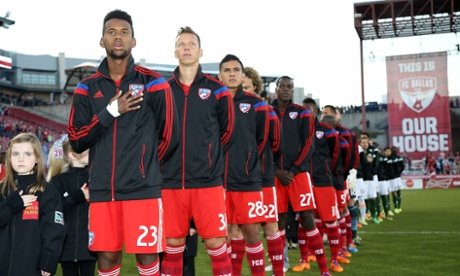
As symbolism goes, it could hardly have generated a more jarring moment. FC Dallas, one of the strongest sides in the country last season, had just shipped four goals without reply to Orlando City, a team yet to make their MLS debut, as they opened their pre-season. The upstart newcomer had turned over one of the league’s establishment clubs. A badge of honour for Orlando perhaps as they took their first steps at the top level. For a member of the old order, though, it was an unflattering image. They may have struggled for distinction in years past, but the FC Dallas of today are considered resurgent. And with eyes fixed firmly on securing a title if not this season, then soon, it hardly seems to matter how meaningless such games ultimately prove to be.
Yet the real story may lurk deeper. The official narrative of this closed-door fixture will state Orlando’s flagship player, the Ballon d’Or winner Kaká, scored one goal and set up another on his debut. But the line-ups also reflected a metaphor for competing methodologies on how an MLS championship might be secured. On one hand, an ambitious latecomer boasting an expensively acquired, one-time superstar versus a philosophy that often eschews the big name, resting much of its hopes in youthful zeal. While Orlando started with Kaká anchoring an XI close to the one that will start their MLS debut against New York City on 8 March, Dallas sent out a side made up largely of emerging youngsters. Oscar Pareja’s team will look entirely different in Frisco when San Jose Earthquakes visit for opening day. But youth will still play a predominant role.
They call it the FC Dallas Way. In this worldview, talented youth and conservative spending trumps expensive, ill-considered purchases and journeymen on the make. It’s framed as a cultural approach, aiming to revolutionize technique and tactical awareness from the first team to the club’s top-ranked development academy. It now claims a string of superlatives. Among them: an MLS record 13 homegrown players and, last season, the current contingent combined for the most minutes in the league. Careful curation also means the squad is rounded out by foreign talent tending toward younger, cheaper imports from Latin America, and experienced players familiar with MLS who marry with the club culture. “We are looking for the right mix,” muses Fernando Clavijo, FC Dallas’ technical director.
It’s risky. Last season the club suffered a mid-season dip when Argentinian playmaker Mauro Diaz was injured. Pareja, the man who helped spearhead the academy at the outset and returned to lead the club in 2013, was forced to change tactics as a result. He often tinkered with his preferred possession game to a more direct approach that exploited the pace and trickery of Colombian winger Fabian Castillo, a 22-year-old plucked from a troubled background and transformed into one the league’s brightest young players. A promising opening to the season was thus rescued by a much an improved run-in to the end of the campaign. But doubters ponder whether they have enough to deliver silverware this time around. Some crave a missing piece of the jigsaw, a hope likely to induce cool responses from the club owners. Drew Epperley, managing editor of a popular blog dedicated to FC Dallas’ progress, admires the emphasis in youth but believes it won’t produce regular titles. Not that high-profile pursuits are entirely rare. Initial interest in US national team players Sacha Kljestan and Mix Diskerud came to nothing. A deal to bring Uruguayan striker Diego Forlan last year fell through at the 11th hour. Club president Dan Hunt is circumspect. “We will never say never to signing a player like that,” he says. “But we want to be thoughtful in how we do it.”

They might be considered idealists. The current crop of academy products have a distinctly Texan air. Victor Ulloa, 22, led the way last season, playing nearly 30 games from midfield. Moises Hernandez, 22, and Kellyn Acosta, 19, are also from the Dallas area. They were both bit-part players last season but likely won’t be far behind this season. This organic group is not entirely random selection. The Hunts nurture it.
“We have a curriculum that we teach when [kids] first get here about not only what we expect on the field – the things we ask them to do – but also the behavior off the field,” says Hunt, who more than once refers to himself and brother Clark, chairman of Hunt Sports Group, which owns the club, as football traditionalists. On the ownership level, the Hunts are probably as close as it gets to soccer purebreds. As scions of Lamar Hunt, one of US club soccer’s early pioneers, calling themselves traditionalists can be credited as more than empty rhetoric. “We help raise them with their parents but we expect them to be great professionals on and off the field,” says Dan Hunt. “You instill that in them and you will have a consistent base that will allow you to win on a regular basis. We are trying to do it the right way.”
The message is clear. They do not want to buy a league title; they want to create one. The cautionary tale of 2007 purchase, Brazilian star Denilson, remains pinned in the collective memory locally. For perhaps the first time since the club’s academy was established, last season saw the seeds of what the new model may look like, and they nearly made the Western Conference final.
Nearly. Admiring glances and platitudes quickly followed. One treatise compared the approach to the Southampton Way, the stylish, lucrative conveyor belt of talent that fills St Mary’s coffers and populates the England team. But the big question remains whether it delivers the big prizes on a consistent basis. The FC Dallas guiding troika – Hunt, Pareja and Clavijo – insist it can. Hunt talks of the chemistry in the squad as the secret ingredient. “We are close, very close,” is how Clavijo puts it. “I know for a fact that you win a championship when you can identify yourself with all the things that’s happening from the bottom up. I think it is a lot more rewarding than just going out and buying yourself a championship. I know the owners are behind us 100% with that.”
In MLS, of course, the approach Dallas are taking isn’t entirely new. Real Salt Lake, for example, achieved sustained success on a limited budget. Texas rivals Houston Dynamo, too, delivered titles on the back of thrift. However, the broader results suggest it is a policy with increasingly diminishing returns. The league has grown. The return of big-name US intenrationals like Clint Dempsey, Jozy Altidore and Kljestan continues to flow. The deep pockets of the other league newcomer, New York City, may raise the bar further. Frank Lampard will arrive soon. And then there is that man Kaká.
What the cheerful accounts from the pre-season mauling against Orlando did not mention was the appearance from the bench of Alejandro Zendejas, the latest youngster off the FC Dallas production line. The El Paso native, who only just turned 17, is perhaps the most exciting prospect in red and white right now, a left-sided player seen as the complete midfielder and the sort of prospect integral to the club’s future. Expectation levels should perhaps be muted but there is reason to believe Pareja’s first-year experiment could turn into a sophomore success.
An MLS Cup may just elude them, a Supporters’ Shield may be a big ask. But they look primed to be among the contenders asking all the right questions of their contemporaries at the business end of the season. A fairytale for Pareja’s blossoming yearlings cannot be dismissed as fanciful.