Summary
We’re going to wrap our live coverage of the Sony cyberattack for the day, with a list of the key developments below.
- The FBI accused North Korea of the cyberattack on Sony over its film The Interview. The agency cited analysis of malware and similarities to past hacks by North Koreans as evidence.
- No other country was implicated in the attack, President Barack Obama said in a briefing with reporters. “We will respond,” he said, “we will respond proportionally, and in a place and time that we choose.”
- Obama said Sony made a mistake by acceding to the hackers’ demands that its satirical film be scrapped. “We cannot have a society where some dictator someplace can start imposing censorship here in the United States …That’s not who we are.”
- Sony chairman Michael Lynton insisted his company made no such mistake and would still try to distribute The Interview. He tried to shift blame onto the theaters that refused to carry the film after the hackers’ threats.
- A North Korean diplomat denied any connection between the country and the hack, saying “DPRK is not part of this.” The country’s ambassador to the UN had previously described The Interview as “an act of war”.
- Obama urged Congress to pass a cybersecurity bill that would codify rules for information sharing between the government and private sector. He also answered questions at length about Cuba, race relations and the Keystone XL pipeline.
“This is a problem that’s going to be with us for a very long time,” Senator Dianne Feinstein has announced from the pulpit of CNN.
Feinstein, the chair of the Senate intelligence committee, said it is imperative that Congress pass legislation that would “allow companies to share information with each other and the government … and be protected from liability for doing so.”
Pressed by Jake Tapper on the question of whether Sony made a mistake, she refused to assign blame, saying she thought that chairman Michael Lynton “did practice all due diligence, he did call the White House, he recognizes there are contracts with big theater companies.”
“This is a complicated matter …if something were to happen, who is liable for a loss of life?”
She instead returned to the responsibility of the federal government “to respond appropriately, imminently.”
“This can’t continue to happen in my view. This is a problem that’s going to be with us for a very long time. so we have to get certain strictures in place to get a handle on it.”
“I hope we can convince the North Koreans that this action has a very heavy price.”
Finally, Feinstein urged US allies to write an international accord on cybersecurity, saying that the US has already been attacked by hackers in China, Russia, Iran and the states.
“At some point if we face a disastrous attack, and this is what we must prevent, only an international agreement [can] solve it.”
Sony chairman: 'we made no mistake'
Sony made no mistake in pulling The Interview, the company’s chairman insists, despite President Obama’s assertion that they did just that.
Michael Lynton told CNN’s Fareed Zakaria that Sony “experienced the worst cyberattack in American history and persevered under enormous stress for months.”
Lynton tries to shift blame onto the theaters at “the crucial moment that the threat came out, from what was called the GOP at the time”.
“The movie theaters came to us one by one over the course of a very short period of time, and announced that the would not carry the film. At that point we had no [choice] but to not proceed. And that’s all.”
The CEO even argued “we have not backed down” and said that Sony still has “every desire to have the American public see this movie.”
He said the company is considering “a number of options”, but that it requires an intermediary such as Netflix or a video-on-demand distributor. None, he said, have “stepped forward and said they are willing.”
“We don’t have that direct interface with the American public.”
Asked by Zakaria whether he’d still make the film, Lynton tried to put on a brave face: “I would make the movie again, for the same reasons we made it in the first place. It was a funny comedy, it served as political satire. Knowing what I know now we might’ve done some things slightly differently, but I think a lot of events have overtaken us in a way we have no control of.”
Updated
The Interview is not the only film that distributors are shying from in the wake of the Sony cyberattack: Paramount Pictures has pulled the 2004 comedy Team America: World Police from screenings in a handful of theaters around the US.
Courtesy my colleague Oliver Laughland (@oliverlaughland):
Paramount has contacted cinemas to inform them Team America, which depicts the death of former North Korean leader Kim Jong-il, has been pulled from release.
A spokesman for the Capitol Theatre in Cleveland told the Guardian the studio did not offer any reason for the film’s removal. The cinema had booked Team America back in October for a late-night cult screening.
The Alamo Drafthouse cinema in Dallas had booked a screening of the film after The Interview was dropped, but announced on Twitter this too had been pulled “due to circumstances beyond our control”. The Plaza cinema in Atlanta also tweeted it had pulled a screening of Team America.
The 2004 film, which sees Kim Jong-il played by a puppet and killed after he is impaled on the spike of a bavarian helmet, grossed over $50m at the box office. After his death, Kim is revealed to be an alien cockroach from the fictional planet Gyron.
The Guardians of Peace have warned Sony to “never let the movie released, distributed or leaked in any form of, for instance, DVD or piracy”, the Associated Press reports.
The email was confirmed by a person close to the studio who requested anonymity because the person wasn’t authorized to speak publicly about the matter. It was sent to several employees of the Culver City, California, company that’s been roiled by a hacking group calling itself Guardians of Peace.
“Very wise to cancel ‘the interview’ it will be very useful for you,” read the message. “We ensure the purity of your data and as long as you make no more trouble.”
The email also warned against any release of the Seth Rogen, James Franco comedy and insisted that “anything related to the movie, including trailers” be removed from the Internet.
“Now we want you never let the movie released, distributed or leaked in any form of, for instance, DVD or piracy,” wrote the hackers.
“It’s above us now at government level,” said the person close to Sony.
Joshua Pollack, a North Korea watcher and associate fellow at the Royal United Services Institute for Defence and Security Studies, is reading between the lines of various statements.
FBI made statement on NK Sony Pictures hack; POTUS called it a "crime." This implies it won't be treated as warfare.
— Joshua H. Pollack (@Joshua_Pollack) December 19, 2014
How the administration classifies the hack could affect its response. North Korea was removed from the list of state sponsors of terror in 2008, and hawkish senator John McCain said the cyberattack was “an act of war” earlier Friday.
So what happens to The Interview, asks my colleague Peter Bradshaw from the Guardian’s film desk, a question he answers in piece all about censorship and the states eager to stop writers like Salman Rushdie and comedians like Seth Rogen.
Despite being withdrawn from cinemas, and having no theatrical or DVD release schedule, it will certainly surface. Variety’s Steven Gaydosshrewdly commented that it will of course become freely available online using precisely the same BitTorrent technology that the North Korean cyber-warriors used for their hacking. On another commercial and diplomatic level, questions will be asked in Los Angeles and Washington about exactly how much China knew about all this. Sony Pictures have led the way in partnerships with the Chinese film industry: even planning a Chinese remake of My Best Friend’s Wedding. All this might be under strain.
Perhaps, in any case, Hollywood misread the nature of the North Korea regime. Despite its authoritarianism and instinctive suspicion and loathing for anything that smacks of artistic freedom, it does take cinema very seriously. The Pyongyang international film festival, however bureaucratic and sclerotic, is a rare North Korean institution to which outsiders are theoretically invited (it even showed Bend It Like Beckham once).
You can read the full piece, titled “Sony’s retreat signals an unprecedented defeat on American turf,” here.
Summary
A quick look at the day’s developments.
- The FBI accused North Korea of the cyberattack on Sony over its film The Interview. The agency cited analysis of malware and similar hacks by North Koreans as evidence.
- No other country was implicated in the attack, President Barack Obama said in a briefing with reporters. “We will respond,” he said, “we will respond proportionally, and in a place and time that we choose.”
- Obama said Sony made a mistake by acceding to the hackers’ demands that its satirical film be scrapped. “We cannot have a society where some dictator someplace can start imposing censorship here in the United States …That’s not who we are.”
- A North Korean diplomat denied any connection between the country and the hack, saying “DPRK is not part of this.” The country’s ambassador to the UN had previously described The Interview as “an act of war”.
- Obama urged Congress to pass a cybersecurity bill that would codify rules for information sharing between the government and private sector. He also answered questions at length about Cuba, race relations and the Keystone XL pipeline.
Updated
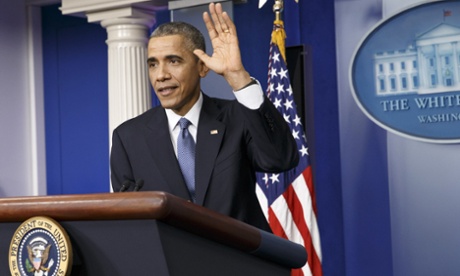
Obama ended with a reflection on the past year and his entire presidency:
“One of the great things about this job is you get to meet American people of every race and every faith. And what I don’t think is always captured in our political debates is that the vast majority of people are trying to do the right thing. And people are basically good and have good intentions. Sometimes our institutions don’t work [as well]. Maybe police departments [do the wrong thing and] surface hidden biases.”
He says videos like that of Eric Garner’s death “trouble everybody”.
“We’ve gone through difficult times. It is your job, press corps, to report on all the mistakes that are made and all the bad things that happen and crises that look like they’re popping, and I understand that.
“But through persistent effort and faith in the American people, things get better.”
Obama listed the economy, energy, education and other issues as having improved over the past six years.
“Part of what I hope as we reflect on the new year is this should generate some confidence. When we work together we can’t be stopped.
“And now I’m going on vacation.”
Updated
One last question gets in, on the topic of race relations in the US.
“Black America in the aggregate is better off than when I came into office,” Obama said.
He continued: “This is a legacy of a troubled racial past, but that’s not an excuse for black folks, and I think the overwhelming majority of black folks understand that’s not an excuse.”
People are working hard, “hustling every day”, Obama said.
“They’re starting behind oftentimes in the race. What’s true for all Americans is we should be willing to provide people a hand up – not a handout. Help them afford college, and if we can help them succeed that’s going to be good for all of us.
“A lot of what we’re seeing is coloured by Ferguson, and what we’ve seen in New York, and that is that there are specific instances at least where law enforcement doesn’t feel as if it’s being applied in a colorblind fashion.
“The taskforce that I’ve formed is supposed to respond back to me in 90 days – not with a bunch of abstract musings about race relations but some really concrete practical things that law enforcement, and police departments, can begin using right now.”
Obama also responded to a question about the broader press around police killings and existing divides between black and white Americans.
“I actually think it’s been a healthy conversation. This is not a new phenomenon. You’re not going to solve the problem if it’s not being talked about.”
Updated
The Keystone XL pipeline comes up in what Obama says is the last question.
Obama: “At issue in Keystone is not American oil. It is Canadian oil, that is drawn out of tar sands. That oil, currently, is being shipped out, through rails and trucks, and it would save Canadian companies and the Canadian oil industry an enormous amount of money if they could simply pump it through the United States down to the Gulf.
“There’s very little impact, nominal impact, on US gas prices, what the average consumer American cares about, by having this Canadian oil get through.
“And sometimes the implication is that gas prices are going to go lower here in the States, but they’re not. It’s good for Canadian oil companies. But it’s not going to be even a nominal benefit to American jobs.”
He talks more about jobs.
“Now the creation of the pipeline itself is probably going to create a couple of thousand jobs. There’s probably a couple additional jobs that can be created in the refining process down at the Gulf.”
Those aren’t insignificant, he says, but next to the jobs created by work on roads and bridges they simply don’t compare. He pitches infrastructure to Congress again.
“We could probably create hundreds of thousands of jobs, or a million jobs, so if that’s the argument there are lots of ways to create American jobs.
“I want to make sure that if in fact this process goes forward, I want to make sure it’s not adding to the problem of climate change, which I do consider a very serious issue. And it does increase the cost to the American people.”
Updated
Asked about politics and Congress, Obama says he takes Speaker John Boehner and Mitch McConnell at their word that they want to work with the president and not against him.
The reporter also asks about his streak of executive actions, like on immigration.
“The question’s going to be if executive actions on areas like minimum wage or equal pay, or a more sensible immigration system – if those are important to Republicans or if executive action bothers them, there is a very simple solution: pass legislation.”
He says both Democrats and Republicans simply need to start finding compromises again.
Updated
A reporter now asks what happens if Cuba’s human rights abuses worsen.
“That doesn’t mean that over the next two years we can’t anticipate and take certain actions that we may find deeply troubling, either inside of Cuba or with respect to their foreign policy. And that could put significant strains on the relationship,” Obama replies.
“But that’s true of a lot of countries out there where we have an embassy.
“And the whole point of normalizing relations gives us the greater opportunity to have an influence.”
Obama says he would be surprised if the Castro regime “moves to effectively undermine their own policy”.
“There will be carrots and sticks that we can apply.”
Asked about whether Fidel came up in his conversation with President Raul Castro of Cuba, Obama says that the ex-president was mentioned only in passing. Obama says he took about 15 minutes to get his preliminary remarks out of the way, “and the end of my remarks I apologised for taking such a long time.”
“And he said, ‘Don’t worry about it Mr President, you still have a chance to break Fidel’s record, he once spoke for seven hours straight.’ And then Raul gave his own preliminary remarks that lasted at least twice as long as mine, and that gave me the opportunity to say ‘it runs in the family’.”
About the embargo:
“We can’t unilaterally bring down the embargo. But what I do think is going to happen is there’s going to be a process where Congress digests it; there are bipartisan supporters [...] people will see the reactions that unfold. I think there’s going to be a healthy debate in Congress.”
Updated
Obama: no indication North Korea was working with another country
“We have no indication that North Korea was acting in conjunction with another country,” Obama said in relation to the Sony hack.
He is then asked about Cuba, and his position on the regime and human rights abuses there.
“We are glad Cuba has released more than 50 dissidents,” he says, adding that he’s glad Raul Castro agreed to work with the UN and international groups.
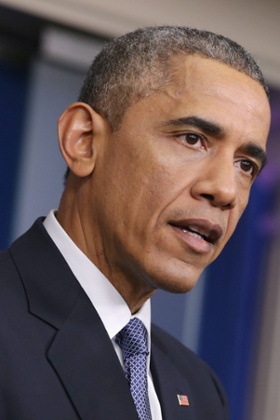
“I share the concerns of dissidents there and human rights activists. This is still a regime that represses its people. As I said in the announcement I don’t anticipiate overnight changes. But I know deep in my bones that if you do the same thing for 50 years and nothing’s changed, you’ve got to do something else.”
Then he moves onto the long term strategy of the tectonic shift in US-Cuban relations.
“Suddenly Cuba is open to the world in ways it hasn’t been. It’s open to Americans. It’s open to church groups visiting their fellow believers in ways they haven’t before. It opens the prospect of telecommunications and the internet.
“And over time that chips away at this hermetically sealed society, and I believe that offers the best prospect of greater freedom, greater self-determination of the Cuban people. I think it’ll happen in fits and starts, but we’ll have a better chance.”
“Change is going to come to Cuba, it has to. They’ve been reliant for years, first on subsidies from the Soviet Union, then from Venezuela.” It has to change, Obama says, though he doesn’t know how quickly.
Updated
Obama now talks about pushing infrastructure in the next Congress.
“We are way behind, and early on we indicated that there’s a way to incorporate corporate tax reform [...] eliminating loopholes so that everybody’s doing their fair share. Infrastructure has historically not been a Democrat or Republican issue, and I’d like to return to that.”
Updated
Obama then banters a bit with a Politico reporter who is leaving for Brussels.
He tells her he’ll miss her around the White House and wishes her the best of luck: “I think that what Belgium needs is some, uh, version of Politico.”
Updated
“I think it says something about North Korea,” Obama said, that it would “mount an all-out attack over a satirical film … starring Seth Rogen.”
“That gives you a sense of the regime we’re talking about here.”
Asked about how the US will respond, Obama shut down the line of questioning:
“We will respond, we will respond proportionally, and in a place and time that we choose. It’s not something that I will announce here today at this press conference.”
“More broadly, this shows we need to cooperate [with international partners] on [cyber security]. Right now, it’s sort of a wild west. And part of the problem is you’ve got weak states that can engage in these kinds of attacks, you’ve got non-state actors [...] that’s part of what makes this issue so important.”
Obama then made another push for Congress to draft a cyber security bill for information-sharing between the government and private companies and organisations.
Updated
Obama: Sony made a mistake in pulling The Interview
Obama continued: “We cannot have a society where some dictator someplace can start imposing censorship here in the United States. Because if somebody’s going to intimidate [Sony] for releasing a satirical movie, imagine what’s going to happen when there’s a documentary they don’t like.
“Even worse, if producers and distributors start engaging in self-censorship because they don’t want to offend the sensibilities of somebody who frankly probably needs their sensibilities offended.

“That’s not who we are. That’s not who Americans are.”
“Again, I’m sympathetic to Sony – but I wish they had spoken to me first.”
“We’ll engage with not just the film industry but the news industry, and the private sector.
“All of us need to anticipate that occasionally there are going to be breaches like this. But we can’t start changing our patterns of behavior anymore than we would stop going to a football game because there might be a terrorist attack. Any more than Boston didn’t run its marathon this year.”
Updated
Q: What does a proportional response look like to the [Sony] hack? Did Sony make the right response by pulling the film?
Obama: “Sony’s a corporation, it suffered significant damage. There were threats against its employees. I am sympathetic to the concerns that they face.
“That being said, yes, I think they made a mistake.”
“Our first order of business is to try to prevent those attacks from taking place.
“Everything that we can do at the government level to prevent these types of attacks [we’re doing]. We’re coordinating with the private sector but we’re not even close to where we need to be.
“We need strong cybersecurity laws that provide for data sharing.”
Updated
Obama: “I’m energized, I’m excited about the prospects of the next couple of years, and I’m certainly not going to be stopping for a minute in the effort of making life better for ordinary Americans.
“Thanks to their efforts, we are better positioned than we have been in a very long time.”
“My presidency’s entering the fourth quarter. Interesting stuff happens in the fourth quarter. I’m looking forward to it.”
He finishes off with basketball before taking questions.
Updated
Obama says the administration has “repaid taxpayers every dime” that went into the bailouts of 2009, and says the Affordable Care Act has helped more than 10 million Americans gain health insurance.
“Meanwhile, around the world, America is leading. We’re leading the campaign to degrade and destroy. We’re leading the [coalition] to check Russian aggression in Ukraine.”
“We’re leading efforts to combat climate change. […] We’re writing a new chapter here in the Americas by [changing] our relationship with Cuba.”
Obama says 2014 will end with more members of the military home than there have been in a decade.
“Take any metric you want, America’s resurgence is real. We’re better off.”
Updated
President Obama arrives on stage: “All I want for Christmas is to take your questions.”
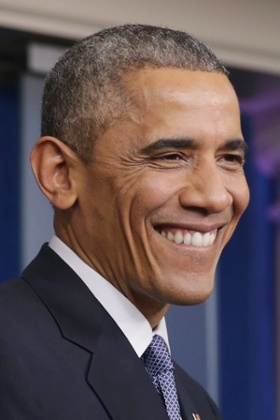
“I said that 2014 would be a year of action and would be a breakthrough year for America. It has been. Yes, there were crises around the world, and many were unanticipated.
“There is no doubt that we can enter into the new year with renewed confidence that America is making significant strides where it counts.”
Obama now talks a bit about increasing jobs, wages, oil and natural gas production, and manufacturing investment.
Updated
DPRK diplomat denies responsibility
A North Korea’s diplomat says the country has no connection to the Sony hacking incident, Reuters reports.
The diplomat declined to comment further to Reuters and spoke only on condition of anonymity: “DPRK is not part of this.”
Voice of America’s Steve Herman has heard the same refrain, which has been the country’s stance since it first denied involvement on 4 December.
#DPRK diplomat early this month told @VOA_News his country had nothing to do with @SonyPictures cyberattack. Fresh denials again today.
— Steve Herman (@W7VOA) December 19, 2014
Updated
Not all nations have left North Korea in the cold – Russian President Vladimir Putin has invited Kim Jong-un to visit next year, Kremlin spokesman Dmitri Peskov tells state-owned Tass news outlet.
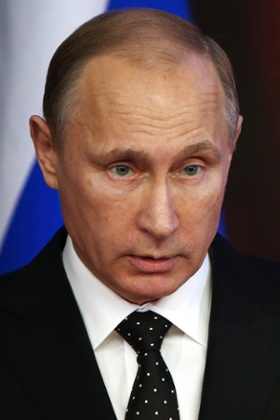
Peskov told Tass that Putin had invited his Pyongyang counterpart to celebrate the 70th anniversary of the defeat of Nazi Germany. If Kim travels to Moscow, it would be his first trip abroad since he succeeded his father as leader of North Korea.
In November Kim’s personal envoy met with Kremlin officials in Moscow to strengthen ties between nations. Pyongyang hopes Russia can provide international leverage on issues like its nuclear program and aid, and the Kremlin wants to build a gas pipeline through North Korea to export fuel to the south.
President Obama is scheduled to speak in just under five minutes – just enough time for you to read a bit about the film that so enraged North Korea’s leadership.
The Guardian’s Jordan Hoffman, one of the few people who’s seen the sophomoric comedy starring Seth Rogen and James Franco, declared it “idiotic”, “chuckle-rich” and featuring a depiction of Kim Jong-un as “actually a great deal of fun”.
You can read his review here, or watch the trailer below – still online despite the hacker’s demands that even these clips vanish.
Updated
North Korea has denied involvement in the hack, but even the most generous reading of a string of public statements from isolated nation suggest its leaders are being less than forthcoming.
Unnamed officials also said in June that the DPRK would have a “merciless response” should the film be released, and that the movie stank of American “desperation”.
Then, in July, North Korea’s ambassador to the UN complained about the film to general-secretary Ban Ki-moon, writing “to allow the production and distribution of such a film on the assassination of an incumbent head of a sovereign state should be regarded as the most undisguised sponsoring of terrorism as well as an act of war.”
Finally, in December, North Korea said Sony cyberattack could be the “righteous” work of its supporters but denied any direct responsibility.
You can check out the full timeline of the The Interview’s troubled story here.
Former senator Chris Dodd, the head of the MPAA, says the cyberattack was a “despicable, criminal act”, Reuters reports, quoting the first statement from a major Hollywood studio about the hack.
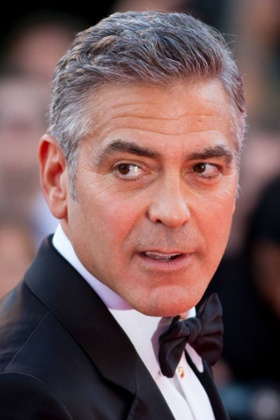
Actors have been less reserved in their criticism not just of the hackers but of the press and each other. George Clooney said Thursday that “a good portion of the press abdicated its real duty” by not investigating the hackers.
Clooney also turned his anger against the film industry: “As we watched one group be completely vilified, nobody stood up. Nobody took that stand. Nobody wanted to be the first to sign on. Now, this isn’t finger-pointing on that. This is just where we are right now, how scared this industry has been made.”
You can read more about Clooney’s comments here.
How did the FBI peg North Korea as the principal actors in the Sony hack?
A digital “fingerprint” likely gave them away, a cybersecurity specialist told my colleagues Dominic Rushe (@dominicru) and Oliver Laughland (@oliverlaughland) earlier this week.
Eddie Schwartz, president of White Ops, said investigators will begin by looking at the malware, the software used by the hackers and then look at the next moves they made. “Different groups have different patterns of activity that they take on once they enter a system. Those patterns are like a fingerprint, almost like a playbook. You’ll see that they go after certain servers first, that they conduct operations in a certain way.”
He said there was only a “small universe of teams” capable of pulling off a hack as large as this.
Schwartz said North Korea was capable of pulling off the Sony hack, but that in past cases third parties had been shown to be responsible, and it was unclear who had commissioned them.
The Sony hack was “an attack on our freedom of expression and way of life”, Homeland Security secretary Jeh Johnson has said in a statement.
The cyber attack against Sony Pictures Entertainment was not just an attack against a company and its employees. It was also an attack on our freedom of expression and way of life.
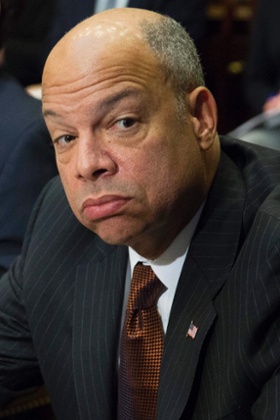
This event underscores the importance of good cybersecurity practices to rapidly detect cyber intrusions and promote resilience throughout all of our networks. Every CEO should take this opportunity to assess their company’s cybersecurity. Every business in this country should seek to employ best practices in cybersecurity.
The Department of Homeland Security and other federal agencies are here to help. We seek to raise the level of cybersecurity in both the private sector and civilian government, and provide timely information to protect all our systems against cyber threats.
Johnson goes on to pitch DHS’s Cybersecurity Framework to businesses to better protect themselves.
Updated
North Korea’s annual GDP per capita is just $1,800, per CIA estimates and a Reuters report about just how difficult it will be to respond to the cyberattack.
Pyongyang has been sanctioned in various forms by the United States for more than 50 years and has become expert in hiding its often criminal money-raising activities, largely avoiding traditional banks. While sanctions may have slowed its nuclear weapons program, they have not derailed it.
One possible response would be to pressure private companies that provide North Korea’s cellular and television services, or to persuade China to close Internet connections, something Beijing, the North’s sole major ally, has been loath to do.
Egypt’s Orascom and Thai company Loxley Pacific are both invested in the North’s telecommunications industry.
“In concrete terms, there’s not a heck of a lot they can do because one, North Korea doesn’t have an economy, and two, we’ve already got every sanction known to man against them,” said Jim Lewis, a senior fellow at the Center for Strategic and International Studies who focuses on cybersecurity.
Senator John McCain has called the cyberattack “an act of war”, CNN reports, quoting McCain’s comments to an Arizona radio station.
“This is the greatest blow to free speech that I’ve seen in my lifetime probably. We have to respond in kind. We have lots of capability in cyber and we ought to start cranking that up.”
“Cyber security is the least understood, most dangerous element of our national security today.”
McCain also said Sony should “suck it up, show the movie”.
As the next chair of the Senate armed services committee, McCain said he plans to hold a cybersecurity hearing in the coming weeks.
Updated
With the official accusation now public, all eyes turn to President Obama, who is scheduled to speak with the press at 1.30pm.
And the answer is FBI links specific tactics, tools, and ISPs to past North Korea attacks. Wow. 1st Q to Pres Obama today now clear.
— Olivier Knox (@OKnox) December 19, 2014
Obama will almost certainly face questions about what the US can do, considering North Korea is already subject to sanctions and has been economically isolated for decades.
The US’s complicated relationship with China could also be an obstacle to retaliation, since the latter is North Korea’s primary source of goods. China and the US have traded sharp accusations about cyber espionage in recent years as well.
Updated
FBI accuses North Korea of hack
The FBI has released its update on the Sony investigation, which reads in part:
“The FBI now has enough information to conclude that the North Korean government is responsible for these actions. While the need to protect sensitive sources and methods precludes us from sharing [all the details of its evidence], our conclusion is based, in part, on the following:
- “Technical analysis of the data deletion malware used in this attack revealed links to other malware that the FBI knows North Korean actors previously developed. For example, there were similarities in specific lines of code, encryption algorithms, data deletion methods and compromised networks.
- “The FBI also observed significant overlap between the infrastructure of this attack and other malicious cyber activity the US government has previously linked directly to North Korea. For example, the FBI discovered that several internet protocol (IP) addresses associated with known North Korean infrastructure with IP addresses that were hardcoded into the data deletion malware used in this attack.
- “Separately the tools used in the SPE [Sony Pictures] attack have similarities to a cyber attack in March of last year against South Korean banks and media outlets, which was carried out by North Korea.
“We are deeply concerned about the destructive nature of this attack on a private sector entity and the ordinary citizens who worked there. Further, North Korea’s attack on SPE reaffirms that cyber threats pose one of the gravest national security dangers to the United States. Though the FBI has seen a wide variety and increasing number of cyber intrusions, the destructive nature of this attack, coupled with its coercive nature sets it apart.
“North Korea’s actions were intended to inflict significant harm on a US business and suppress the right of American citizens to express themselves. Such acts of intimidation fall outside the bounds of acceptable state behavior. The FBI takes seriously any attempt – whether through cyber-enabled means, threats of violence, or otherwise – to undermine the social prosperity of our citizens.
“The FBI stands ready to assist any US company that is the victim of a destructive cyber attack or breach of confidential business information. Further, the FBI will continue to work closely with multiple departments and agencies as well as with domestic, foreign, and private sector partners who have played a critical role in our ability to trace this and other cyber threats to their source. Working together, the FBI will identify, pursue, and impose costs and consequences on individuals, groups, or nation states who use cyber means to threaten the United States or US interests.”
You can read the full statement here.
Updated
“The US should provide evidence to China,” a spokesman for China’s foreign ministry has told reporters about the Sony hack. The Guardian’s Jonathan Kaiman (@JRKaiman) reports from Beijing:
Responding to questions about China’s role in the incident, foreign ministry spokesman Qin Gang said in a press conference that China is also the victim of hacking, and the Chinese government is committed to combatting cyber crime.
“We do not understand the full situation, but countries should work together to solve this problem,” he said. “If the US has more evidence concerning this incident, it should provide [that evidence] to China.”
The state newswire Xinhua has been intermittently reporting on the incident – on Friday night, a headline read that the White House considered the breach a national security incident; the story did not mention China’s relationship with North Korea or its possible role in the hack.
Hello and welcome to our live coverage of the Obama administration’s response to the hack on Sony Pictures, which anonymous officials have strongly suggested has links to North Korea.
President Obama will hold a news conference at 1.30pm ET, and is expected to comment on the US response and Sony’s decision to cancel the film after hackers released thousands of internal emails and threatened terrorist attacks on theaters. Obama is expected to speak on a wide variety of other topics as well.
Reuters reports that the FBI will release an update on what it knows about the cyberattack, and whether its investigators have found a definitive link to North Korean or Chinese involvement. An FBI spokeswoman told the Guardian they could not confirm those reports.
On Thursday, Sony decided to cancel the Christmas release of its comedy The Interview, which mocks North Korean leader Kim Jong-un. In a statement released to CNN on Friday the hackers purportedly praised the company for acceding to their demands, writing “It’s very wise that you have made a decision to cancel the release of ‘The Interview.’
“We ensure the security of your data unless you make additional trouble.”
Updated