Summary
We’re going to wrap coverage of FBI director James Comey’s speech on race and policing with a summary of its key points below.
- Comey defended police, saying “law enforcement is not the root cause,” of the problems of racism and inequality that pervade the US. He argued that all Americans – including police, minority communities and especially the majority of white Americans – must not “roll up their windows, turn up the radio and drive around these problems.”
- The FBI director urged police to “get out of their cars, both literally and figuratively,” and build stronger relationships with people in the communities they patrol. He called for greater empathy for both minority communities and police officers, saying “it’s hard to hate close up.”
- Comey also called for an overhaul of the “ridiculous” way the FBI and police collect and share information, saying “data seems like a dry and boring word” but without it law enforcement cannot understand the reasons behind arrests, shootings and deaths.
- He argued in favor of better training of police in both militarized equipment and overcoming “unconscious biases” toward other races. About the equipment, he said “it’s not about the stuff,” but conceded that some departments lacked training and discipline.
- The director tried to strike a middle ground between critics of the police and law enforcement, saying “I am not willing to let law enforcement off the hook” and also that police are “overwhelmingly doing the right thing and making the right choices.”
Some early reviews of Comey’s speech are in and they are … mixed:
MSNBC’s Joy Reid:
Comey is being as blunt and forward leaning on race as I've ever heard someone in law enforcement be, besides Eric Holder himself.
— Joy Reid (@JoyAnnReid) February 12, 2015
Comey talking recruitment of minority agents. There's a long history of cynicism of African-Americans toward the FBI he'd have to overcome.
— Joy Reid (@JoyAnnReid) February 12, 2015
The Intercept’s Dan Froomkin.
Sounds to me like Comey’s just making excuses for police racism. "It is easier to talk only about the cops, and that's not fair."
— Dan Froomkin (@froomkin) February 12, 2015
National security journalist Kevin Gosztola:
Comey suggests cops should show young law-abiding Black men respect & decency when approach them [*Or, how about maybe not approach at all?]
— Kevin Gosztola (@kgosztola) February 12, 2015
Finally, someone asks about the nature of the conversation, which Comey had earlier said he doesn’t think is very healthy. The questioner brings up the media, and Comey takes the opportunity to urge empathy and put the media in its place.
“We own the media outlets. They reflect us. They’re not creating us, we’re creating them.”
“What we need to do, he says, “is to try to imagine how others see the world. It’s the central challenge of human existence, right? … We own the media outlets, they don’t own us.
“I worry that it’s a bit of a copout to say we’re polarized because the media’s fractionalized. No no no. The media’s us.”
And with that the session ends and Comey et al start filing out.
Another question prompts Comey’s call for cities to pony up more cash for their police departments.
“They’re starving their police departments, making it really really hard for people to get out of their cars. Not long ago there were 5,000 police officers in Detroit, now there are only 2,000. How do you patrol a city of that size? How do you?”
He then says that “things that seem small but are vital, like police athletic associations, citizens academies,” are also part of the drive to improving both policing and the relationship between police and their communities.
“What we’re doing now in cities around the country, [it’s] like the homeowner thinking I’ll invest now but I won’t fix the hole in the roof. You must invest in that kind of maintenance in the relationship with the communities, and that requires resources.”
Someone asks about what Comey hopes he can achieve as FBI director on the issue.
“I think I have a bully pulpit in a way” to push departments into action, he says, before getting back to his argument about records and information.
“One of my frustrations is I could Google and find out from the CDC how many people went to the emergency room with flu symptoms last week,” he says, then saying it’s “ridiculous” that he can’t as easily find out information about police-involved deaths.
“I intend to take that notion that it’s ridiculous to the men and women in uniform and ask do they agree.”
After that, he says, “the next step would be the legislature, and I don’t have that authority.”
Another student asks about the military equipment in the hands of police departments and the FBI, prominently on display in the Ferguson protests that saw armored vehicles, teargas and heavy weapons facing off with protesters.
“It’s not about the stuff,” Comey says, saying that the armor, weapons and gear are inherently “neutral”.
“We in law enforcement need that stuff,” he says, because “we often face adversaries barricaded in a location or firing high powered weapons trying to kill innocent people.”
“Vests aren’t going to stop high powered rounds. We need the stuff. The issue is how do we use that stuff.”
“Do we use that stuff to confront people who are protesting in a community? Do we use a sniper rifle to see closer in a crowd?”
“That’s where it breaks down. It’s about the training and the discipline and how we use it. It’s not the stuff. That’s how I think about it.”
A student asks about the disproportionate number of minority arrests for drug offenses, and Comey replies by saying police and society should probably do more to confront the bigger issue of drugs and addiction.
He says that “overwhelmingly” the number of drug dealers arrested are black or hispanic, but that “overwhelmingly the users of drugs are Caucasians.”
Come says that “just dealing with the dealers is like just bailing out water from the boat without dealing with the hole,” and that another “hard truth” is that “users are overwhelmingly from the suburbs and white.”
The Q&A session with Georgetown students has picked up, and one of the first questions is about what Comey wants to change as quickly as possible in police departments.
“I think it’s hard to hate up close. I think police in our country need to get out of their cars, and get to know the people they serve.”
He says that a lack of funding is in part responsible for a lack of police on the streets, which has in turn kept officers in their cars, “both literally and figuratively.”
“That is actually critical to people’s trust of the entire justice system. And if we neglect it, we can have all the rules and technology in the world, but underneath it there will be a lack of trust that’s corrosive.”
“Do we know the people they serve, and do they know us? Empathy is often in short [supply] in the human experience … and I worry that sounds vague or mushy, but that is I think the actual answer more than policy or technology.”
Comey closes out by bringing it back to his introductory remarks about how history and how both police and communities inherit certain legacies.
“Because we must get better, I intend for the FBI to be a leader in getting the facts we need … to make sound policy and sound decisions with that information.”
“America isn’t easy. America takes work.”
“Today is Abraham Lincoln’s birthday,” Comey says, wrapping it back around to the history of slavery and law enforcement’s complicity in that history: “That is our inheritance as law enforcement.”
He then argues that Americans at large, “especially we who are part of the majority” must confront the truth … as a country we must also confront the truth in ourselves.”
“Law enforcement is not the root cause. … Police officers are risking their lives,” he says, and beset by “a host of problems that will not be solved by body cameras.”
He quotes Martin Luther King Jr – “We must learn to live as brothers or we will perish together as fools” – and closes out the speech: “Relationships are hard. Relationships require work. So let’s begin that work. It is time to start seeing each other as who we really are.”
Updated
He uses Bed-Stuy, the Brooklyn neighborhood, as an example of effective policing.
“For a couple decades Bed-Stuy was a kind of shorthand for chaos and disorder … But no more, thanks to those who chose a life of danger and service.”
Comey then makes a pitch for data collection and better record keeping of shootings, police incidents, and interaction generally between police and citizens.
“Some of that [improvement] has to involve better sharing of information. I asked my staff how many people were shot who were African American. I wanted trends and data … They couldn’t give me.” That’s not their fault, he says, but rather a gross and longstanding oversight about the way law enforcement keeps track of and uses information.
We need “ideological agnostics,” Comey says, essentially describing technocrats who seek data-driven solutions while also looking at ways to work cooperatively with communities.
“Data seems like a dry and boring word, but without it we cannot understand” how to make the improve enforcement, Comey says.
“How can we understand or address these issues,” he asks, without demographic data and the context and details of how each shooting and incident actually happened.
Reporting by police departments is voluntary, and that means neither they nor the FBI can fully track incidents, he says. “Without complete or accurate data, we are left with ideological thunderbolts.”
“One of the hardest things I do as FBI director is call the chiefs and sheriffs when officers have been killed in the line of duty … I make far too many calls.”
He talks about the two officers killed in New York last year, “two minority officers working in a minority neighborhood,” making the the point that police should reflect and understand the communities they serve.
“I am not willing to let law enforcement off the hook,” Comey says.
“We must better understand the people we are trying to serve and protect … We must know deep in our gut what it feels like to be a young black man when he sees police walking toward him on the street.
“We must work, in the words of New York City police commissioner Bill Bratton, ‘we must learn to really see each other.’ We simply must see the people we serve.”
“But the seeing needs to flow in both directions. Citizens need to see the men and women of law enforcement. They need to see what police see … the risks and dangers they see on every late-night shift. … And they need to give them the respect and space they need to make their job possible.”
He says police are “overwhelmingly doing the right thing and making the right choices.”
“The truth is that what really needs fixing is a truth that only a few like President Obama are willing to speak about.”
He makes a sociological argument, about young people growing up poor and often without support systems who then “inherit a life of crime”.
“Changing that legacy is a challenge so enormous and complex” that Americans must do more than simply “talk about cops”, he says.
“Let me be transparent about my affection for cops,” he says, and then describes in detail his grandfather’s work as a police officer, making the rhetorical point that many good people join police departments and joined them for good reasons.
He describes a scene of police officers reacting differently to two young men, one white and one black, dressed identically and walking down the same street.
“The officer turns toward one side of the other, and not the other. We need to come to grips that this behavior complicates the relationship between the police and the people they serve.”
“Why does that officer do that?” Comey asks. “Is it because he’s racist?” Why are people not indicted or indicted, he asks. “Is it because those juries and judges are racist?”
No, Comey answers, but rather systemic changes, from training to societal work, need to be made.
“Something happens to people in law enforcement. Many of us develop different flavors of cynicism that can be hard to resist because they become shortcuts.”
“Criminal suspects lie about their guilt, and nearly everyone we charge is guilty. That makes it easy for law enforcement to think that everyone lies and everyone is guilty. That is easy but that is false.”
“Something happens to people working in that environment … That mental shortcut becomes almost irresistible.”
“But if we can’t help our latent biases, we can help our behavior in response to those instinctive reactions. Which is why we work … to try to overcome them.”
“Racial bias isn’t epidemic in law enforcement anymore than it is in academia or the arts. … People who risk their lives to help other people. They don’t sign up to be cops in LA or New York to help white people, black people, Hispanic people,” Comey says, but rather they do it simply to help all people.
He espouses better training for law enforcement, but says this too is not enough.
“A second hard truth. Much research exists that suggests unconscious bias” exists in everyone, Comey says, that makes people react negatively without thinking, and that that affects the ways police interact with the people they meet.
“In fact, we all, white and black, carry various biases around with us.”
“I am reminded of the Broadway song Everyone’s a Little Bit Racist,” he says, and proceeds to quote it – but not sing it. “You should be grateful I did not try to sing that.”
He says Americans need to have conversations about these relationships, “conversations in the true sense of the world … but if we’re willing not only to talk, but to listen.”
“I worry that this conversation has been focused entirely on the nature of police and law enforcers.”
“But it should also be about something much harder to discuss.”
All of us in law enforcement must be honest enough to acknowledge that much of our history is not pretty.” He says that law enforcement has often enforced a status quo that was not fair to too many people. He then describes the experience of Irish immigrants in the 19th and early 20th centuries, and says “they had some tough times, but that does not compare with the experience of African Americans.”
“We must talk about our history. It is a hard truth that lives on.”
“We are at a crossroads. As a society we can choose to live our lives every day raising our families, going to wokr, hoping that someone, somewhere will do something to ease the tension.”
“We can roll up our car windows, turn up the radio, and drive around these problems”
“Or we can choose to have an open and honest discussion about our relationship.”
“What it could be, what it should be, if we took more time to undersetand each other.”
“Unfortunately … there is a disconnect between police agencies and the communities they serve, predominantly in communities of color.”
Comey heads to the podium.
“Good morning, ladies and gentleman … I am honored to be here,” Comey begins.
“I wanted to meet with you here today to share with you my thoughts on the relationship between law enforcement … like a lot of things in life, that relationship is complicated, as relationships often are complicated.”
“Healy was born into slavery, in Georgia, in 1884,” Comey says, referring to the man after whom the hall is stands. “Healy is believed to be the first African American to earn a PhD.” He says this is why he chose this venue.
Comey has just taken the stage at Georgetown, along with dean Edward Montgomery, who will act as a moderator for a question and answer session.
A school official says that “this is a topic whose importance and urgency have been made obvious in events” spanning the country, and that the US “at this current moment … seeks a greater understanding,” and that its people are trying to build a renewed trust and sense of responsibility to each other.
Comey’s speech, entitled “Hard Truths: Law Enforcement and Race”, is the first time an FBI director has spoken broadly about policing and race but not the first occasion for Comey, the New York Times has found after rifling through the archives.
The Times dug up an editorial co-written by Comey as a student at William and Mary in 1980, criticizing the college for failing to invest in diversity. The editorial reads in part:
So, if the college wants to enroll more black students, what is the holdup?” “Is the college unable to provide the resources necessary for an effective recruiting program? Unable, no. Unwilling, yes.”
“We think that a lack of commitment is the problem. The college, it seems, is only committed to staying out of the courtroom. We wish we attended a college committed to its social responsibilities.”
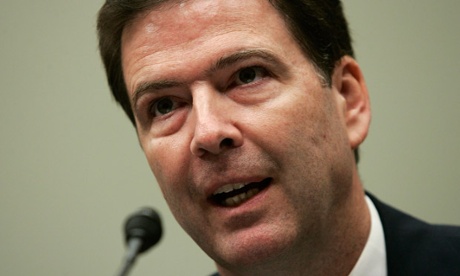
Welcome to our coverage of FBI director James Comey’s 10am ET remarks on race and policing in the US, in a speech that marks the first occasion a sitting director has broached the issue writ large.
The speech, at Washington’s Georgetown University, is expected to highlight how the problems of race, policing and civil rights issues have become high-profile in the past six months, following several police killings of unarmed black men and protests around the country. On Monday, for instance, protesters in New York marked the six-month anniversary of the death of Michael Brown, the unarmed 18-year-old shot dead by a white police officer in Ferguson.
Police departments around the US often look for guidance from the FBI, the most powerful branch of domestic law enforcement in the country, and an organ with close ties to the NYPD. Previous directors have limited remarks on race and policing to specific civil rights investigations, such as the bureau’s investigation of Dr Martin Luther King in the 1960s.
Comey plans to defend the police, according to unnamed FBI officials who spoke to the New York Times. Those officials said Comey will cite research about white people’s unconscious reactions to black people, that police who work in minority neighborhoods can become cynical about race, and that most officers are not racist.
Updated