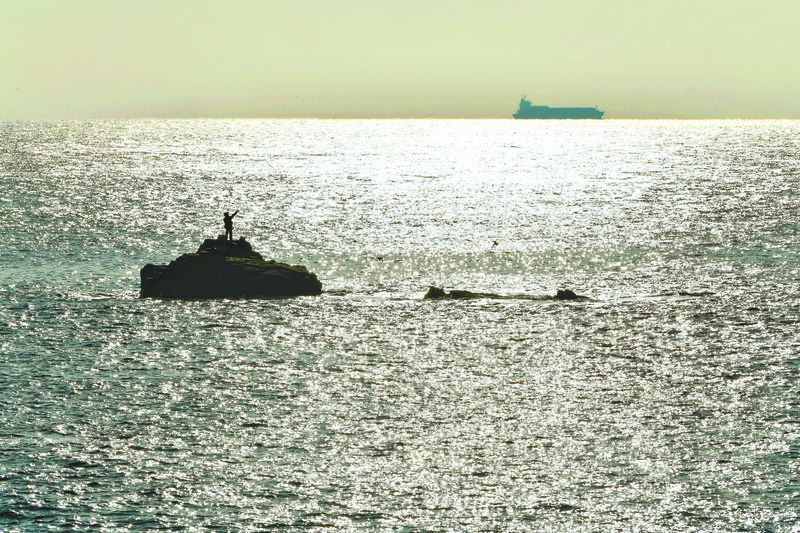
As I stood on Cape Ashizuri in Tosa-Shimizu, Kochi Prefecture, the horizon stretched out as far as the eye could see. Large ships slowly passed by every so often.
In January 1841, then 14-year-old Manjiro Nakahama, who grew up in a fishing village near the cape, was caught in a rainstorm when he went out fishing with four friends. Their ship rode the Kuroshio current and drifted to an uninhabited island 580 kilometers off the Japanese mainland. They avoided starvation by drinking rainwater and eating albatrosses. About five months later, they were rescued by a U.S. whaling ship that passed by the island.
When the U.S. ship called at a Hawaiian port, Manjiro parted from his friends and headed with the ship's captain to his home area, the east coast of the United States.
Manjiro learned about U.S. politics and geography from the captain. "Hyoson Kiryaku" (A brief account of drifting toward the southeast), which Manjiro dictated later in his life, states that: "In the United States, people elect a person who they believe is best suited as president from many talented and educated people." According to Yukie Maeda, 62, an official at the Sakamoto Ryoma Memorial Museum, "Manjiro is the first Japanese who learned about democracy through experience."
He called himself "John Mung" and studied mathematics, navigation and other subjects at school. Later on, he was hired by another whaling ship and navigated all over the world.
When his ship called at Hawaii, he learned that when a ship from New York arrived in Edo (the current Tokyo), Japan was asked to allow the United States to set up a consular office in Edo, but the request was refused. This apparently refers to the arrival of Commodore James Biddle, commander of the U.S. East India Squadron, to Japan in 1846, indicating that there was growing interest in negotiations with Japan in the United States.
As Manjiro returned to the East Coast, he heard there was a state called "Kyarefone" and there was a large gold mine in the state. This was a reference to the gold rush in California. Manjiro went there and engaged in mining for about a month to earn money. Then he took a ship for Shanghai in order to return to Japan.
On the way, he took on his long-parted fishing friends in Hawaii and arrived at the Ryukyu archipelago in January 1851.
At that time in Japan, traveling abroad was a capital crime. However, Nariakira Shimazu, the lord of the Satsuma domain who governed Ryukyu, welcomed Manjiro and asked about the situations in foreign countries.
Manjiro was questioned by magistrates in Nagasaki and given a formal punishment of three days in prison, but he returned to his home area of Tosa in 1852. There he compiled the "Hyoson Kiryaku." Since the book contained a lot of overseas information, retainers of the domain all read it.
The days of Japan's national isolation were coming to an end, and domain lords and retainers were starved for information about maritime security and international conditions. Manjiro was a person needed by the rapidly changing times.
In 1853, U.S. Commodore Matthew Perry sailed into Uraga, and Japan was thrown into confusion over the pros and cons of the opening of the country. Manjiro became a direct retainer of the bakufu feudal government and a teacher at a warship training center. In 1860, he accompanied the feudal government's diplomatic mission to the United States.
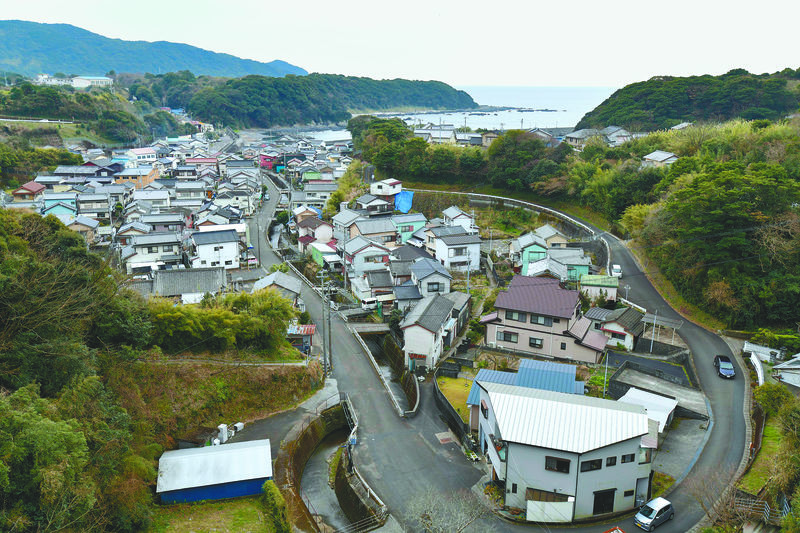
I visited the Nakahama district of Tosa-Shimizu, Manjiro's hometown. The tomb of the Nakahama family can be found at Daikakuji temple in the district, and next to the tomb is a small, 20-centimeter stone that is said to be a tentative grave set up by Manjiro's mother for her son after he was lost in the sea.
"A fisherman got lost at sea and later became a person who supported the central government. He must have ridden the wave of the times," said Eiji Nishikawa, 67, the head of the district.
Read more from The Japan News at https://japannews.yomiuri.co.jp/