Detachment used to be an essential part of press box etiquette. Not so long ago there was even a specific, if rather sniffy, phrase – "fans with typewriters" – to describe reporters who did not even attempt to subvert their personal allegiances when covering, say, Scottish football. The advent of blogging and computer keyboards has altered all that. Fail to offer an opinion on the hour every hour seven days a week and people assume you must be ill.
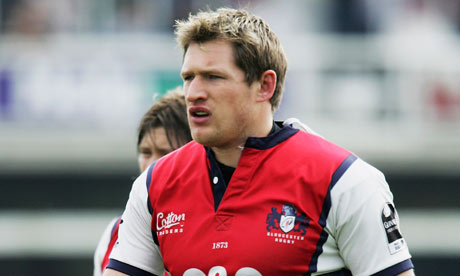
There are certain sports news items, though, which do not so much tug at your emotions as punch you in the heart. The past few days have yielded two desperately sad examples. We can only pray that Seve Ballesteros, currently stuck in the medical equivalent of waist-high rough, summons up the sort of miracle recovery which was once his trademark. And, while we are on our knees, spare a thought for James Forrester, Gloucester's erstwhile back-row forward. It is cruel when anyone has retire at a young age; to see the athletic Forrester chopped down prematurely is a crying shame.
Those who only glimpsed Forrester a couple of times may wonder what the fuss is all about. Players retire early all the time and the 27-year-old was hardly a household name, despite his two England caps. But sometimes statistics tell considerably less than half the story. They do not take into account the priceless ability to light up a stadium with one nonchalant flash of skill or speed. As a kid Forrester kicked goals for his school first XV and had football trials with Oxford United as a centre-back. He wasn't really built like an international forward but possessed the hands and footwork of an NBA legend. His knees were knobbly, his modest demeanour almost apologetic at times but he did things no England back-row forward has been capable of since Andy Ripley.
Various mental snapshots present themselves: a turbo-charged hat-trick of tries against Bristol at the Memorial Ground in December 2001, an eye-catching display alongside James Simpson-Daniel for England against the Barbarians when Jonah Lomu trailed in the pair's slipstream and the celebratory bird impressions of his team-mates during last year's Premiership play-offs in homage to their absent No8 with the impressively prominent nose. Forrester was always uncomfortably aware he did not resemble the average player. "The other day I was looking at photos of myself when I first started," he confided the last time we talked. "It was scary. No wonder I used to get injured a lot, I was just a stick."
Now, unfortunately, the stick has snapped once too often. The possessor of what he once called "girly wrists" has suffered yet another serious knee setback and will be galloping around our fields no more. The good news, if his family history is any guide, is that he will respond well to his present adversity. His late grandfather, Major-General Michael Forrester, was awarded two DSOs and two MCs during the Second World War and played a prominent role in protecting Crete from the Nazis. "Out of the trees came Capt Forrester in a long yellow army jersey, waving his revolver in his right hand," read one eye-witness account. "He was tall, thin-faced, fair-haired, with no tin hat – the very opposite of a soldier hero. It was a most inspiring sight. The Germans fled."
More recently Forrester junior and his family attended the unveiling of an eight-foot high memorial in the southern Italian town of Scafati to mark the 65th anniversary of the battle which proved decisive in the Allied forces' drive through Italy. Maj-Gen Forrester and fellow soldiers of the Queen's Royal Regiment, together with partisans he had trained, attacked German forces from behind and cleared mines under the Sarno bridge, saving the town from a grim fate. "The Nazi commander had his finger on the detonator to blow up the bridge as my grandfather took it," recounted Forrester. "It saved a lot of civilian casualties and the whole town would have had to have been rebuilt."
Rebuilding an alternative career will, hopefully, be less stressful. At least, unlike Ballesteros, his life is not under threat. It is just the rest of us who must mourn the passing of a shooting star who, under the new experimental law variation requiring defenders to retreat five metres back from scrums, might well have come into his own. In common with the former Southampton footballer Matt Le Tissier, he was an artiste amongst artisans who never subscribed to the stereotypical norm. Now there is only his great mate James Simpson-Daniel left. If Sinbad crumples beneath a heavy tackle between now and the autumn Tests, rugby's new romantic era really will be over.
Rhythm section
It is a dull column that drones on endlessly about refereeing interpretations at the breakdown. But if the aim of the International Rugby Board was to simplify the game and entice the floating voter, their recent initiatives are clearly failing. Pinging anyone who topples even momentarily off their feet, allied to prolonged bouts of aerial kick-tennis, is having precisely the opposite effect. Were Montauban guilty of a ruck offence in the closing stages against Munster? It was pretty hard to tell for certain, even in slow motion. When referees are encouraged to use a magnifying glass and a slide-rule at the tackle area, it makes for a desperately frustrating, anally-retentive product. I share the view of Duke Ellington: "It ain't worth a thing if it ain't got that swing."
Cheats prosper
While we're on the subject of Europe, the rise in on-field cynicism was impossible to miss last weekend. Leinster had Felipe Contepomi sin-binned for a blatant professional foul against Edinburgh and Chris Whitaker should have seen yellow for a similarly crude offence. The Ospreys were denied a match-winning late try when Leicester's Harry Ellis made a totally illegal nuisance of himself at the vital five-metre scrum. Toulouse's Byron Kelleher could be heard complaining loudly to the ref about Butch James being offside when, in reality, the fly-half's chargedown was perfectly legal. If you can get away with it etc etc. All the three guilty teams I've mentioned won their matches. It is starting to make Neil Back's infamous "Back-hander" in the 2002 final against Munster feel positively quaint.