Afternoon summary
-
Ukip has said that the EU referendum will not be fair because the bill published today will allow the government to publish pro-EU material in the run-up to polling day. In a statement, Steve Crowther, the Ukip chairman, explained.
[The bill] fails to mandate a period of ‘purdah’, normal in elections, to prevent the government from making announcements in the run-up which might affect the result.
With no guarantee from the government that they will set and enforce fair and equal spending limits, this omission leaves the door open for the government or indeed the European Union’s agencies to make ever more appealing announcements, right up to polling day, to ‘nudge’ people towards a vote to stay in.
The people have waited 40 years for this opportunity and they must be given a free, fair and open choice to decide whether we stay in the EU, or reclaim our ability to govern ourselves.
-
George Galloway, the former Respect MP, has announced he will stand for London mayor next year. (See 2.22pm.)
That’s all from me for today.
Thanks for the comments.
Updated
The French MP Christophe Premat, a member of President Hollande’s Socialist party, told the World at One that David Cameron’s proposed referendum could not be used “as a threat” in the EU renegotiation. He said:
We respect that a referendum will be held in Great Britain, that’s the destiny of the people in the UK. That’s correct. But, at the same time, we can’t use the referendum as a threat in order to have more space in the renegotiation. The method should be approached in another way. That might be the message of President Hollande to David Cameron tonight.
The government special adviser Ramsay Jones has tweeted this terrific picture from Number 10.
Guess what just flew in to No10? Not so much #herongate as knock knock knocking on #heronsdoor pic.twitter.com/37epG7GZA7
— Ramsay Jones (@Ramsay59) May 28, 2015
A Labour leadership round-up
Here’s a Labour leadership round-up, featuring some of the most interesting blogs and stories written about the contest in the last day or so.
- Isabel Hardman at the Spectator names six more MPs who have endorsed Yvette Cooper. They are: Emily Thornberry, Ian Austin, Jim Cunningham, Karen Buck, Lyn Brown and Steve McCabe.
“I had a life before politics,” she replies, when I ask her about this background. “Not a lot of people know about my background, but I think it’s important that people understand we have alienated – I think our language alienated – self-employed tradesmen, women, anyone running a small business, that the way we spoke about businesses made them feel excluded.
“If we want the great public services, the good schools, the good hospitals, the good roads – speaking as a cyclist – we have to have people running businesses and paying their taxes to enable that to happen, and creating wealth.”
Whether it’s reforming our public services to give people more control or carving out an ambitious new role for Britain in the world, Liz is the candidate who has been making the running and mapping out a platform from which Labour could take on the Tories. Liz would also offer Labour a fresh start. Free from endlessly debating the successes and failures of the Blair and Brown years, we could finally move the debate on to show what a modern Labour Party will do to improve the lives of millions.
Crucially, I believe Liz has the desire and determination to win in 2020. She understands that winning is not an afterthought in some great intellectual project, winning should be the aim. For too long pragmatic steeliness has been missing in our politics and we need to get the bit between our teeth again. Our desire to win elections should never be seen as a betrayal of our principles, but the truest expression of them.
We cannot have more of the same. But neither can we have our offer for 2020 being caricatured as a back-to-the-future vision that doesn’t understand why we lost in 2010, never mind 2015. We won’t win over the voters we lost, or failed to gain, by being a poor imitation of the Tories.
That’s the lesson of New Labour: we don’t have to be like Tories, we have to be different to and better than them. And we are at our best when we have something to offer everyone. To do that we must speak to the country. Andy Burnham is the man to lead us in that conversation, and then matching his words with action to win again for Labour in 2020.
Cameron calls for new leadership at Fifa
David Cameron has just tweeted about Fifa.
I welcome the probe into allegations of FIFA corruption and bribery, and support the FA's call for new leadership and reform.
— David Cameron (@David_Cameron) May 28, 2015
The SNP has dismissed Michael Fallon’s statement about the concerns raised by the Royal Navy Trident whistleblower. (See 1.39pm.) Alex Salmond, the former Scottish first minister, has secured an adjournment debate on this which will start at 5pm, and Brendan O’Hara, the SNP’s defence spokesman, said Fallon’s statement was not convincing and that there should be a full, transparent investigation. He said:
I am extremely disappointed with the MoD statement and I find it hard to believe that Mr. McNeilly’s detailed 18 page dossier can be dismissed in a 500 word statement by the secretary of state for defence.
There are serious questions that remain unanswered and the MoD cannot restore public confidence by simply saying that there is absolutely nothing of any substance in anything that [William] McNeilly has alleged.
The MoD has a history of secrecy, complacency and reluctance to report its faults on a reasonable timescale - and this dismissal of absolutely everything that Mr McNeilly alleges in such a high-handed fashion will do little to improve their reputation. The “there’s nothing to see here, please just move along quickly” attitude isn’t acceptable and I repeat my call for a full, thorough and transparent investigation into the allegations and for the findings of that investigation to be made public.
George Galloway to stand for London mayor
George Galloway, the former Respect MP, has announced he will stand for London mayor next year.
I'm standing for Mayor of London 2016. If you can help in any way, write to me at galloway4london@gmail.com pic.twitter.com/UDX0KMZ2VO
— George Galloway (@georgegalloway) May 28, 2015
Lunchtime summary
-
Philip Hammond, the foreign secretary, has said Britain will vote to leave the EU unless European leaders agree to a “substantial package of reform” demanded by David Cameron. Hammond also indicated that No 10 would like to keep open the option of a referendum next year when he suggested that negotiations could be concluded by the end of winter. This lunchtime Cameron is in the Netherlands, where he is having lunch with Mark Rutte, the Dutch prime minister, and discussing his reneogtiation demands. As he arrived, Cameron said the UK and the Netherlands were “old friends and like-minded allies”. He went on:
I am looking forward to discussing many issues but obviously we will be talking about European reform and the need to focus on flexibility, the need to focus on growth and jobs, the need to make sure we complete the single market, the need to make sure that, as you have put it, ‘Europe where necessary but nation states where possible’.
We have worked together on making sure that the European budget is under control, we have worked together on trade deals with other parts of the world, we have worked together on strong, pro-market, pro-enterprise agenda. So we will discuss all that and my plans for European reform.
David Cameron and Dutch PM Rutte meet in The Hague. pic.twitter.com/9honCdwmXw
— Imelda Flattery (@Imeldaflattery) May 28, 2015
- The British government has joined calls for Sepp Blatter to step down as president of Fifa. Downing Street said Cameron the government was “four square” behind the candidacy of Blatter opponent Prince Ali for Fifa president in the election. In a Commons statement, John Whittingdale, the culture secretary, said Fifa needed a change of leadership.
- The SNP has claimed that the Scotland bill published today does not fully implement the devolutions proposals set out in the Smith Commission report. (See 12.43pm.)
-
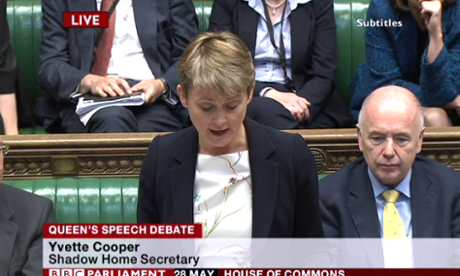
Yvette Cooper, the shadow home secretary, has strongly criticised Theresa May, the home secretary, for backing moves to stop search and rescue in the Mediterranean. Cooper told May in the Queen’s speech debate:
Last summer, you led the arguments in Europe to stop search and rescue in the Mediterranean, leaving people to drown in the waves in order to deter others from coming and now you are refusing to help again when the UN asks for help. Frontex [the EU border agency] has said the main cause of the increase in boats is Syria, which has caused the worst refugee crisis since the Second World War, yet you are still resisting the UN’s appeal to give sanctuary to more Syrian refugees.
Cooper said that, although Labour would not support an arbitrary quota system, the party did think Britain should take more refugees from Syria.
Throughout our history this country has refused to turn its back on those fleeing persecution and seeking sanctuary. So just as you should not rip up that legacy of international standards on human rights, you should not rip up that legacy of international compassion.
- The Electoral Commission has said that political parties received a record £30.6m in donations in the first three months of 2015. (See 11.20am.)
-
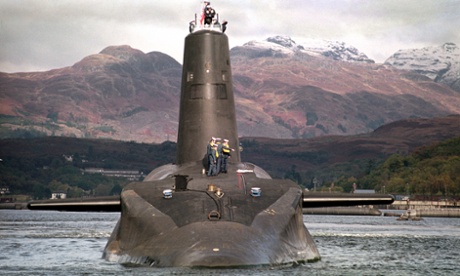
Michael Fallon, the defence secretary, has rejected the concerns about the safety of Trident raised by the Royal Navy submariner William McNeilly. In a Commons written statement (pdf), Fallon said McNeilly’s claims have been investigated, and were unfounded.
Most of McNeilly’s concerns proved to be either factually incorrect or the result of mis- or partial understanding; some drew on historic, previously known, events none of which had compromised our deterrent capability and, where appropriate, from which lessons had been learned to develop our procedures as part of a continuous improvement programme. Only one of the allegations remains to be fully examined – the allegation that e-cigarettes were being used within the submarine. No independent corroboration of this has been found but even if it were true, there is clear evidence that their use did not put the safety of the boat at risk.
-
One in 10 households in England are struggling with their fuel bills, official figures have revealed. As the Press Association reports, some 2.35m households were in fuel poverty - judged as facing both low incomes and high energy costs - in 2013, the latest year for which the figures are available. It is a reduction of just 0.5% from 2012, when 2.36m families were in fuel poverty. The gap between the bills fuel-poor households face and what they can afford to pay was £374 on average in 2013, a reduction from £385 the previous year, with the total gap across all homes in fuel poverty falling from £909m to £877m.
Updated
The EU referendum bill has also been published. Here is the 47-page bill (pdf). And here are the explanatory notes (pdf).
Updated
SNP says government has broken its promise to implement Smith Commission
In a news release the SNP has set out more detail as to why it thinks the Scotland bill does not fully implement the proposals in the Smith Commission. This is from John Swinney, the Scottish deputy first minister.
Less than a fortnight ago, the prime minister came to Edinburgh and pledged to the people of Scotland to deliver the Smith agreement in full. Today, it’s plain to see that promise has been broken.
Delivering the Smith Commission’s recommendations was the minimum the UK government had to deliver.
There is no mention in Smith of the UK government having the ability to veto Scottish government decisions – yet there are eight vetoes in this legislation, including on Universal Credit.
In key areas, particularly the restrictions the bill places on employment support and carers benefits, the lack of an explicit power to create new benefits in devolved areas, and the devolution of the Crown Estate this bill falls far short of what the people of Scotland have been promised.

Sturgeon says Scotland bill does not go far enough
The Scotland bill has been published. Here is the Scotland Office’s news release, here is the 81-page bill (pdf) and here are the 53-page explanatory notes (pdf).
In the Scottish parliament Nicola Sturgeon, the Scottish first minister, has just said that the bill does not fully implement the Smith Commission proposals. It would allow the UK government to veto changes to welfare rules in Scotland, she said. In the Commons Joanna Cherry, the SNP MP and the party’s justice and home affairs committee, made the same point in her maiden speech, which she finished a few minutes ago.
And here is some Twitter comment on the bill.
From Adam Tomkins, a Glasgow law professor and adviser to the Scottish secretary
Scotland Bill welfare clauses very different from January's draft, and much improved. Draft fell short of Smith; today's bill does not.
— Adam Tomkins (@ProfTomkins) May 28, 2015
Reality: HM Govt listens to and acts on fair criticism of draft welfare clauses, fixing earlier problems SNP spin: attack attack attack
— Adam Tomkins (@ProfTomkins) May 28, 2015
From Elizabeth Lloyd, Nicola Sturgeon’s chief of staff
#Scotland bill fails first test - UK veto on welfare powers remains, largely ignores devo committee report and missing key welfare power.
— Elizabeth Lloyd (@eliz_lloyd) May 28, 2015
From Wings Over Scotland, the nationalist website
In typical UK government style, the Scotland Bill is basically unreadable. You don't get the actual bill, just the changes to the 1998 one.
— Wings Over Scotland (@WingsScotland) May 28, 2015
Updated
Tessa Jowell, who is seeking the Labour nomination as candidate for London mayor, has been holding a Twitter Q&A this morning.
I've started my #AskTessa Q&A and I'm here until noon. Please tweet me your questions now :) pic.twitter.com/xD8AoRgCF2
— Tessa Jowell (@TessaJowell) May 28, 2015
You can read all the replies on her Twitter feed. Here are some of the highlights.
#AskTessa What would you do to address the concerns of @londoncouncils about the negative effects of #betting shops? https://t.co/VPqzJxwKxd
— reth!nk gambling (@rethinkgambling) May 28, 2015
Gambling Commisssion not using its extensive powers and a new planning class needed. #AskTessa https://t.co/4IEQwNSacm
— Tessa Jowell (@TessaJowell) May 28, 2015
What are your thoughts on 'enhanced' Right to Buy & impacts on London? Any ideas to mitigate those impacts? #AskTessa
— Luke Alexander (@lukealexander) May 28, 2015
Disaster for London will fight it every step of the way. Sign my petition: http://t.co/FDuWQYFCCH #AskTessa https://t.co/PvtZpXz4co
— Tessa Jowell (@TessaJowell) May 28, 2015
How are you going to make sure landlords don't rip off tenants? #AskTessa
— Ludo Orlando (@LudoOrlando) May 28, 2015
Support Boroughs to do Compulsory Licensing and campaign for rent stabilisation powers. #AskTessa https://t.co/eBpV5stRcQ
— Tessa Jowell (@TessaJowell) May 28, 2015
#AskTessa Should FIFA suspend their Presidential election given yesterday's events?
— Jack Storry (@JackStorry) May 28, 2015
Since 1974 FIFA had 2 rulers-even North Korea has had 3. So yes FIFA has to change.#AskTessa https://t.co/2szyBzSksc
— Tessa Jowell (@TessaJowell) May 28, 2015
@TessaJowell Do you think London could benefit from a tourist tax? #asktessa
— Jade Symonds (@JadeSymonds) May 28, 2015
Yes. Would introduce a tourism levy to pay for NY fireworks and activities for young people. #AskTessa https://t.co/8PdN6jP4v4
— Tessa Jowell (@TessaJowell) May 28, 2015
Updated
In the Commons the Queen’s speech debate on home affairs is underway and the two opening speeches have just finished. Theresa May, the home secretary, opened, and her speech was relatively routine. She was repeatedly asked when the government would meet its promise to get net migration below 1000,000, but refused to say.
Then Yvette Cooper, the shadow home secretary, responded. She was much more fired up and, after opening with a joke about her and May both running for the leadership of their parties, she launched into a powerful passage mocking May and Michael Gove, the new justice secretary, over their tetchy relationship and their decision to postpone plans to abolish the Human Rights Act.
Here’s are some of the highlights.
Two weeks ago they promised the Queen’s speech would repeal the Human Rights Act. Two weeks on, the repeal has been repealed. We have been here before, because two years ago the home secretary promised Tory party conference that she would abolish the Human Rights Act. She promised us a document and a draft bill, and she said she was prepared to pull out of the [European convention on human rights] together. But what happened? No document, no plans, no bill.
Last time it took her two years to ditch her promise. This time it has taken her two weeks. The British bill of rights has disappeared again, and we still have no idea what they actually want to do ...
This time the home secretary cannot blame the Liberal Democrats for the chaos because this time she and the justice secretary [Michael Gove] and this time they are going to have to work together to sort it out, and I bet that will be fun for them. You look at them; they can’t even bear to sit next to each other on the front bench.
I bet she was really pleased at his appointment; probably the only person in the government who could make her relationship with the former deputy prime minister a good one.
Last summer the justice secretary told friends that the home secretary was “dull and uninspiring”. Then she said he was a “wild-eyed neocon”. He said she “lacks the intellectual firepower and quick wit”. No wonder they want to abolish the right to free speech.
But you can understand the poor old prime minister desperate to find the justice secretary a job that he could actually do. Because he clearly could not stay at education; he upset the entire teaching profession and lost so many teachers’ votes. He clearly could not stay as chief whip. He upset all of his backbenchers and lost an awful lot of parliamentary votes. So the one job he thought he could do was go and be in charge of justice and prisoners, because at least they don’t have the vote.
Updated
John Whittingdale, the new culture secretary, answered an urgent question in the Commons this morning on the Fifa scandal. He suggested that Sepp Blatter should stand down as Fifa president and sponsors should threaten to break off their contracts with the “corrupt organisation”. He said the government fully supported the Football Association’s position that significant and wide-ranging reforms are urgently needed at the top of Fifa, including “a change in its leadership”.
Political parties received record £30.6m in donations in first three months of 2015
The Electoral Commission has just published political donation figures for the first three months of 2015. A total of £30.6m was donated to 10 political parties, it says - more than has been given in any other quarter since the law was changed 15 years ago to make publishing donations obligatory.
By comparison, £19.3m was given in the first quarter of 2010 (shortly before the 2010 general election) and £26.3m was given in the second quarter of 2010 (covering the election period).
This is how much the five biggest parties received in total from January to March this year.
Conservatives - £15.4m
Labour - £9.3m
Lib Dems - £3m
SNP - £1.1m
Ukip - £986,327
The details of the donations are here. The biggest single donation was the £3.5m that Unite gave Labour.
The second reading of the EU referendum bill will be held on Tuesday 9 June, Chris Grayling, the new leader of the Commons, told MPs in his business statement.
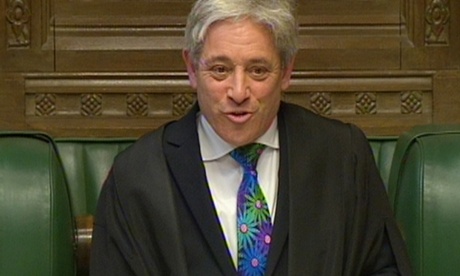
In the Commons yesterday Alex Salmond, the former Scottish first minister, urged John Bercow, the Speaker, to consider whether the government had the right to go ahead with its plans for English votes for English laws (Evel). Ministers want to achieve this by changing the Commons’ rules of procedure. Salmond said this would “breach the fundamental principle that all members of the House are equal”.
Bercow agreed to consider the matter, and this morning he gave Salmond his reply. Essentially he said there was nothing much he could do about this. It was for the House to decide what its own procedural rules were, he said.
While it is certainly an important responsibility of the chair to ensure that members are treated fairly and impartially in accordance with the rules of the House, this does not limit the power of the House to determine its own rules and procedures.
As he prepares to lay the Scotland Bill before the Commons today, the new Scottish Secretary David Mundell has told the Good Morning Scotland programme on BBC Radio Scotland that the SNP must show the impact on the rest of the UK of any amendments they bring forward.
He insisted there would be the opportunity for “extensive debate” of the bill, which could become law as soon as February 2016, including by “our new MPs from Scotland”.
The SNP have argued that their landslide victory in the general election gave them a mandate for powers greater than those recommended by the Smith Commission.
Mundell responded:
The clear message that I got during the general election was the the SNP MPs were going to be a voice for Scotland; that they were coming to the Westminster parliament to make sure we delivered on our commitments to extra powers. We are delivering. This is one of the first bills that is coming forward and it is going to be a very significant part of parliament’s deliberations over the next few weeks, it meets the Smith Commission criteria, it’s going to make very substantial changes to the Scottish parliament and to the ability of the Scottish government to shape policy and we’re getting on with it.
Yesterday, Mundell suggested that the bill would be law in time for the Holyrood elections next year because Scottish Tory leader Ruth Davidson “wants to make the case for lower taxes in Scotland, (and) parties need to be able to make the case based on the powers they know are going to be available”.
Philip Hammond suggests EU renegotiation could conclude early next year
At one point in his Today programme Philip Hammond, the foreign secretary, said it would be wrong for people to “speculate” on the idea that the EU referendum could be held “early” (which means in 2016). But sometimes it is best to ignore comments like this, and speculate away merrily, because elsewhere in what was a rather informative interview - for a politician, Hammond scores well for his willingness to actually answer questions - he suggested that the EU renegotiation could be done and dusted by early next year.
Here are the key points from his Today interview, and from others he has given this morning.
-
Hammond suggested that David Cameron’s EU renegotiation could conclude early next year. He said:
We are very confident that over the course of the summer, and perhaps onwards through the winter, we will be able to negotiate a substantial package of reform which will address the concerns that the British people have and that the prime minister has articulated.
Later in the interview, when asked directly whether the EU referendum could he held in 2016, Hammond said “possibly” and that this had not been ruled out. But he then went on to play down speculation about an early referendum. It was important to get it right, he stressed.
I would urge people not to speculate on an early date. We are absolutely clear that we have to get this right. We are certainly not going to trade substantive reform just for getting it done quickly. We have to get this done properly. We are asking the British people to make a long-term decision about Britain’s future ... and it is absolutely essential that we get the package right.
- He said Britain wanted “a substantial package of change”.
-
He said that some of the changes the government wanted to achieve would require changes to the EU treaties “to make them irreversible and substantive, and make them proof against challenge in the European courts”. He explained.
The advice we’re getting is that we will need treaty change in order to underpin particularly the changes on migration and welfare benefits. That is the best legal advice that we are receiving. But we are just at the early stage of negotiation.
But many of the other changes would not require treaty change, he said. This issue is significant because insisting on treaty change significantly complicates the renegotiation because some EU states require treaty changes to be agreed by referendum.
-
He said that, if Britain did not get the changes it wanted, Britain would vote to leave the EU.
We have a clear set of requirements, and the prime minister is very clear in dealing with European Union counterparts that if we are not able to deliver on these big areas of concern that the British people have, we will not win the referendum when it comes.
- He said he expected some other EU countries to adopt a “hardline” stance at the start of negotiations.
- He said the government would not be giving a “running commentary” on the renegotiation.
-
He said most of the proposed reforms would benefit the whole of the EU.
A large part of our agenda is about reform that will be good for all 28 countries of the EU; making it more competitive; making it more outward-looking; making it more focused on how to hold our own in a global economy; making sure that the whole of the European Union can create the jobs, the economic growth, the prosperity that we need. These are agendas that matter to everybody across the European Union – making the institutions more accountable to the people of the European Union.
But we’ve also got some issues that are specific to Britain. Because we are not in the euro and will never be in the euro, we need changes to the structural arrangements to make sure that Britain as a non-eurozone country is treated fairly, that the eurozone countries aren’t able to ride roughshod over our interests.
Hammond said this last issue was very technical, but was one of the most important issues in the renegotiation.
- He said there was something “deeply wrong at the heart of Fifa” and that the problems in the organisation needed to be resolved.

Updated
David Cameron is starting a two-day tour of EU capitals today, during which he will be trying to drum up support for his EU renegotiation agenda. He is also publishing the EU referendum bill, and Number 10 has already published the question that will be on the ballot paper:
Should the United Kingdom remain a member of the European Union?
Nigel Farage, the Ukip leader, suggests this is biased.
That Cameron is opting to give pro-EU side the positive 'Yes' suggests strongly that his negotiations are so much fudge.
— Nigel Farage (@Nigel_Farage) May 28, 2015
Cameron has already decided which way he wants the answer to be given in #EURef without a single power repatriated
— Nigel Farage (@Nigel_Farage) May 28, 2015
Farage has set out his objections in more detail here.
Philip Hammond, the foreign secretary, has been giving interviews this morning about the EU renegotiation. He has just told the Today programme that Britain does think this will involve treaty change. I will post more from his interviews shortly.
Here is the diary for the day.
9.30am: Chris Grayling, the leader of the Commons, makes a business statement when the Commons meets before MPs go on to debate home affairs in the Queen’s speech debate.
9.30am: The department for energy and climate change publishes fuel poverty figure.
Morning: The Scotland bill and the EU referendum bill are due to be published.
12.15pm: David Cameron holds a meeting with the Dutch prime minister, Mark Rutte, at the start of his two-day tour of EU capitals.
As usual I will be covering the breaking political news as it happens, as well as bringing you the best reaction, comment and analysis from the web. I will post a summary at lunchtime and another in the afternoon.
If you want to follow me on Twitter, I’m on @AndrewSparrow
Updated