The number of people infected with the novel coronavirus in areas far from Japan's major metropolitan centers has been increasing rapidly since mid-March. Miyagi, Yamagata, Ehime and other local governments have declared their own states of emergency, but pressure on their medical systems is intensifying. There is a growing sense of alarm in many parts of the country, with Ehime Gov. Tokihiro Nakamura saying, "We have entered the fourth wave."
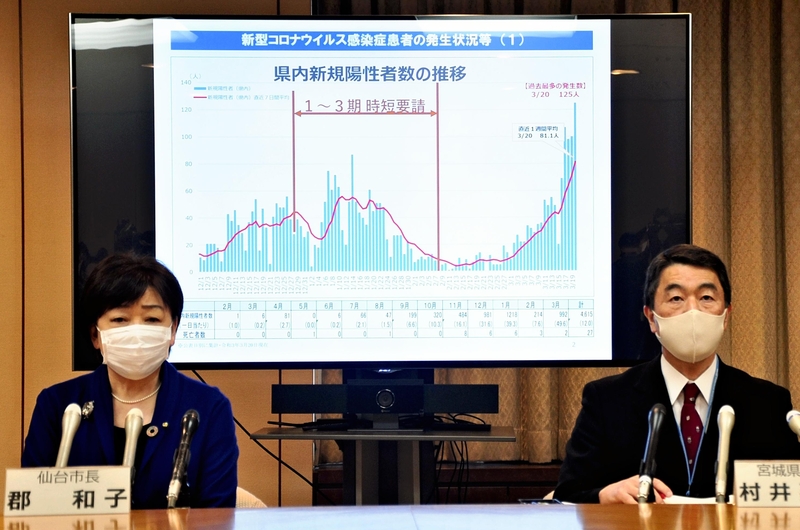
According to the Health, Labor and Welfare Ministry, the number of new infections per 100,000 people in Miyagi Prefecture in the seven-day period from March 19 to 25 rose to 36.08, far higher than the rates of 16.08 in Tokyo and 13.63 in Osaka.
In Miyagi Prefecture, the situation has reached Stage 4, the most serious level, according to several indicators including the number of people receiving treatment and those infected. The hospital bed occupancy rate as of March 23 was 33.9%, which was more than 16 points higher than in the previous week.
The prefecture resumed participation in the central government's "Go To Eat" restaurant support campaign on Feb. 23 for the first time in about two months, but infections spread rapidly in March, and the campaign was suspended again on March 16. Miyagi Prefecture and its capital Sendai declared their own states of emergency on March 18, and about 10,000 restaurants and other establishments have been requested to shorten their business hours since Thursday.
Toshio Nakagawa, chairman of the Japan Medical Association, commented on the situation in Miyagi Prefecture, saying, "The lifting of the request for shorter hours by the city of Sendai on Feb. 8 and the resumption of the 'Go To Eat' campaign are probably factors." He added, "We must learn the lesson that a little slack can cause this many infections."
In the neighboring prefecture of Yamagata, the weekly number of infections per 100,000 people has reached 16.6. Both the prefectural and the Yamagata City governments have begun requesting shorter hours. Yamagata Gov. Mieko Yoshimura said, "In many families, three generations live together, and we must stop the spread of the virus from the young to the elderly."
In Ehime Prefecture, the daily number of newly infected people had been hovering between 0 and 4 since late February, but the number jumped to 23 on March 23, and reached a record high of 59 on Thursday. This was due to the outbreak of a "downtown cluster" that spanned multiple restaurants in prefectural capital Matsuyama, with the number of related infections totaling 160.
A coronavirus variant has been identified in more than 20 of the 160 cases. Nakamura expressed a sense of crisis Sunday, saying, "The next one or two weeks will be crucial to see if the situation can be brought under control."
In Okinawa Prefecture, the weekly number of infections per 100,000 people has risen to 25.6. According to the prefectural government, the number of infections related to restaurants has been increasing, especially in prefectural capital Naha, and the rapid spread of the virus among young people is believed to be a factor.
Read more from The Japan News at https://japannews.yomiuri.co.jp/