KYOTO -- With Japan gearing up to host the 2019 Rugby World Cup, fans' attention has been drawn to the Tadasu no Mori grove in Kyoto, believed to be the birthplace of rugby in the Kansai region.
The rugby World Cup is known as one of the world's three major sporting events, along with the soccer World Cup and Summer Olympic Games.
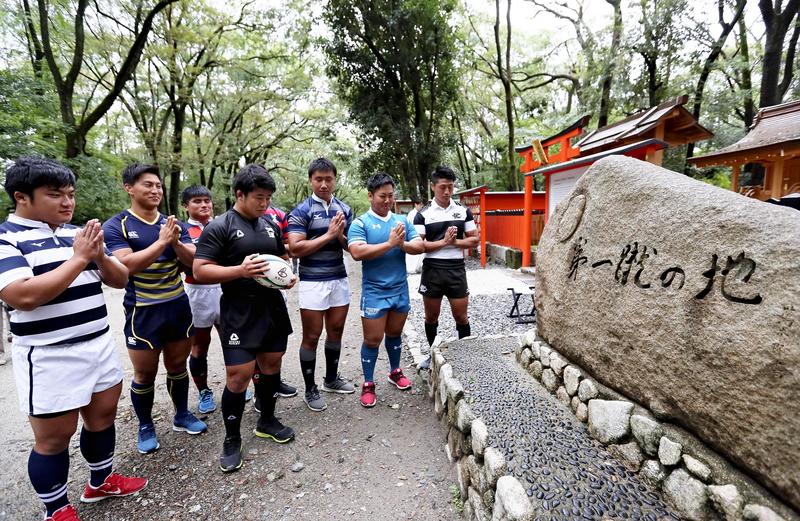
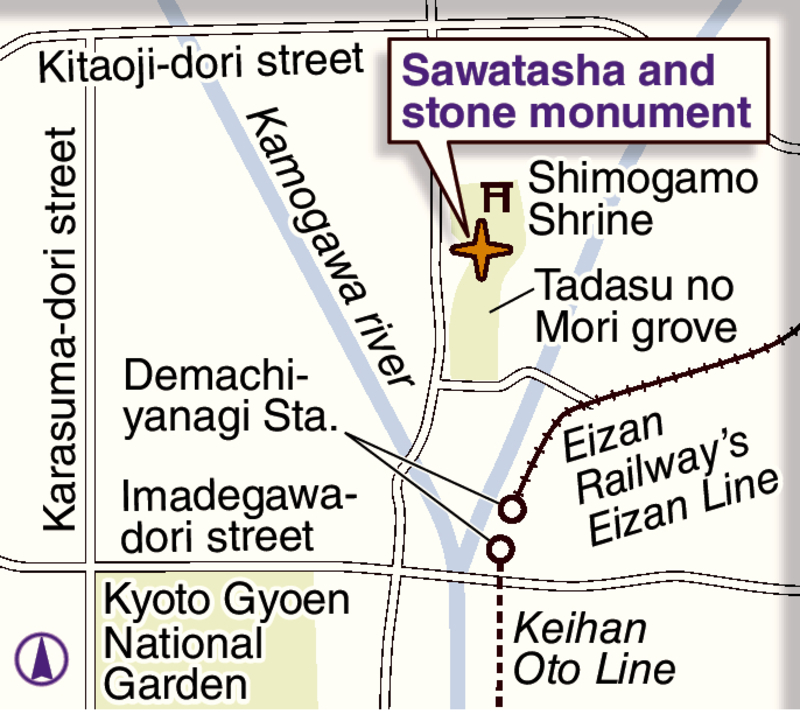
The Tadasu no Mori grove is located in the precincts of Shimogamo Shrine, a UNESCO World Heritage site in Kyoto. In the grove, there is a stone monument in front of the Sawatasha small sub-shrine of Shimogamo Shrine, commemorating the first time rugby was played in the Kansai region.
The characters for "Daiisshu no Chi" (Place of the first rugby game) are engraved on the stone.
Draw for group placements
A yabusame horseback archery event is held annually in the riding grounds of Shimogamo Shrine, as one of the pre-ritual events for the Aoi Matsuri festival in Kyoto. The stone monument stands quietly to the west of the riding grounds.
The history of rugby in the nation is believed to date back to 1899, when Keio Gijuku, the current Keio University, launched the nation's oldest rugby club.
About 10 years later on Sept. 10, 1910, students of Third High School under the old educational system (now Kyoto University's Faculty of Integrated Human Studies and others) learned rugby from Keio Gijuku students at the riding grounds, where there was said to have been turf grass.
On this occasion, a rugby club was launched at Third High School as the first rugby club in the Kansai region. After that, rugby spread rapidly to schools including Doshisha University and Kyoto First Junior High School (the present Rakuhoku High School).
Later, people who were involved in the sport in Kyoto worked to establish rugby clubs at Waseda University, the University of Tokyo and others in the Kanto region.
The event in which the oval ball was used at Shimogamo Shrine created the opportunity to develop rugby in the nation.
The stone monument was set up in October 1969 by people involved in the sport. However, even present-day rugby enthusiasts did not know that this was a "sacred place" for the sport. That became known thanks to Yoshihiro Sakata, 76, chairman of the Kansai Rugby Football Union.
Sakata lives near Shimogamo Shrine and he studied at Rakuhoku High School and then Doshisha University. He became a member of the Japan national team, and later a successful player in New Zealand, the powerhouse of rugby.
In 2012, Sakata was enshrined in the Hall of Fame of the International Rugby Board, the present World Rugby, the international governing body for rugby. "Most people didn't know [about the sacred place]," he said.
Sakata had an opportunity in 2016 to inform them. That year, it was decided that the drawing ceremony for the 2019 Rugby World Cup in Japan would be held in Kyoto. Sakata then made a plan to invite World Cup officials to Shimogamo Shrine.
His efforts at home and abroad bore fruit, and World Cup representatives and coaches from participating nations experienced the ancient ball game of kemari and visited the shrine to receive oharai purification on May 10, 2017, the day before the drawing ceremony.
"The chairman of World Rugby said it was good that [the drawing] was held in Kyoto, as [attendees] could learn something about Japanese culture. The plan was a complete success," Sakata said.
Shikinen Sengu ceremonies
Shimogamo Shrine conducts a series of Shikinen Sengu ceremonies to reconstruct its buildings once every 21 years, with the latest occurring at almost the same time as the drawing for the World Rugby Cup. The coincidence helped the shrine become widely known to many people.
As part of operations related to Shikinen Sengu in 2015, the shrine decided to rebuild the Sawatasha sub-shrine, which is sacred to the Kantama-no-mikoto god of ball games.
Sawatasha used to be located around the area where the stone monument is now, but was dismantled by the end of the mid-1950s due to age. When the drawing was held, the building of the sub-shrine was a temporary one. After the construction of the new building was completed, the Senzasai festival to transfer the object of worship was held in November 2017.
In September this year, before league matches for the top-division rugby teams of Kansai universities, captains from participating schools offered prayers in front of the stone monument and vowed to make their best efforts.
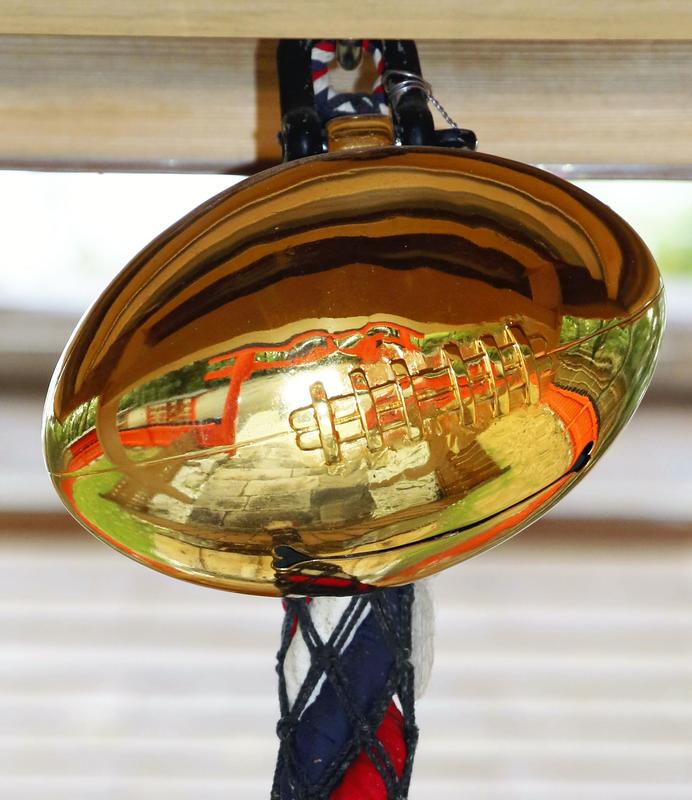
Sawatasha's ema votive wooden tablets and the bell attached to the shrine are shaped like a rugby ball. Many of the ema tablets on the premises contain written wishes for success in rugby games, from children to university students and people who are involved in the Top League in Japan. There are also wishes from rugby fans asking for "success in the World Cup."
An association to honor Daiisshu no Chi was launched to pass on the history and tradition of the sacred place to future generations. The office of the association was established in Shimogamo Shrine.
As part of its youth education efforts, the association has started organizing a tag rugby competition since autumn last year. The sport replaces tackling with removing a tag from the waist of the opposing team's players.
"Even after the end of the World Cup, it's not the end [of this place.] We want people to see this place and learn [our] thoughts, and we hope [this place] can contribute to improving the culture," said Hiroki Kyojo, 39, priest of Shimogamo Shrine.
It has been 108 years since rugby was first played in the Kansai region near the shrine that enshrines the god of ball games.
Daiisshu no Chi was known only to a few, but now it is familiar to many people following a series of coincidental events -- the reconstruction of Sawatasha on the occasion of Shikinen Sengu, and the drawing for the World Cup, among others.
"In both name and reality, the god of rugby has been revived. A variety of conditions came together nicely to create this success," Sakata said. "We wouldn't be where we are if they happened 10 years ago or 10 years later."
Many rugby fans from all over the world are expected to visit this place when they come to Japan for World Cup rugby matches in September next year.
Access
The "Daiisshu no Chi" stone monument and Sawatasha sub-shrine are located in the Tadasu no Mori grove in the precincts of UNESCO World Heritage site Shimogamo Shrine in Kyoto. It is about 10 minutes' walk from Demachiyanagi Station on the Keihan Oto Line. There are bus services from JR Kyoto Station, Kita-Oji Station on the Karasuma Line, and Kawaramachi Station on the Kyoto Line of the Hankyu Railway. Take a Kyoto city bus at one of these stations and get off at the Shimogamo Jinjamae or Tadasu no Mori bus stop.
Read more from The Japan News at https://japannews.yomiuri.co.jp/