Zenchiku Tomitaro, a kyogen performer of the Okura school known for promoting the art in different ways, died of blood poisoning caused by infection with the novel coronavirus on April 30, at the age of just 40. His death came only three weeks after he was hospitalized.
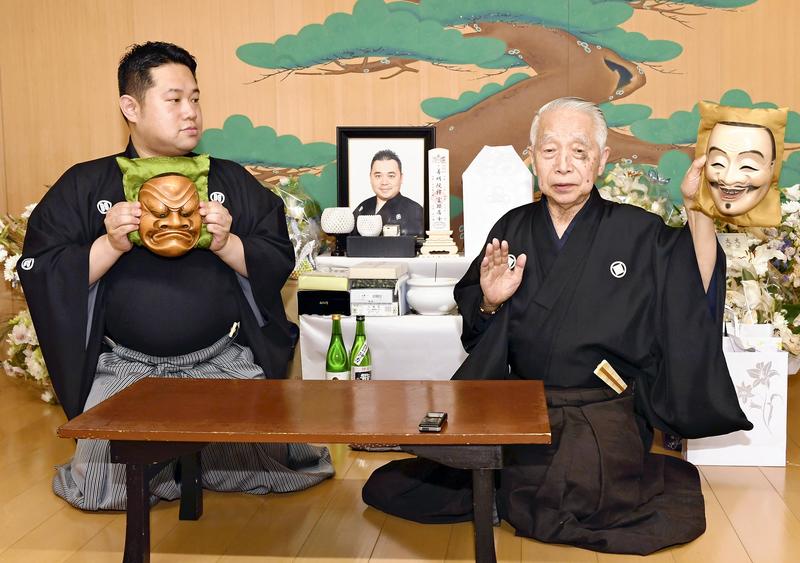
To prevent the virus from spreading, his family was unable to be with Tomitaro as he fought the disease, and even his funeral could not be held normally. His 75-year-old father, Juro, and his brother, Daijiro, 38, who are also kyogen performers, both expressed the sentiment that his death does not feel real to them.
Tomitaro's great-grandfather is the late Zenchiku Yagoro, who became the first living national treasure of the kyogen world. Tomitaro, whose real name is Tomitaro Shigeyama, began practicing kyogen at the age of 3 and made his debut at 5 by playing the role of a small monkey in the "Utsubozaru" program. Throughout his career, he performed the classical comic performing art by taking advantage of his dynamic acting and powerful voice. Yet he also initiated a baroque opera program that combined kyogen and opera, and put his efforts into philanthropic activities such as by teaching kyogen to children with leukemia overseas.
The three family members performed together at times. They had put on a show at a junior high school hall in Tokyo only in February.
-- Sudden change
On the evening of April 9, Tomitaro, who had been complaining of health problems for several days, rapidly become pale and breathless at his office in Tokyo. When Juro spoke to him he did not respond, and he was taken by ambulance to the Japanese Red Cross Medical Center in Shibuya Ward, Tokyo, where he was admitted to an intensive care unit. On April 13, his family was informed that he was infected with the virus.
To prevent the infection from spreading, his family members were unable to visit him at the hospital. They could only confirm his condition by speaking to nurses over the phone. About 10 days after he was hospitalized, Tomitaro was connected to a life support machine called extracorporeal membrane oxygenation (ECMO), which is used for seriously ill patients, but his heart rate began dropping sharply after noon on April 30.
Juro, Daijiro and others rushed to the hospital and "met" with Tomitaro at the ICU through a tablet. He was unconscious, but Juro recalled, "With his beard shaved and hair washed, he looked calm."
As Juro has a high risk of developing serious symptoms if infected, only Daijiro saw his brother's last moments through the ICU window. Tomitaro's heart rate became zero. While the doctor was checking his pupils, Daijiro joined his hands in prayer, pushing down his desire to get close to his brother.
"I told myself, I must never get infected with the virus as I've been entrusted with a mission from my brother," Daijiro said.
-- Direct to crematorium
On May 5, Tomitaro's body was taken directly to a crematorium from the hospital. He was cremated after 5 p.m., as the cremation of deceased people who were not infected with the virus had to finish first. Daijiro visited the crematorium alone and received his brother's ashes in a parking lot. Two days later, a funeral was held at a temple near his home with only his family members participating.
"If we had been able to hold an ordinary funeral for him, we could accept the reality. But I can't feel his death is real," Juro said.
"Tomitaro was sociable and charming. I was looking forward to his future," he added, looking sadly at a portrait of his son.
"I'm determined to move on with the memories of my brother who always pursued new ways of presenting kyogen," Daijiro said. "I hate the coronavirus. To prevent more people from suffering similar hardships, I want everyone to unite in bringing the pandemic under control."
Read more from The Japan News at https://japannews.yomiuri.co.jp/