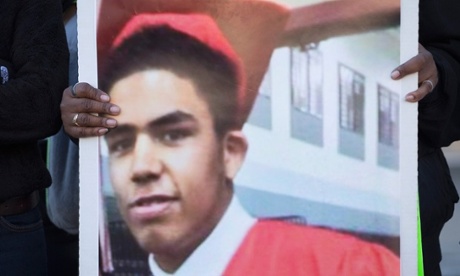
The family of a young unarmed man shot dead by a Madison, Wisconsin, police officer in March have called for calm as the authorities plan a Tuesday press conference to announce whether the officer who shot him will face criminal charges.
Tony Robinson’s uncle, Turin Carter, said the family has tempered its expectations of an indictment ahead of Tuesday’s announcement by Dane County district attorney Ismael Ozanne.
“We’re still hopeful that an indictment will be made, but we’re prepared for anything,” he told the Guardian. He distanced the family from one group’s call to protest after Ozanne’s press conference on Tuesday.
Robinson, a biracial youth, was shot on 6 March by a white Madison police officer, Matt Kenny, who was responding to 911 calls about someone jumping in and out of traffic and allegedly assaulting two people. A Guardian investigation into Robinson’s death revealed he was under the influence of hallucinogenic drugs at the time he was shot and that at least one 911 call made was from a friend asking the police for assistance.
Carter said the biracial youth’s mother, Andrea Irwin, had suffered since learning on Sunday – Mother’s Day in the US – that Ozanne would announce his findings this week. “My sister is pretty much inconsolable right now,” he said. “It’s very upsetting that that sort of thing would be done on such a meaningful day.”
In the weeks since the shooting, Robinson’s family has repeatedly called for peaceful protests.
Carter said that the information that has been released about Robinson, such as his criminal record for a home invasion and a 911 call his mother made in January out of concern for her son, temper the family’s expectations.
“First and foremost, we’d like a sense of transparency via body cameras or just overall transparency in legislation that allows people to have more of a rapport or more trust in what the police are doing. It seems as though it’s more so an us versus them where we’re afraid to walk the streets because the people who are supposed to be protecting us are abusing that power,” Carter said.
The shooting polarized Madisonians and prompted a week of protests led by the Young, Gifted and Black Coalition [YGBC], a local grassroots campaign group. The Wisconsin state capital was thrust into the national spotlight as Robinson’s death marked the latest in a line of high-profile police killings of unarmed people of color.
Dane County has some of the worst racial disparities in the country, ranking third in a study by the Justice Policy Institute for racial inequality in drug-related incarceration. Wisconsin has the highest incarceration rate of black men in the United States, according to 2010 census data.
Speaking with the Guardian on Monday, Carter described the US supreme court case Graham v Connor, which set the legal precedent that allows an officer to determine when lethal force is warranted if that officer feels their life is in danger. “It seems the only time the police are part of the minority community is when things are going wrong. So they are associated with that lack of trust, and a chasm develops as a result.”
Madison’s YGBC, which has been pushing to eliminate the racial disparities in the city’s criminal justice system, has called for a protest on the morning after the district attorney’s decision. Carter distanced the family from the action, however, saying that the group is not acting on their behalf.
The conversation about changing use-of-force standards has occupied the front pages of major newspapers in recent weeks. But Madison’s chief of police, Mike Koval, published a blog post on 28 April arguing that the city should not change its policy. Given the tensions around the Robinson case, some viewed this as impolitic.
The former Madison police chief Noble Wray told the Guardian in a March interview, that policing issues come and go from the headlines. He acknowledged that while many reforms sprang out of the unrest in Los Angeles after the Rodney King verdict, post-9/11, racial profiling issues dropped out of sight. “There’s still a communication gap, not only here, but nationally, and unless we are able to address the communication divide here, we’re not – as a country or as a community – going to be able to address this.”