Snapshot: My husband’s blind grandfather
This photograph of my late husband’s maternal grandparents, Mr and Mrs Edwin Joinson, of Coppenhall, Crewe, Cheshire, was taken some time between the first and second world wars. They are pictured standing in the gateway in front of their house in Reid Street, Crewe. Edwin, otherwise known as Teddy, was a master painter in Crewe Works, where he hand-painted the decorations on the locomotives that were built there.
During the second world war, the railings at the front of most houses were commandeered for the metal to help the war effort. The metal, they were told, was to be recycled for the manufacture of weapons and munitions.
However, the Joinsons were allowed to keep their gate as Teddy, who was blind by this time, used it to lean on while talking to passersby. He also used it as a guide post, so that, when he went for a walk, he would know when he had reached his own house again.
My husband recalled that, after his grandmother died, his grandfather came to live with him and his parents in Lincoln Street, occupying the front parlour. This room was in perpetual darkness, with the curtains always drawn as, due to his blindness, it made no difference to Teddy if it was light or dark.
Moragh Carter
Playlist: The night’s last dance at the women’s disco
I Will Always Love You by Whitney Houston
“If I should stay / I would only be in your way / So I’ll go, but I know / I’ll think of you every step of the way”
“It’s about losing someone you love, you know!” she would tell me, as I pressed in closer.
I didn’t care. At 40, I’d discovered the joy of lesbian life and the monthly women’s discos routinely played Whitney Houston’s I Will Always Love You for the last dance.
I was in love – a love I knew wasn’t reciprocated and would stay unrequited – but, as a reward for my unquestioning adoration, I would be given the last dance by the object of my affections.
Our middle-aged bodies slotted in well and I felt happy and at peace for those few minutes. The difficulties at home – small children and a loving, but confused husband – faded and I would glory in the utter joy of the pleasure of those moments. I had hard decisions to make, and much of my time was spent in utter confusion myself.
But on the crowded dance floor, surrounded by women loving women, my dance partner would laugh as I relaxed in against her and breathed in her musky scent. It all felt so utterly right.
It seems a long time ago that I took my boys and left. They grew up straight and tall, and my civil partner and I now have four grandchildren. I still love my dance partner, but as a good, loyal friend. We go back a long way, it seems, since those heady days. But if I hear Whitney Houston singing the theme tune from The Bodyguard, my knees will buckle slightly and my tummy churn a tad when I think back to those agonising, exhilarating last dances some 20 years ago.
Maybe it was all about losing someone you love after all, but what a way to go!
Penny
We love to eat: Ngoh hiang from Dad’s home town
Ingredients
500g tenderloin pork, minced
500g fresh tofu
175g (drained weight) water chestnuts, coarsely minced
12 spring onions, thinly sliced
4 tbsp potato flour
3 eggs
3 tsp thin soy sauce
3 tbsp oyster sauce
5 tsp shaoxing wine or medium dry sherry
2 tsp sesame oil
2 tsp five-spice powder
2x75g packets dried bean curd sheets
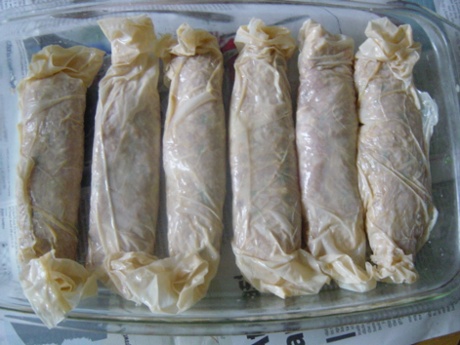
Mix all the ingredients together, squeezing in the tofu block with your hands. Give the mixture a good stir with a wooden spoon. Use fresh tofu, which has a different texture from long-life, and drain it thoroughly.
Finally, the wrap: bean curd sheets look as if they might tear but are actually pretty robust and waterproof. Tip: cut into seven inch (18cm) squares before soaking, rather than cutting them after soaking. They turn soft on contact with water.
Now for the fun family part. Take a sheet of bean curd, lay the pork and tofu filling on the sheet and roll it tight. Flatten the roll slightly, leaving the ends open. Steam in batches for 10 minutes each. Cut across into half-inch pieces. Enjoy.
My dad was the best cook in the world; my mum was dreadful. I like to think I take after Dad, who did the cooking on special days, while my mum was stuck with the daily grind.
The recipes were all in Dad’s head and he always got it just right. He enjoyed cooking; you could see the smile on his face and his relaxed manner as he went about creating luxurious dishes. He didn’t take it too seriously, but he was a performer and his children loved helping out.
The dish I remember most from his myriad repertoire, ngoh hiang, originates from his home town of Teochew in Guangdong, China. Ngoh hiang translates as five-spice powder and it is a roll of the ingredients listed above rolled in bean curd sheet, including a larger quantity of five-spice powder than you would normally use, hence the dish’s name. The Teochew version is steamed rather than deep fried. Steamed ngoh hiangs are impossible to find outside the home because they have to be eaten hot off the steamer and are not good reheated. It’s really an endangered dish.
I have adapted my father’s recipe slightly to reflect healthier times. Instead of pork belly, I use tenderloin, which may be expensive but is easy to mince. I mince my own pork as I do not trust what goes into mince in the supermarkets.
Dad used fresh water chestnuts. Water chestnuts are delicious fresh, but they are murder to skin. Get a large tin and chop them coarsely rather than using a food processor. Chopping water chestnuts is child-friendly and therapeutic. It is a rather special vegetable in that it retains its crunch after cooking, giving ngoh hiang its unique texture.
If you can, try to get young spring onions, as supermarkets sell the old, tough variety. Otherwise, remove about four layers to get to the young tender stem. Slice thinly into rounds.
Invest in a good bottle of oyster sauce. It adds umami that its substitute, sugar and salt, lacks.
Kar Tiang Dunlop
We’d love to hear your stories
We will pay £25 for every Letter to, Playlist, Snapshot or We love to eat we publish. Write to Family Life, The Guardian, Kings Place, 90 York Way, London N1 9GU or email family@theguardian.com. Please include your address and phone number