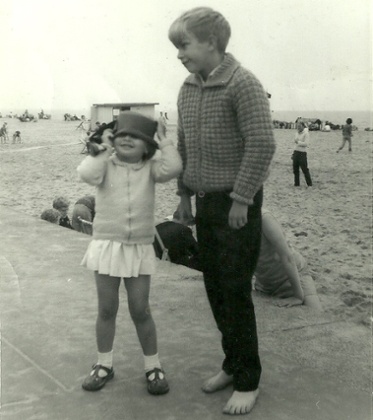
Snapshot: My hat trick and my brother’s stink bomb
Even now, I could take you to the exact spot in Great Yarmouth where this photograph was taken in 1971. Our widowed mum saved hard so that my brother and I could enjoy the same holiday every August. I was dosed up with Kwells travel sickness tablets and we boarded a Morley’s coach from Mildenhall market place for a week by the sea. Just after Norwich, I started to turn green and Mum’s chant began: “We’re on the Acle Straight, hold on, we’re nearly there, hold on … ” Sometimes I managed to suppress my nausea; often I didn’t.
We left our cases at Mr & Mrs Wilkinson’s guest house on the seafront and Mum marched half a dozen paces on to the beach. She indicated to Reg, the deckchair man, where he should place two stripey deckchairs – one for her, one for Grahame, my brother. Our spot was just to the left of Britannia Pier where we could hear the squeals of excitement from the Joyland rides. My brother knocked over my sandcastles and together we raced to the ice-cream kiosk with a shiny new 50p coin. Sometimes, if Mum was feeling flush, we were allowed to have 99s.
She knitted me this white zip-up sweater and I felt so grown-up because it was the same as my big brother’s. I desperately wanted to impress him. On this occasion, my hat trick failed to make him laugh. In the joke shop just off the promenade, Grahame spent his pocket money on false moustaches and silly glasses. One year he bought some funny perfume that smelled of rotten eggs. Unlike Grahame, Mum didn’t find it hilarious. She was horrified when he spilt some on the bedspread in our room. No matter how hard she tried, she couldn’t get rid of the stink. She was so embarrassed that we never went back. That was the end of our annual summer holiday.
Gill Powell
Playlist: Song that took care of me as a student nurse
Bridge Over Troubled Water by Simon and Garfunkel
“When you’re weary, feeling small, when tears are in your eyes I will dry them all / I’m on your side”
Born into a poor Welsh family in 1911, my mother had few choices in her working life. As her only daughter, she was delighted that I had options. She and Dad were incredibly supportive when I decided that I wanted to be a nurse, to do something useful with my life. But now I wasn’t so certain.
It was early 1969. I was a 19-year-old student nurse at the Queen Elizabeth hospital in Birmingham, struggling with “junior nights”. I was finding sleeping during the day difficult and eating at night almost impossible. But how could I let my parents down by opting out now?
While the senior nurse was on her lunch break I would be left in charge of 30 cardiac patients, then at 1.15am it was my three quarters of an hour turn. A tunnel under the road led to a dining room in the basement of the nurses’ home where our meal was served and we would sit shivering and yawning, wrapped in our cloaks, until it was time to go back to the ward.
One night I couldn’t face the dining room and crept up to my room instead. It was on the fourth floor of the nurses’ home and the lift was turned off at midnight; I remember my footsteps echoing on the stairs. I let myself in but couldn’t risk sitting on the bed. I stood by the window and looked out on to the darkened world beneath.
On the chest of drawers next to me was my Dansette record player, a Christmas present from my parents they could really not afford. In all the rooms, students were sleeping but, with the volume turned right down, I put on Simon and Garfunkel and lifted the needle on to my favourite track, Bridge Over Troubled Water. As I stood listening, snow began to fall outside the window, slowly at first and then tumbling out of the sky and blanketing everything below.
That night it was as if they had caught my mood, as if they were singing just for me. I played the track again and again until 1.55am; time to go back. But for the remainder of that rota I went up to my room every lunch break and listened to that song. It got me through that low patch in my training.
Two years later, my parents were there at the great hall in the university when, as the joint silver medallist, I gave a vote of thanks on behalf of my peers at the presentation of awards ceremony; I thanked our tutors, the clinical staff who had supported us and, most of all, our families for their help and encouragement. But at the forefront of my mind then, and for the subsequent 40 years of my nursing career, was the conviction that, had it not been for that song, things could have worked out very differently.
Gill Garrett
We love to eat: Raspberry flop with our garden fruit
Ingredients
About half a pound (225g) of raspberries
225g of sieved icing sugar
Juice of half a lemon
A pint of double cream, whipped
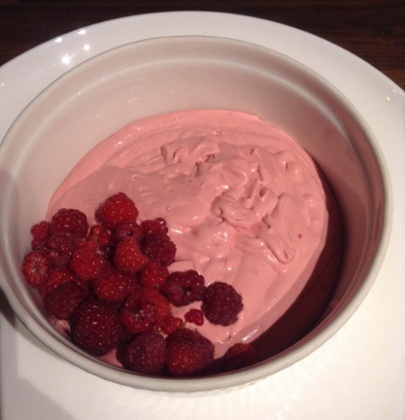
Blend the raspberries and mash them through a sieve so you have a nice red gloop. Mix this with the lemon juice and icing sugar (more or less sugar, according to taste). Fold in the cream, whipped quite firmly, until you have a magnificent sloppy pink trembling bowl of loveliness. Eat with a few raspberries on the side.
I make this for my family every summer when we have a glut of raspberries from the garden. It never had a name until last year when my daughter said, “Can we have raspberry flop?” It’s the perfect name, as when you don’t eat it all and there is some left for the following day, the raspberries separate and it goes even floppier. All you have to do is mix it again, but some of the air is lost and it will not be quite as light.
There isn’t usually any left, though.
Adrienne Watson
We’d love to hear your stories
We will pay £25 for every Letter to, Playlist, Snapshot or We love to eat we publish. Write to Family Life, The Guardian, Kings Place, 90 York Way, London N1 9GU or email family@theguardian.com. Please include your address and phone number