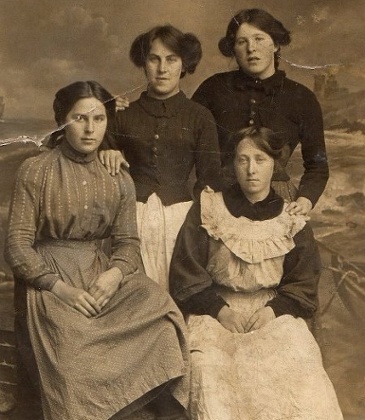
Snapshot: Four hardworking fisher lassies
This photograph was taken sometime before the start of the first world war. I am not sure just when or where but it was commonplace for the girls who followed the fishing fleet as gutters and packers, to dress up and get their photos taken to send home.
The girl on the far left is my granny, Mary Ann Macleman as she was then. Sitting next to her is my great-aunt, also Mary but a Patience. Behind my granny is her first cousin, another Mary, Mary Reid.
Mary Patience was to become her sister-in-law twice over, for my granny married her brother Willie Dan and Mary P married my granny’s brother Hugh. So a brother and a sister married a brother and a sister.
I do not know if either of them was courting when this photo was taken but I have a feeling that they were and the photo was taken to show to both families that there were already links.
I was called after my granny, following the tradition of the time of calling the first grandchild after the father’s parent. I am the only one of her grandchildren to bear her name and for her that was extremely important. As a result, she spoiled me rotten.
My granny was, like a lot of her contemporaries, a brilliant knitter and many a jumper did she make for me to mark the start of the new school year, knitted using no pattern but guessing the size by looking at me.
My granny, like many then, left school at 12 or 13 and went into service or fishing. However hard this life was, going to places like Orkney, Ireland, Whitby or Yarmouth, I like to think it gave them freedom from the restrictions of family life in our wee village. They could meet lads from different places, spend their spare pennies on fancy ornaments and, like all young people, have a great laugh away from their stern Presbyterian grannies back home.
My granny and her contemporaries went on to raise families and run their homes more or less single-handedly while their husbands went to sea, giving me and many of my friends strong female role models to follow. I am very proud of her.
Maryanne Patience
Playlist: Dancing with my sister to P5 in Tokyo
The Night is Still Young by Pizzicato Five
“Tokyo wa yoru no shichi ji / Honto ni aishiteru no ni / Yeah yeah yeah oooh”
Trans: “Tokyo at 7 in the evening / I really love you / Yeah yeah yeah oooh”
My younger, cooler sister had introduced me to Pizzicato Five. She liked them because she was with it – I liked them because they were Japanese. I had read Mishima and listened to Ryuichi Sakamoto. I dreamed of going to a place whose streets I couldn’t imagine.
My sister didn’t so much dream as get out and do things. In her 20s, she took her rucksack and mix tapes and travelled the world. Then, as if to rub it in, she settled in Australia. Eventually I found the ennui of staring at wood-chip walls in terraced houses less than fulfilling. At 30, I dragged myself forward and left Scotland. I posted myself my newly printed Tefl certificate to Tokyo City.
The schools I worked in were mainly in the suburbs, as was my new home. Most days I would work till 9pm or 10pm and slump back to my apartment in the alcohol-scented trains they put on. On Saturday, I worked in Shibuya. I passed statue of Hachiko the dog and crossed at the confluence of millions.
When my sister heard, she let me know that I had arrived. “Living the Pizzicato dream,” she said. I had a feeling she wanted to visit.
Finally, one spring, she did. On Saturdays, I finished work at 5pm. We met at a wooden shack of a bar on Dogenzaka, the area famous for love hotels and sleaze. My colleagues and I had been going there every weekend, trying to get the long-haired DJ to play something a little more recent than Janice Joplin.
But that day was different. Was it my sister’s easy Aussie/Scottish charm or was it just the warm spring air? She asked for some Pizzicato and it came on. On the first bars, we stood as one and danced. The floor was ours. We had arrived in a place we didn’t come from. And we liked it.
My sister is now raising her family in Australia. I lived in Tokyo for 11 years, got married and had my son there. In the end I wanted to leave, but there was always a bit of me that kept loving the city and the freedom it had represented. I know this song is a love song and I imagine that it was written to a person, but to me it is a song about loving Tokyo. And it is about me and my sister, dancing in my city of dreams and pure owning that floor.
Alison Gray
We love to eat: Grandma’s slow-cooked chicken
Ingredients
One large chicken
One large onion (optional)
New potatoes
Veg or salad, according to taste
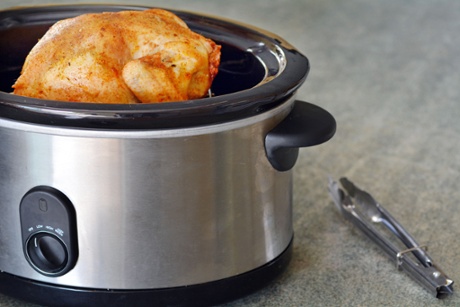
Place chicken stuffed with cooking onion if preferred in a slow cooker. I leave cooker on medium for six hours or high for four hours. Spend the next few hours pursuing whatever activity you want. When the chicken is cooked, remove from the cooker and put the potatoes and veg on to boil.
The chicken should just slide off the bone. Separate the best cuts from the little, less attractive pieces, which can be used for a curry or other dish the following day. All the bones and viscera are easily gathered and disposed of. I love this dish because of its simplicity, flavour and low cost.
I am of an age to remember chicken being an exceptional treat for Christmas or a special occasion. I remember Dad going to the local poultry market and carrying home on the bus a large chicken complete with head and feathers. It would be deposited in the kitchen sink for Mum to pluck and remove the innards. The final task would be to singe off any stubble left by the feathers.
After the war, as a child, I used to visit my grandmother in rural Cumbria. I would accompany Grandma on the short walk to the neighbouring farm, passing on the way a magnificent shire horse pulling the plough. Grandma would select a hen from the dozens running round the farmyard. While the formalities were taking place, I would slip into the milking parlour and watch the cows being milked. I knew that the next day the milk would be brought to the door in big milk churns on a horse-drawn cart, by the farmer’s wife. She would stop at each house and pour a measured amount into the jugs that had been left at the door.
After a little while, Grandma would collect me from the dairy and she would carry home the chicken while I, very carefully, carried a brown bag of new laid eggs. Those days are long gone but I still only buy free-range chicken and eggs, although, I’m very glad to have a modern slow cooker at my disposal.
Maureen Hughes
We’d love to hear your stories
We will pay £25 for every Letter to, Playlist, Snapshot or We love to eat we publish. Write to Family Life, The Guardian, Kings Place, 90 York Way, London N1 9GU or email family@theguardian.com. Please include your address and phone number