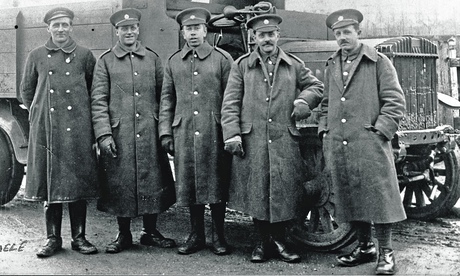
Snapshot: My grandfather and his army ambulance
In the summer of 1917, five young men from Ireland and north-west England arrive at Passchendaele, ready for “the big match at Wipers”. Soldiers of the Army Service Corps (ASC – “Ally Sloper’s Cavalry” – named after a newspaper cartoon of the time), they drove ambulances, evacuating the dead and injured from the front; or, in the words of my grandfather Michael Sieve (the spelling of the family name was later changed to Seeve), standing on the far right of the photograph, “putting the bits and bloody pieces back together again”.
Michael came to Flanders from his home in Limerick, Ireland, where his family had settled after fleeing from antisemitic pogroms in 19th-century Lithuania. He had grown up during the boycott of Limerick’s Jewish community, and work was hard to find. After a spell selling coal around the streets of Belfast, he volunteered for steady work with the British army. Saved from the frontline by his poor eyesight, Mike spent the war years aboard his ambulance, driving back and forth with its precious cargo of thousands of damaged and dying young men.
A quiet man, he spoke little of the war subsequently, except to damn the politicians and rulers who directed it. He left the army to settle in Liverpool, to marry and raise three sons. Kindly and placid, he suffered from his “nerves”, and getting work was always difficult. His wife Bluma, a migrant from prewar Russia and a full-time midwife, kept things afloat.
Meanwhile, Mike would take refuge in his card games, a quiet figure in the formal dress of the time, smoking his pipe and taking long walks along the dockside.
Little remains to us of Michael’s part in this calamitous time; an abiding family refusal to wear Field Marshal Haig’s blood-red poppies; a recollection of him softly singing a few lively verses from the popular battlefield song of the time, “Mademoiselle from Armentières, parlez-vous”; and the memory of a life lived humbly through the storms of the last century.
Natalie Seeve-McKenna
Playlist: Grandad Ian just knew I was ready for pop
The Day He Caught the Train by Ocean Colour Scene
“You and I should ride the coast / And wind up in our favourite coats just miles away”
I miss my grandad. He didn’t think he was old enough to be a grandparent, so we all called him Ian. He was solid, dependable and constant and I miss him a lot.
He has left me quite a musical legacy; he loved musicals and Seven Brides for Seven Brothers will always remind me of him. But it is a song that I’m not even sure that he knew that causes me to shed a tear.
At the start of the 1996 school holidays, I was dropped off at my grandparents’ house. Every year, I spent at least a week with them on my own and I loved it. This visit marked a minor milestone for me, I was no longer a child. This year, it wasn’t the single bed with the Peter Rabbit duvet cover; I unpacked in the big double guest room. I remember thinking that I had become a respected teenager.
Grandad was a man of action rather than words: he walked into the room with a massive radio/cassette player and a collection of extension leads, set it up next to the bed, tuned it in to Radio 1 and left me to it. Ocean Colour Scene had just released their new single and I sang along as I settled in. It was that summer that I discovered the joys of pop music. I loved Britpop and it was the soundtrack of my summer and the next few years.
I have many memories of Grandad but it is this very small gesture that always moves me. If this song comes on the radio, I will find a tear running down my cheek. How did he know that in this summer, I would love to listen to Radio 1? Did he ever realise what impact this small gesture had on me?
Louisa Tunstall
We love to eat: Homemade chocolate aeroplanes
Ingredients
Bourbon biscuits
KitKats
Liquorice allsorts
Cooking chocolate
I asked my children, Roxy and Riley, what they wanted for lunch.
“Chocolate aeroplanes,” said Riley.
“Aeroplanes?”
“Yes. Chocolate ones.”
“OK,” I said, absent-mindedly, having fallen into a hazy reverie about the many happy boyhood days I spent making model planes out of plastic and balsa wood. Surely there was something in the kitchen we could use?
We went to look on Mummy’s shelf in the cupboard (where all the good stuff is). We found bourbon biscuits, KitKats, liquorice allsorts and some cooking chocolate.
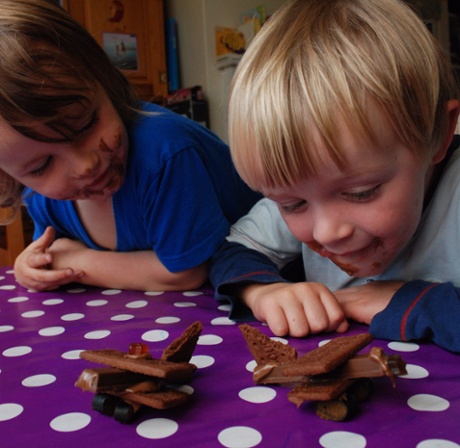
I gently separated the bourbons in half with a knife, cut the sticky stuff off the biscuit pieces and gave it to Roxy and Riley to dispose of. KitKat fingers formed the fuselages, and the bisected bourbons became the wings. Wheels, propellers and the pilots’ heads were made from liquorice allsorts, and the rear rudders from another carved-up biscuit. We used melted chocolate as glue.
And there they were: our homemade chocolate biplanes.
Roxy and Riley very much enjoyed the construction process and were far more helpful than usual when it came to tidying up the leftover bits. They flew the aeroplanes around the room for at least 30 seconds before devouring them.
NB: This recipe can be found in my new book, 101 Recipes to Make Your Children Hyperactive and Virtually Unmanageable …
Andy Miller
We’d love to hear your stories
We will pay £25 for every Letter to, Playlist, Snapshot or We love to eat we publish. Write to Family Life, The Guardian, Kings Place, 90 York Way, London N1 9GU or email family@theguardian.com. Please include your address and phone number