Snapshot: Grandad, after his factory accident
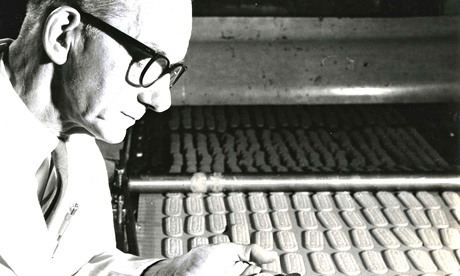
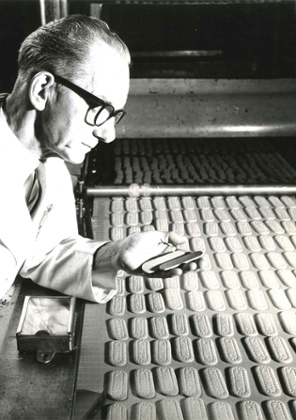
This is Grandad Murphy featured on the front cover of Peek Frean’s magazine in 1960, checking the quality of the finger biscuits. Grandad was a conscientious and serious man who had risen to foreman in the company. Sunday afternoons as a child often involved a trip to have tea with Nan and Grandad, where we would generally be given a large bag of broken biscuits to take home – one of the perks of the job.
What the picture doesn’t show is that he wore a prosthetic right hand, courtesy of having lost most of his fingers in a biscuit machine. I am not sure what, if any, compensation would have been paid but Grandad wasn’t one to moan. He was proud of his job and to this day we use the set of cutlery that he was presented with on his retirement.
The photo reminds me of his life and of so much that has been and gone in the world. Grandad was born in Bermondsey at the end of the 19th century and Peek Frean was based there, although the factory shut in the 1980s, long after he had died. But by the time that he worked there he was commuting from a brand new 1930s semi-detached house in Welling – part of the suburbanisation of London.
In the first world war he had been a communications engineer in the trenches – his serious demeanour was purported to be a result of that experience. Opposite their house in Welling was a corner shop and whenever we visited we were also always given a Jamboree bag. My childhood memories include the remnants of an Anderson shelter in his garden in Welling, being taught rudimentary carpentry in his garden shed, jumping over, and trying not to fall into, the pond under the apple tree and, of course, the tea and biscuits. A particular treat was going on a trip to central London with him to have his glove refitted – he instilled a terror of falling on to the electric rail that I still carry to this day.
During the second world war, the yard at the back of the corner shop opposite had sold petrol. During a night-time German air raid, Grandad had apparently climbed over the fence into that yard to expel an incendiary bomb that had landed there.
After all that he experienced in life, perhaps he was lucky to have only lost a few fingers. Britain has changed. But his story, which I find remarkable but I suspect is probably typical, tells me of a time when people had different aspirations and perhaps were more content with their achievements in life.
Edmund Lamb
Playlist: Our miracle, born on the Fourth of July
Millennium by Robbie Williams
“We’ve got stars directing our fate / And we’re praying it’s not too late /Millennium”
This song was playing during the birth of our only child, Maria, and whenever my husband and I hear it we are flooded with wonderful memories. We waited almost nine years for her to come into our lives and she has brought us such love and happiness. She became a teenager on 4 July and we thank God for her every day.
However, the song also reminds us of very sad and heartbreaking memories too. Not long after Maria was born, she began to have severe breathing difficulties. She was admitted into the intensive care unit of the Liverpool Women’s hospital and then Alder Hey hospital. The doctors fought for her life for nearly three weeks. We were told it was very unlikely that they would be able to save her. We had her christened in the intensive care unit and she looked like a little angel in the cot. Thank God the doctors diagnosed what was wrong with her, and after a few days of treatment she began to improve.
This song reminds us that our daughter is a miracle come down from the stars to us. She is a loving and caring girl who fills our lives with love and joy.
Geraldine Miller
We love to eat: My mother’s potted meat
Ingredients
1lb stewing steak
½lb lean bacon or gammon
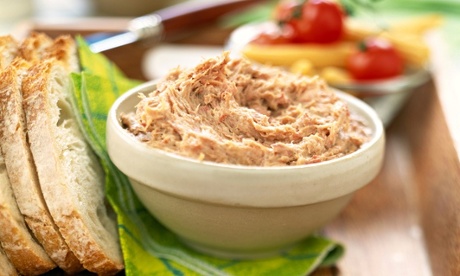
Cut the meat up very small and put into a pudding basin with 2 tbsp of water. Cover the bowl with foil, put into a pan of boiling water, cover and cook on a low heat for three hours. Alternatively, you can cook it in a slow cooker. Cool the meat and then put through a food processor – or if you have a traditional mincer, use that as it gives a better texture.
I remember my mother making potted meat in the 1960s and I suspect it was a recipe handed down from her own mother. Making this always reminds me of my childhood: potted meat on toast for lunch or potted meat sandwiches in the garden of our house in Kent, or on picnics on days out with my parents. Potted meat would also be served when they had friends round for a buffet meal. The ingredients were simple, but the results felt and tasted luxurious.
After my mother cooked the meat, she would put it through an old-fashioned green metal hand mincer, screwed on to the edge of the worktop or table. When we were old enough, my sister and I were allowed to do the mincing and the best fun came at the end, when most of the meat was minced. We put stale bread through the mincer, and it came out as mottled “bread worms” – bread mixed with the remnants of the meat left in the mincer – which we could eat as a treat.
I still make the potted meat today, but now only have a food processor to do the mincing job. Although it tastes as good, I miss the texture produced by the old mincer! And I still measure the meat in pounds, as in my mother’s original recipe.
Carolyn Smith
We’d love to hear your stories
We will pay £25 for every Letter to, Playlist, Snapshot or We love to eat we publish. Write to Family Life, The Guardian, Kings Place, 90 York Way, London N1 9GU or email family@theguardian.com. Please include your address and phone number