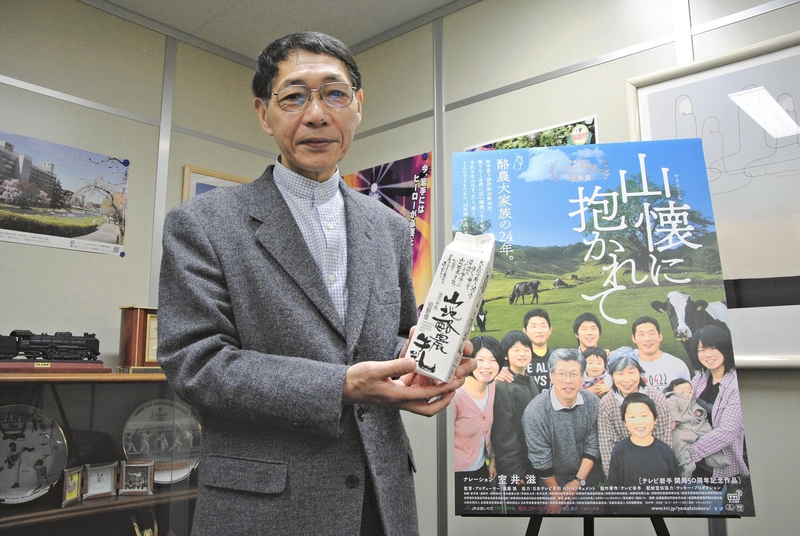
MORIOKA -- A documentary film featuring a large family whose parents engage in dairy farming with their five sons and two daughters, which was produced by the Morioka-based TV Iwate, will be shown at Polepole Higashi-Nakano, a theater in Nakano Ward, Tokyo, from Saturday.
"Yamafutokoro ni Idakarete" (In the arms of mountains), is based on a TV series. It details the more than 20-year struggle of the family as it thrives in the harsh but beautiful nature of Iwate Prefecture.
Dairy life for a large family
Kimio Yoshizuka, 67, and his family are engaged in dairy farming in a mountainous area of Tanohata village in Iwate Prefecture, which faces the Pacific Ocean. Different from ordinary dairy farming where cows are fed in a barn, they lead their cows to graze in the mountains throughout the year and feed them lawn and other wild grasses that span four seasons.
Yoshizuka studied at the Tokyo University of Agriculture, where he was impressed by this farming method. In order to pursue it, he moved to the village in 1974.
Takashi Endo, who served as a director and head of a news section at TV Iwate, had covered agricultural issues in the prefecture, which is how Endo became interested in Yoshizuka's mountain dairy farming methods. He began covering such farming in 1994. In the process, Endo also became fascinated in the daily life of the large family with four sons and two daughters (the fifth son was born in 2000.)
"Small children helped their parents' work by carrying branches and leading cattle. Everything I filmed looked new and I was impressed that such a situation still endured," Endo recalled.
A major turning point came in 1996. To overcome some financial difficulties, Yoshizuka began producing his own milk brand and appealed to consumers about the safety and high quality of mountain dairy farming. A TV program introducing this effort was broadcast nationwide and drew a lot of reaction. As a result, the number of orders for Yoshizuka's milk significantly increased.
"Yoshizuka was prepared to stop dairy farming at one point. As I did not want to see the family leave the mountain, I was glad to see him succeed," Endo said.
After that, Endo continued to produce documentary programs featuring the family every time they reached milestones in their lives such as their children's graduations from school and marriages.
In particular, the 2011 Great East Japan Earthquake was the biggest challenge for the family. Since mountain dairy farming leaves cows to pasture, the effects of radioactive contamination became a concern. Although his milk was proved to be safe, the number of orders dramatically declined.
Yoshizuka was shocked as he thought, "I never imagined that this dairy farming method could work negatively."
Sympathizing with Yoshizuka, Endo tried to dispel damage to the reputations of agricultural products based on groundless rumors through filming Yoshizuka undergoing safety inspections of his products and other scenes.
During his 24 years of filming, Endo also saw Yoshizuka's son, who studied dairy farming outside the prefecture, confront his father over the management of their dairy farm.
"Because their children have helped their parents' dairy farming since they were little, they developed their own opinions. I think Yoshizuka himself grew by listening to their opinions." Endo said.
Now, Yoshizuka's dairy farm is engaged in new businesses such as cheese production, with its number of customers steadily increasing.
Over 1,000 hours of filming
TV Iwate marks the 50th anniversary of its foundation this year. The production of the documentary film is part of the anniversary project, and Endo directed the film.
There are more than 1,000 hours of video of Yoshizuka's family. While it was challenging to edit the video and cover the family again, Endo was encouraged by the entire company's policy of bringing what TV Iwate has filmed to the attention of the public.
Of their five sons and two daughters, some live independently outside the prefecture. However, for the last scene of the film, all of the family members sat down around the table just like old times. In that scene, audiences will see Yoshizuka broadly smile surrounded by many grandchildren.
"By watching parents and their children growing up in the richness of nature, I hope people living in urban areas feel that they are kept alive as well," Endo said.
The film's title also conveys this.
Read more from The Japan News at https://japannews.yomiuri.co.jp/