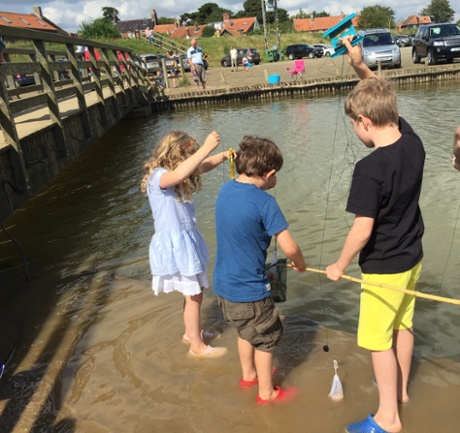
Snapshot: Tempting crabs with a rasher of bacon
As a child I was lucky enough to be taken abroad almost every summer, visiting several countries around the world to spend time with “relatives” of my Austrian-American mother. In time, I realised that most of my aunts, uncles and cousins were actually friends not family. I also learned that I had completely underestimated what was meant by a traditional British holiday, and in particular “going crabbing”.
In this photo, my children, Calum and Holly, are with my childhood friend’s son, Dillon. The children have known each other since they were born, and travel from Edinburgh to Suffolk, or vice versa, annually, and refer to each other as cousins.
My children, the city mice from Edinburgh, love visiting country mouse Dillon. His world is one of beaches, fields, dens and romping outdoors; and while we try to offer these things in Edinburgh, we invariably spend more time indoors than I would prefer.
Here, my children are learning the delights of crabbing. As I understand it, crabbing is the main draw in the Suffolk village of Walberswick, although from the 13th century up until the first world war it was a thriving port and market town. The village lies on the south bank of the river Blyth amid acres of unspoiled coast, heath and marshland. Previously, I had thought crabbing involved rock-pooling – hunting hopefully along the shores of East Lothian for the odd hermit crab. Now I know differently.
It seems that crabbing actually involves popping a slice of bacon into a net bag and lowering it on a string into the water, standing on the banks of the estuary crammed alongside hundreds of other families, and waiting with bated breath.
Within seconds, the children reel the string up and work as a team to scoop a fishing net under the small bag of bacon and catch the crabs clinging on; finally plopping them into a waiting bucket of water. Once they have collected 100 or so, the children tip the bucket over amid squeals of excitement and commentate on the race as the crabs scuttle swiftly back into the water; only to be pulled out by another child shortly after.
This photo reminds me how lucky my children are to have such a broad “family”, with whom we can expand our horizons and share experiences.
Sarah Neary
Playlist: Crafty Brian was plane crazy for this song
Rock Your Baby by George McCrae
“Woman, take me in your arms / Rock your baby / Woman, take me in your arms / Rock your baby”
At the start of our marriage in 1973, we rented the downstairs of a small terraced house in Dagenham, east London. Upstairs lived another couple in an equally tiny couple of rooms – the only thing we shared was a small porch.
Each Saturday, Brian, our upstairs neighbour, would indulge in one of his passions – constructing detailed models of first and second world war aircraft. In their bedroom-cum-lounge, a large number of these little planes were suspended from the ceiling, but his wife wouldn’t allow him to even unpack the boxes upstairs, never mind construct the things – she hated the glue, the aerosol spray-paint and the stickers, so he was banished to the porch for the whole day to put together his latest project.
There he would be with the tiny pieces laid out in an area about three feet square, and we’d open our door to find him crouched down in a toxic fug of glue and paint. “What’s it today then, Brian?” we would ask.
“Avro Lancaster … brilliant …”
Another Saturday treat for Brian would be the purchase of a single. One Saturday he bought Rock Your Baby and it became the loud soundtrack for the whole day – he set the record player to play it over and over – and the words became etched into my brain as it played again and again and again … In fact, so evocative are the opening bars, that when I hear it now, I swear I get the whiff of Humbrol paint!
Patricia O’Brien
We love to eat: Dad’s corned beef hash castles
Ingredients
Enough potatoes to make a pan of mash, with milk and butter
Pinch of salt
1 tin of corned beef
1 onion
1 Oxo cube
Piccalilli (if desired)
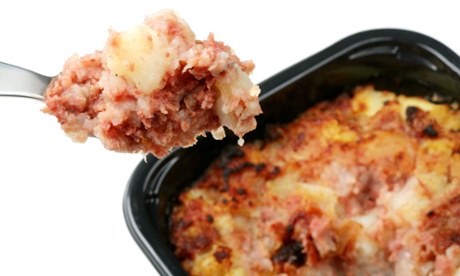
Peel the potatoes and boil with a pinch of salt, then drain and mash with a little milk and butter. Cut the corned beef into cubes and add to the potatoes, ensuring there are no lumps of either potato or corned beef. Fry the onion and stir it in. Dissolve the Oxo cube in boiling water and use as gravy – the piccalilli can be spread on the hash if desired.
As a child growing up in the austerity years of the 1950s, I was luckier than many of my schoolfriends in that, as an only child whose father worked in a bank, money was not as tight as it was for other families. Mum was a fantastic cook – her mince pies, jam tarts, apple pies and scones were to die for.
One of my favourite meals was corned beef hash. A simple and relatively cheap meal, it was just corned beef with mashed potato and onions, but made special by the antics of my dad. When the hash was on his plate, Dad would shape it into a castle and create a moat. Into the moat he would pour Oxo gravy, then add a dollop of piccalilli to the top of the castle. The castle was a stronghold against the evil baddies, but was unfortunately demolished with each mouthful – such fun for a five-year-old!
I still enjoy a plate of corned beef hash, but have never quite mastered the art of building a castle with it as created by my dear dad.
Irene Stuart
We’d love to hear your stories
We will pay £25 for every Letter to, Playlist, Snapshot or We love to eat we publish. Write to Family Life, The Guardian, Kings Place, 90 York Way, London N1 9GU or email family@theguardian.com. Please include your address and phone number