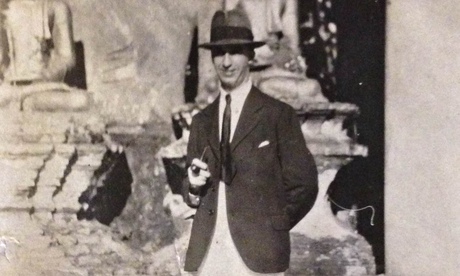
Snapshot: My grandfather in Rangoon, 1935
September 1935: my grandfather, John, standing barefoot outside a Buddhist temple in Rangoon, now Yangon. In his trilby, white flannel trousers and pipe in one hand, he looks every inch the European abroad. Rangoon’s dry temple air might have been a relief to him after the humidity and damp of dockside Bombay, where he was chief engineer for a shipping company headquartered in his native Scotland.
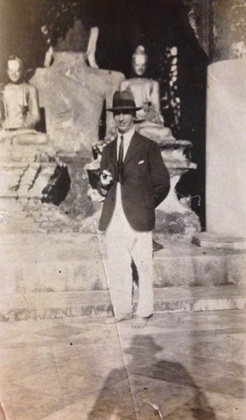
What made him so ill in the east was never recorded in family history, but a shadow cast by an unknown person in the photograph is like a presentiment. Two months after the photograph was taken, my grandfather was dead.
Pulmonary tuberculosis is a crafty passenger – a stowaway – that can incubate for months unseen. My grandfather may have harboured the tubercle bacillus when he left Scotland for Burma on the SS Jaladuta in early 1934. Or perhaps he caught tuberculosis from the crew.
In Bombay, his job was to accompany the SS Jaladuta with cargoes of jute, tea, coffee and ivory, Benares brass-ware and Kashmir shawls to trading posts throughout the British empire, Rangoon among them. Once a year his Bombay company, the Scindia Steam Navigation Company, arranged to ferry Muslim pilgrims to Mecca across the Indian ocean. What my grandfather had left behind in Scotland – a wife and baby son (my father) – he probably came to miss less and less. His alienation from the stockyards and steamship industries of Glasgow could not have been more complete.
Already dying, he was repatriated to Glasgow by sea in the autumn of 1935. Perhaps he had some sense of homecoming – of being restored to Scotland – on sight of the Clyde estuary.
At a military hospital outside Perth, the Glenlomond sanatorium, he was given sulfa drugs. Scotland was a European tuberculosis blackspot anyway and over the next few days my grandfather’s expectorations turned steadily darker. No amount of time in the sanatorium could help. At 5am on 15 July 1936, he died, aged 49. My grandfather’s life pre-tuberculosis remains unknown to me.
Ian Thomson
Playlist: United by a classic we all love to hate
Apache by the Shadows
(Instrumental)
My family isn’t the closest. We don’t gather every night to share the stories of our days and we don’t have similar tastes in music either. This is often the cause of many an argument in the car over which radio station to listen to, whether it be my mum wanting her old nostalgic 80s songs, my brother wanting his heinous dubstep or me wanting my own – obviously – awesome music. We can almost never agree, but there is one song that always unites us.
My dad is a fan of older music than the rest of us and one song, a western-style guitar-based tune, unites the rest of us through our sheer hatred of it. One minute we can be bickering about what to listen to on the two- hour car journey, but the moment my dad decides to just ignore us and put on that song, we all stop fighting and quickly agree that anything would be better than allowing my dad to keep playing it. Its boringly simple and overly repeated guitar riff, and lack of lyrics, is a crime against music.
A compromise is quickly decided upon and it isn’t long before we have re-claimed the radio and once again have it playing a half-decent tune. I’m pretty sure he does it on purpose more and more, just so we will stop arguing and decide on what to listen to. The song in question? The piece of rubbish that unites us in hatred? Apache by the Shadows.
Don’t get me wrong, not all my memories involving Apache are bad ones. Many an alcohol-fuelled new year’s has been spent with us all air-guitaring along to the main riff of the tune before bursting into laughter at our own drunkenness. At one point in fact, during my guitar-playing stage, my dad actually paid me to learn and then teach him the main riff. It was an amusing experience that ended with me deciding it wasn’t worth the meagre sum he was offering.
Recently, I have found my hatred for Apache lessening. In fact, as I sit here now, listening to it as I write, I can’t help but tap my foot along to the tune. My dad will never know this. No, he must never know this. It would change the balance of power over the radio and chaos would ensue. For the good of the family, I must – and I will – continue to hate this song.
Andrew Kerr
We love to eat: Roasted tomato pinocchi with stringy cheese
Ingredients, serves four
2 packets of cherry tomatoes
Oregano
Garlic (as much as you want)
2 tins of plum tomatoes
Big squirt of tomato puree
Mixed herbs and fresh basil
1 tsp salt
1 tsp sugar
2 packs of ready-made gnocchi
2 mozzarella balls
Parmesan
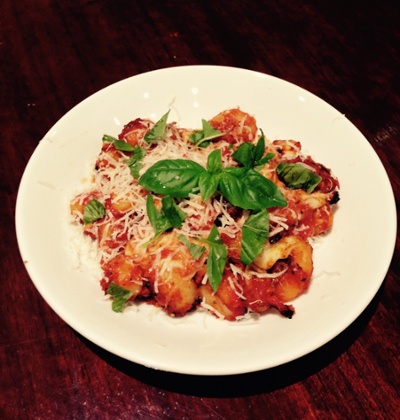
Blend the plum tomatoes and garlic and put in a big pot with herbs, salt, sugar and tomato puree. Place over a medium heat and reduce. Cover the cherry tomatoes in olive oil and oregano and roast in a baking tin with slices of garlic.
Put gnocchi in a big oven-proof dish and stir in roasted tomatoes first then pour over the sauce and stir again. Put in the oven at 200C until it bubbles and starts to brown at the edges. Add the mozzarella for 10 minutes until all melted and stringy. Top with basil and parmesan once it’s on the plates.
This is a family favourite in our house. My children fight over the stringy cheese bits and my five-year-old thinks it’s called pinocchi – perhaps a slight linguistic mix-up with that fictional little boy whose nose grew when he lied. It has taken years to perfect this dish. My husband and I ate roasted tomato gnocchi on holiday in northern Italy (long before our children appeared) sitting outside a little restaurant in a back street in a small town called Gradisca. It is a meal I will never forget. We were blown away by the amazing flavours of such a simple dish. I may have added my own touches to the recipe, and it does taste good, but I don’t think it will ever match up to the real thing.
My husband’s grandmother was born in nearby Fogliano Redipuglia and grew up in the town of Sagrado. The area is a regular holiday destination for the whole family as my father-in-law owns a little flat in Sagrado.
Granny Kerr still makes an annual trip to visit one of her sisters, an amazing feat considering she is 90 and it takes two aeroplanes to get there! She moved to Dumbarton on the west coast of Scotland after the war having fallen in love with a Scots soldier – Grandpa Kerr. I can only imagine the shock of the transition to dreary postwar Scotland, away from family and friends and speaking only a little English.
Amy Kerr
We’d love to hear your stories
We will pay £25 for every Letter to, Playlist, Snapshot or We love to eat we publish. Write to Family Life, The Guardian, Kings Place, 90 York Way, London N1 9GU or email family@theguardian.com. Please include your address and phone number