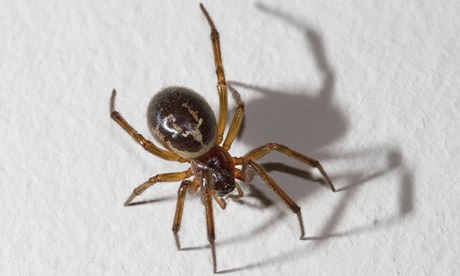
Age: About 400m years, but only arrived in the UK in 1879.
Appearance: Spider-like.
Can you be a little more precise? Brown bulbous abdomen, cream markings, orange legs.
Are you describing Steatoda grossa or Steatoda nobilis? OK, no need to show off. The distinction is rarely made in media coverage of false widows, but it's significant. Steatoda grossa is a native species that poses little threat to humans; Steatoda nobilis – the one we're concerned with here – is the more venomous incomer. Don't mention this to Nigel Farage, or we'll never hear the end of it.
How big are they? The female's body measures about 15mm, or 32mm if you include the legs.
And the males? Smaller and friendlier. Also, they only live a year, whereas females live to three. It's basically feminism gone mad.
Is that because the female eats the male after mating? You are thinking of its deadlier cousin the black widow spider, with which it is frequently confused. False widow males tend to die of natural causes after sex.
Are false widows dangerous? ARE THEY DANGEROUS? You have clearly not been paying attention to recent press reports. Steatoda nobilis is Britain's most venomous spider. A bite can kill, or at the very least produce a nasty swelling and give you palpitations.
And the number of deaths in the UK so far? None, but you can't be too careful.
So what's the real danger level? Minimal according to the experts, though as with wasp stings there is a possibility of death as a result of anaphylactic shock.
Are false widows increasing in number? Too right they are. They were first spotted in Torquay in the 19th century, having arrived from the Canary Islands, possibly in a crate of bananas; established themselves in the south-west; moved to the south-east and London (which is of course when the media got interested), and are now heading north.
Is climate change a factor in their proliferation? Yes, according to every reputable scientist. No, according to James Delingpole.
Not to be confused with: The white widow.
Do say: "Ouch!"
Don't say: "This is a story with legs."