Afternoon summary
-
Alex Salmond, the former Scottish first minister and now the SNP’s international affairs spokesman, has expressed reservations about extending air strikes against Islamic State to Syria. Speaking in the Commons debate he said:
The reason for scepticism is the experience we have of the success of military interventions in a range of Islamic countries. In each stage of military intervention we were assured and told and it was argued this next intervention was the absolute key or at least would progress the objectives of this country. I think, on it has to be said every occasion, exactly the reverse has come about.
-
Nicola Sturgeon, Scotland’s first minister, has suggested that the government’s plans for English votes for English laws could make it easier for the SNP to justify holding a second independence referendum. (See 3.15pm.)
That’s all from me for today.
Thanks for the comments.
Sturgeon suggests Evel could help to justify a second independence referendum
Nicola Sturgeon, Scotland’s first minister, has put out a statement about the government’s English votes for English laws (Evel) plans. Significantly, she suggests that this could make it easier for the SNP to justify a second independence referendum.
The Tories have produced a constitutional shambles - staggering in the extent of its hypocrisy and incoherence.
Under these plans - which are all about cutting Scottish MPs out of votes which impact on Scotland and our budget - the Tories are proposing an ‘English veto’ and ‘double majority’.
And yet they are imposing a totally inadequate Scotland bill - which fails even to live up the recommendations of the Smith Commission, never mind responding to the election result in Scotland - on the basis of the vote of a single Tory MP in Scotland, in defiance of the views of the 56 SNP MPs and frequently the 58 non-Tory MPs ...
I have been very clear that, at least in part, the level of support for independence will be determined by what the Tory government at Westminster does, as well as what the SNP Government does. And there is no question that the great disrespect shown to Scotland in these proposals is likely to have more people asking whether Westminster is capable of representing Scotland’s interests at all.
In the past Sturgeon has said there would have to be a “material change” in circumstances for the SNP to justify holding a second independence referendum. She has said that the UK voting to leave the EU would constitute such a “material change”. She does not specifically say that Evel amounts to a “material change”, but she is suggesting that, at the very least, it’s a contributory factor.

Lunchtime summary
- Michael Fallon, the defence secretary, has told MPs that the government will only ask parliament to approve air strikes against Islamic State (Isis) in Syria if there is a “consensus” in support. Having said yesterday that he thinks it is illogical for Britain to bomb Isis in Iraq, but not in Syria, he chose not to push the idea forcefully when he opened a Commons debate on international security. Instead, he stressed his desire to listen to the views of MPs. David Cameron, who in principle is in favour of extending air strikes, is still very cautious after he lost a vote in the Commons on bombing Syria in 2013, and the Conservative chairs of the foreign affairs and defence committees have both expressed strong reservations today about this course of action. (See 1.37pm.) But Cameron’s position has been strengthened by Labour signalling that it would back him on this issue. (See 1.42pm.)
-
Two cabinet ministers have criticised the BBC for being too deferential to Islamic State. During business questions the Conservative MP Rehman Chishti said that, when he wrote to the BBC, on behalf of 120 MPs, asking it to refer to the organisation by the term Daesh instead, he got a reply saying the BBC would continue to call it Islamic State to preserve its impartiality. Chris Grayling, the leader of the Commons, condemned this stance. He said:
I have to say that I have a different view of what impartiality means to the BBC. During the Second World War, the BBC was a beacon of fact, it was not expected to be impartial between Britain and Germany. Today it should be a beacon of fact, but it is not expected to be impartial about threats to the security and safety of the lives and limbs of the people of this nation.
Later, during the defence debate, Michael Fallon made a similar point. He said:
The BBC needs to be impartial about the facts, but you can’t be impartial between terrorism and the rules by which the rest of us live.
Fallon was responding to a question from the Tory MP James Gray who said that the BBC did not have to be impartial “with murderous scumbags” like Isis.
Updated
Here is the full quote from Harriet Harman, the acting Labour leader, on her party’s stance on extending air strikes to Syria. This is what she told ITV.
Isil brutalise people, they murder people and they are horrifically oppressive. So everything that can be done to stop them must be done, and any proposals that the government bring forward which will help tackle the growing horror of Isil, of course we will look at them very very seriously.
Paddy Ashdown, the former Lib Dem leader, has said that it would be a mistake to intervene militarily in Syria without a proper diplomatic strategy, the BBC reports. He said:
If you take military action outside a diplomatic context, you won’t succeed anymore than we did in Iraq, or Afghanistan or Libya and to make that mistake for the fourth time just seems to me to be foolish.
Labour signals it could back extending air strikes against Isis to Syria
Labour has signalled that it would support David Cameron over extending air strikes against Isis to Syria.
This is from Vernon Coaker, the shadow defence secretary, who is speaking in the Commons now.
Vernon Coaker says 'we stand ready to work with the government to defeat Isil'. Heavy hint Labour could back bombing Syria.
— Steven Swinford (@Steven_Swinford) July 2, 2015
Vernon Coaker says Labour "stands ready" to work with the government to defeat Isil and will carefully consider any proposals on Syria
— Isabel Hardman (@IsabelHardman) July 2, 2015
(2/2) action must command the support of other countries in the region including Iraq and the coalition already taking action in Syria.
— Isabel Hardman (@IsabelHardman) July 2, 2015
And this is from Harriet Harman, the acting Labour leader
Harriet Harman says circumstances differ from 2013 and that 'Isil is a terrorist organisation that is ignoring the border between Iraq&Syria
— iain watson (@iainjwatson) July 2, 2015
Julian Lewis says bombing Isis in Syria would help Assad
Michael Fallon’s speech is over. In it he said very little about Syria, and he did not put the case for extending air strikes as explicitly as he did on the World at One yesterday.
The most important moment probably came when Julian Lewis, the Conservative MP who has just been elected as chair of the Commons defence committee, rose to ask a question. He suggested bombing Isis in Syria would help President Assad.
In 2010 the government wanted to remove Assad without helping al-Qaeda or similar groups that subsequently became Daesh. Now we apparently want to remove Daesh but without helping Assad. These two things are incompatible. It is a choice of evils.
The two most important select committees on this topic are foreign affairs and defence. They are both chaired by Conservative MPs, and now both of them (see 9.41am) have expressed reservations about extending air strikes.
In the Commons Fallon is still speaking. He says the forthcoming defence review will have to make allowance for the fact that the work is now “darker and more dangerous” than at any time since the end of the cold war.
The review will be completed before the end of the year, he says.
He says today’s debate will allow him to hear what MPs think.
At the Number 10 lobby briefing the prime minister’s official spokeswoman said that there was a need for “more thought, more deliberation, more time” before deciding whether to table a motion asking MPs to approve the extension of airstrikes into Syria. She told journalists:
The PM has long thought that Isil poses a threat to Britain and Isil needs to be destroyed in Syria as well as in Iraq. That’s exactly what he said in the debate in the Commons last September. He set out in the debate that there was a strong case for the UK to do more in Syria and that remains his view. But he also said he wanted consensus in the House.
The PM’s views haven’t changed. What has changed is the growing evidence that Isil represents a threat to Britain and our national security.
Fallon is still speaking, but there has been nothing you would describe as sabre-rattling. This assessment, from the Spectator’s Isabel Hardman, is spot on.
Fallon being v.gentle in making case for combating Isis in Syria in Commons, clearly keen not to upset already agitated Tories behind him
— Isabel Hardman (@IsabelHardman) July 2, 2015
The SNP’s Tasmina Ahmed-Sheikh says it would be better to called Islamic State Daesh than Isis or Isil.
Fallon says he has a lot of sympathy for that point of view. Countries in the region call it Daesh. But it may be too late to stop people using the term Isil, he says. He says the BBC has changed its stance.
James Gray, a Conservative, says there are reports saying that the BBC has not changed its policy on using the term Islamic State. The BBC wants to fair to it, Gray says. But it should not feel the need to be fair to murderous “scumbags”.
Fallon says he agrees with this.
Fallon says Cameron has said he will not ask the Commons to vote to back air strikes in Syria unless there is sufficient support for the idea.
Michael Fallon's speech on the case for extending air strikes against Isis
Michael Fallon, the defence secretary, is speaking now at the start of the international security debate.
He says the government is spending £75m this this year on fighting Islamic State (Isis).
He says David Cameron has said there could be a case for extending air strikes to Syria.
But the government would seek permission from the Commons before taking the step, he says (subject to reserving the right to act in an emergency).
Julian Lewis, the Conservative chair of the defence committee, says you cannot intervene in Syria without helping either the Assad regime, or Isis. Which would be worse?
Fallon says the government does not favour either option.
Quite a lot of Tory resistance to idea of bombing Isis in Syria. Julian Lewis says it is impossible to do w/out helping Assad.
— Kiran Stacey (@kiranstacey) July 2, 2015
Updated
Grayling’s statement is now over.
Here is some Twitter reaction from Labour MPs.
From Owen Smith, the shadow Welsh secretary
Yes Grayling, the Scots voted to stay in the Union. And what a way to reward them, by carving their representatives out of the UK Parliament
— Owen Smith (@OwenSmith_MP) July 2, 2015
From Chris Bryant, the shadow culture secretary
Grayling refuses to answer questions about his proposal from Father of the House. Shabby shabby man. Leader of the House shd show more grace
— Chris Bryant MP (@RhonddaBryant) July 2, 2015
And this is from Stephen Noon, who was chief strategist for the Yes campaign in the Scottish independence referendum.
Sitting here in the heart of Westminster, watching the #EVEL debate, it's clear that the Union, like the building, is falling apart
— Stephen Noon (@StephenNoon) July 2, 2015
The SNP’s George Kerevan says Grayling does not understand the West Lothian question. He says he has discussed this with Tam Dalyell, He says Dalyell objected to the idea of there being different classes of MPs. That would create a muddle, he thought. He says Dalyell thought you should either have separate parliaments or (Dalyell’s preference) a single, union parliament.
The SNP’s Roger Mullin says these plans put the Speaker in an invidious position. He says he will be the arbiter of what is in the interests of his constituents, not anyone else.
Grayling says Mullin is wrong. Under devolution, Mullin cannot vote on education matters affecting Scotland.
The Labour MP Stephen Doughty has responded on Twitter to Grayling’s last point. (See 12.28pm.)
Grayling just says Private Members Bills won't be subject to this procedure?! So we will now have 2 types of primary legislation? #chaos
— Stephen Doughty (@SDoughtyMP) July 2, 2015
The SNP’s Patrick Grady says these proposals include the concept of a “double majority”. But the government ruled this out in relation to the EU referendum bill, he says. (The SNP want a rule saying the UK will only leave the EU if the UK as a whole votes in favour, and if there are majorities in all four separate nations).
Will this apply to private members’ bills?
Grayling says this measure will not apply to private members’ bills, or to 10-minute rule bills.
Pete Wishart, the SNP’s shadow leader of the Commons, said that these measures would be good for the cause of Scottish independence. (See 11.48am.) Here are tweets from two journalists who agree.
From the Daily Mirror’s Jack Blanchard
SNP sound furious at Tory (D)EVEL plans. But they must be secretly delighted. Hard to see how this fails to push Scotland closer to the exit
— Jack Blanchard (@Jack_Blanchard_) July 2, 2015
From the Daily Mail’s Gerri Peev
I will put money on the SNP deciding EVEL plans constitute a 'material change' in Union ...referendum take 2, anyone?
— Gerri Peev (@GerriPeev) July 2, 2015
Grayling says he cannot understand why Labour and the SNP, which both profess to support devolution, do not support giving more power to English MPs.
In the Commons Nigel Dodds says, when his party comes to vote on this, it will be governed by what it thinks is best to preserve the union.
He also suggests that, if English MPs should have a veto over English-only laws, Northern Irish MPs should have a veto over measures affecting just Northern Ireland.
English votes for English laws - How the new system will work
Here is the section from the Cabinet Office’s summary guide (pdf) explaining in detail how the new system will work.
- When a bill has been introduced in the Commons, the Speaker will certify whether the bill, or parts of it, should be subject to the new process. When making this decision the Speaker will decide whether the legislation relates exclusively to England, or England and Wales, and concerns matters which are devolved to Scotland, Wales or Northern Ireland.
- Once the Speaker has certified a bill it continues to Second Reading and Committee Stage as normal.
- Any bills that the Speaker has certified as England-only in their entirety will be considered by only English MPs at Committee Stage. The membership of this Committee will reflect the numbers of MPs that parties have in England. This will not apply to any other bills, such as those which contain a mixture of England-only and England and Wales provisions or bills which contain provisions which are UK-wide.
- After this the bill continues to Report Stage as normal.
- For bills containing English or English and Welsh provisions, there is then a process for gaining the consent of English or English and Welsh MPs. A Legislative Grand Committee considers a Consent Motion for any clauses that the Speaker has certified as English or English and Welsh-only. This is a new stage which will allow all English or English & Welsh MPs either to consent to or to veto those clauses. At this stage no amendments to the text of the bill can be made but specified clauses can be vetoed by amendments to the Consent Motion. In the case of a bill which is England-only, or England and Wales-only, this stage allows those MPs to consent to or veto the whole bill.
- If clauses of the bill are vetoed by the Legislative Grand Committee there is a Reconsideration Stage when further amendments can be made, to enable compromises to be reached. The whole House can participate in this stage, which is, in effect, a second Report Stage for disputed parts of the bill. This is followed by a second Legislative Grand Committee at which all English or English & Welsh MPs are asked to consent to the amendments made by the whole House. If no agreement is reached at this point, the disputed parts of the bill fall.
- Following Report stage and any Consent Motions the bill continues to Third Reading, in which as now all MPs can participate. It then progresses to the House of Lords. If there are any consequential amendments to the rest of the bill required as a result of disputed parts of the bill falling, there will be an additional stage before Third Reading to allow this.
These rules will not apply in the House of Lords.
But, if the Lords amends a bill, when the bill returns to the Commons any changes relating to England-only, or England and Wales-only, will have to be approved by a “double majority” (ie, a majority of all MPs, and a majority of English, or English and Welsh, MPs too.)
Updated
Labour’s Paul Flynn asks why the Lords is not being reformed. It is still possible to buy a seat there, he says. These plans will lead to the break up of the UK.
Grayling says, if Flynn feels so strongly about Lords reform, he should explain why Labou did not back Lords reform in the last parliament.
Alistair Carmichael, the Lib Dem former Scottish secretary, says that the plans will create two classes of MPs and that it is an “outrage” that the government is trying to bring this in through changes to standing orders. Something of this importance should be introduced through primary legislation, he says.
Grayling says Carmichael can argue for primary legislation when Evel is reviewed next year.
Back in the Commons Grayling says that legislation will continue to need the support of MPs from the whole of the UK to become law.
Chris Grayling’s office has published three documents to go with today’s announcement.
Updated
Sir Gerald Kaufman, the father of the Commons, says one of the great things about the Commons is that all MPs are equal. He says he hopes Tory MPs will vote against the plans. The government is undoing something that has lasted since Magna Carta, he says.
Grayling is replying to Wishart.
The government is giving the Scottish people more control over their destiny. So why shouldn’t the English have more control over their own destiny, he says.
Pete Wishart, the SNP MP, says Grayling was talking “bilge”.
He says Grayling might just have proposed stamping the foreheads of Scottish MPs.
This is the most dramatic and imporrtant constitutional statement we’ve had since the days of Gladstone.
He says the Speaker will be dragged into controversy.
He says Grayling is proposing a “cobbled together, unworkable mess”.
This week SNP MPs voted for measures supported by most Scots. But they were defeated, he says.
He says the Conservatives are doing their best to ensure that Scotland becomes independent. They are ham-fisted, he says. But he almost wants to thank Grayling for what he is doing for the cause of independence.
There has been a great deal of jeering. John Bercow, the Speaker, says all MPs who want to speak will get the chance.
Charles Walker, the Conservative chair of the procedure committee, says his committee will conduct a “quick and dirty” review of this process. But he suggests that will be inadequate. He says his committee will have to come back to this later.
Grayling is replying to Eagle.
He says in the last parliament William Hague tried to consult Labour. But Labour refused to take parts in talks on this, he says.
He tells Eagle that most of her constituents will think this is a fair proposal.
He says there will not be two classes of MP. Then, soon afterwards, he says the West Lothian question created two classes of MPs.
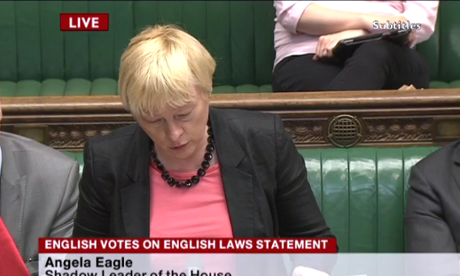
Labour accuses Grayling of 'procedural trickery' and endangering the union
Angela Eagle, the shadow leader of the Commons, is responding.
She says Labour supports the principle of changing rules to address the West Lothian question.
But reform should be introduced by cross-party agreement, she says.
She says Labour thinks this matter should be addressed by a constitutional convention.
She says there could be “plenty of opportunities for constitutional chaos”.
She says the government is going further than the plans in the McKay commission set up by the government in the last parliament.
Some MPs will effectively get two votes. As Labour moves to one member one vote, the government is introducing multiple votes, she says.
The government must be worried about losing votes in the Lords, she says.
She says the government is introducing two classes of MPs. The McKay commission cautioned against that.
These proposals risk the union, rather than saving it .... The leader of the House is playng with fire. Why is he being so reckless?
She says the government is using “procedural trickery” to give itself a much larger majority than it actually has.
MPs to vote on Evel on 15 July
Grayling says he is publishing a paper today for MPs explaining in detail how the system will work.
He says the new system will not affect the House of Lords.
The system will require a new way of counting votes, he says.
Votes will be counted on tablets. That means the clerks will be able to find out immediately how many English MPs supported a particular measure.
He says the Commons will vote on the new rules on 15 July.
He says he has asked the procedure committee to undertake a technical assessment of the new rules.
Today’s announcement is an important first step, he says. So a review will be carried out after the first bills passed under the new system have reached the statute book next year, he says.
Today we are answering the West Lothian question, he says.
Chris Grayling is making his statement now.
He says Tam Dalyell first raised raised what is now called the West Lothian question in 1977. Since devolution, that question has become more pressing, he says.
He says the government has strengthened the devolution settlements.
But it wants to boost the rights of English MPs too.
Under these plans, English MPs will have a veto on measures affecting England only. And English and Welsh MPs will have a veto over English/Welsh legislation.
The same principle will apply to secondary legislation, and to some English public spending announcements, he says.
Chris Grayling's statement on English votes for English laws (Evel)
Chris Grayling, the leader of the Commons, is about to make a statement to MPs about the government’s plans to introduce “English votes for English laws” (Evel).
David Cameron and William Hague unveiled these plans during the election. Here is how I summarised them on our election blog.
Cameron and Hague said a Conservative government would introduce English votes for English laws (Evel) within 100 days of the election. They underlined their commitment to Evel by publishing details of how they plan to change Commons rules to give English MPs a veto over English-only legislation. Under the plans only English MPs would participate in a bill’s committee stage, chosen in proportion to party strength in England. An English-only bill would have to be approved by an English grand committee. And the rate of income tax in England would be decided by English MPs. Hague said these changes could be introduced quickly, without primary legislation.
And this is what Cameron said about the proposals in the Commons yesterday at PMQs.
English MPs are entirely excluded from any discussion of Scottish health or Scottish housing or Scottish education. What we are proposing is absolutely a very measured and sensible step which says that when there is a bill that only affects, for instance England, committee stage should be of English MPs, but then the whole House will vote at report stage and indeed at third reading stage.
What this is going to introduce as it were is a system for making sure the wishes of English MPs can’t be overruled. That, I think, is only fair in a system when the Scottish Parliament and the Welsh Parliament and indeed the Northern Ireland Parliament have increased powers.
A Labour leadership round-up
There’s a Labour leadership hustings at the LGA conference later. I will try to post some highlights, but I will be focusing on the Commons defence debate.
In the meantime, here’s a Labour leadership round-up.
- A poll of more than 200 Labour councillors has shown Andy Burnham in the lead as preferred leadership candidate. He was on 36%, ahead of Yvette Cooper on 30%, Jeremy Corbyn on 19% and Liz Kendall on 15%. But when the Labour History Research Unit at Anglia Ruskin University also surveyed 155 Tory councillors, they found Kendall was the Labour leader seen as a biggest threat to them. In the Labour deputy leadership contest, the Labour councillors had Tom Watson in the lead (41%), ahead of Caroline Flint (27%), Stella Creasy (18%), Angela Eagle (7%) and Ben Bradshaw (6%). The Tory councillors said Flint was the candidate who would post the biggest threat.
-
Cooper has said that, under her leadership, Labour would extend decentralisation, so that towns and rural areas can get the same powers being offered to cities in city deals. In an announcement ahead of today’s LGA conference she said:
Rhetoric about devolution at the same time central government shelves major regional transport is just not good enough. We need sustainable investment and devolution for all parts of the country and it should go further than the government plans so that towns can be involved as well as cities, and so that energy, skills and policing are all included too.
John Baron, a Conservative MP and a member of the Commons foreign affairs committee in the last parliament, has put out a statement saying he would be “very wary” of air strikes against Isis in Syria.
We should be very wary of conducting air strikes in Syria. The more we intervene, the more we take responsibility for events on the ground. I am also not convinced we fully understand what is happening, as illustrated by the fact that within eighteen months we have now, in effect, swapped sides in the Syrian civil war.
Meanwhile, questions remain about our efforts to combat Daesh in general. What more could be done to significantly disrupt their prominence on social media, their business activities, and the financial flows from friendly neighbouring Arab states?
Furthermore, in Iraq, why are we not making greater progress in training up the Iraqi Army, in giving better and more direct support to the Kurds, and politically reaching out to the Sunni minorities – we all know soldiers can only buy time?”
Only a full-spectrum response will defeat Daesh. The government needs to address these questions, particularly when they seek parliament’s approval to intervene, should they decide to conduct air strikes.
You can read all today’s Guardian politics stories here.
As for the rest of the papers, here is the PoliticsHome list of top 10 must-reads, and here is the ConservativeHome round-up of today’s politics stories.
And here are two stories I found interesting.
Frans Timmermans, the second most powerful man in Brussels, said he is “terribly annoyed” by how frequently the leader of the UK Independence Party appeared to correctly diagnose the bloc’s failings – particularly its handling of the migration crisis – even when he strongly disagrees with his proposed solutions.
“What I really like about the man is his incredible sense of humour,” he said. “The problem is, I don’t get annoyed when he talks rubbish.
“I get terribly annoyed when he’s right. And on some issues he is right too often. If he criticises the EU for not having a migration policy that is effective he is right. He is absolutely, completely wrong with his solutions. But to start criticising the EU for not dealing in the right way with the migration crisis is right.
“The problem with Ukip and the extreme right, Mr Le Pen, Wilders, they are really good at making an analysis of the problem. And they immediately go completely overboard in providing a solution that would never work and is morally completely unacceptable,” said Mr Timmermans, the First Vice-President of the European Commission and a former Dutch foreign minister.
Hammond confirms that final British death toll in Tunisian attack was 30
Philip Hammond, the foreign secretary, said he can now say “with a high degree of confidence” that the final British death toll in the attack in Tunisia was 30. Those 30 victims have all now been formally identified, he said in a short clip for the broadcasters.
In a blog for Coffee House, Isabel Hilton says there has been a clear shift of thinking in government on the case for bombing Isis in Syria.
There is quite clearly now a shift in mood at the top of the Conservative party at least. In the last Parliament, David Cameron’s colleagues said he had ‘lost his appetite’ for another vote concerning Syria. There were strong denials when it was reported that the whips were pounding out MPs on what they thought about action in Syria when they prepared for the vote on Iraq last autumn. But now the defence secretary is talking openly about it on the airwaves and in the Commons today. Something has changed, but whether it will lead to strikes against the terrorists in Syria is not yet clear.
Here is this week’s Guardian Politics Weekly podcast.
It features Tom Clark, Anne Perkins, Phillip Inman, Natalie Nougayrede and Rafael Behr discussing Greece, the government’s reaction to the Tunisian massacre, and what this means for liberal Toryism.
Here are two Labour views on air strikes against Isis in Iraq.
From Peter Hain, the former cabinet minister
Of course need air strikes in ISIL lair Syria & not just Iraq but, like US, UK must liaise with Assad forces where & when or risk too great
— Peter Hain (@PeterHain) July 2, 2015
From Paul Flynn, the MP
Fallon must not let UK be provoked by ISIS into advancing their plan to create World War of West & East to achieve Caliphate.
— Paul Flynn (@PaulFlynnMP) July 2, 2015
Crispin Blunt says UK air strikes against Isis in Iraq would make no difference
Here is more from Crispin Blunt’s interview on Today. Blunt, the former soldier and Conservative former justice minister, is the new chair of the Commons foreign affairs committe. His intervention will have been deemed “unhelpful” by Number 10. He did not say he was opposed to bombing Isis in Iraq; he just said that it was unnecessary and that it would make no difference, and that it would not address the main problem.
Here are the main points.
-
Blunt said that British air strikes against Isis in Iraq were unnecessary and would make no difference.
There’s no military necessity for this. We are not providing very many of the aircraft. Five per cent of the missions are being flown by the United Kingdom. Therefore it makes no practical difference ... This does not make any difference what [Michael Fallon] is proposing, in effect on the ground. It will make a slightly different deployment of the British forces there but what is frustrating about this is it’s not going to make any difference to the outcome. We should all be focusing on the outcome - what do we want to achieve?
-
He said authorising air strikes in Iraq would take the government into a “legal grey area”.
We are getting ourselves in to a slightly more legal grey area. I don’t think it’s as clear as people have said. It’s easy to come in as guests of the government of Iraq at their invitation in their country. It becomes slightly more questionable when you don’t have a UN Security Council resolution and you are operating in another country.
- He said the role the UK was playing in the fight against Isis was “minor”.
-
He said the government should be focusing instead on getting other countries in the region to defeat Isis. That would be a “battle-winning decision”, he said.
We should be concentrating on getting the battle-winning decision - which is actually getting the regional states to co-operate around the mission, which is to defeat Isil (ie, Isis) ...
The mission is to defeat Islamic State - Daesh, call it what you will - and their defeat means occupying the territory that they currently administer. That can really only be done by Sunni armed forces in the main, on the ground. We can deliver battle-winning capability such as air power, special forces and the rest to allow that to happen, but we need the states there - Turkey, Iraq and Iran, the Saudis, possibly the Egyptians and certainly the Jordanians - to actually get their act together and sit down in a room and produce the strategy.
Once we know what the strategy is, we can deliver for them the military capability to enable them to defeat IS, which is an enemy to all of us.
-
He said he assumed that there was some degree of cooperation between the Americans and Assad’s forces in Syria to ensure that they did not get in each other’s way when attacking Isis.

On the Today programme Lord Dannatt, the former head of the army, said he agreed with Michael Fallon that it was illogical to bomb Isis in Iraq but not in Syria.
So-called Islamic State - Isil, Isis, call them what you like - have no respect for the borders that currently exist. Iraq is Iraq and Syria is Syria to us, but not to them,” said the former head of the Army.
As Michael Fallon has said, they don’t differentiate, and frankly it has been illogical for the last year that our forces have been engaged just in the air above Iraq and not above Syria.
Dannatt also said that ministers were right to seek parliamentary approval before extending air strikes to Syria.
Michael Fallon is absolutely right to open up this issue. I think he’s also right to say that probably if we were going to take that action and bomb Syria, the issue should be put back to Parliament.
I think the principle of getting broad-based support is a good one, a correct one, particularly after the difficulty two years ago when the notion was put of bombing president Assad’s forces in 2013. He’s right to think about it and I think he’s right to put it to Parliament.
Ministers are today engaged in a major ‘testing-the-water’ exercise. Michael Fallon, the defence secretary, will use a general debate on international security to argue that, as well as launching bombing attacks on Islamic State (Isis) in Iraq, Britain should also be launching air strikes against them in Syria too. He made this case on the World at One yesterday, and will explain it again in more detail later today.
Last year, when MPs backed the use of military force against Isis in Iraq, David Cameron was scrupulous about making it clear that the vote did not cover Syria. (The Iraqi government had requested foreign help in the fight against Isis; air strikes in Syria, which could conceivable drag the UK into the civil war between Isis and the brutal dictator, President Bashar al-Assad, would be much more problematic.) Now ministers would like to extend the operation. But having lost a Commons vote on military action in Syria in 2013, Cameron does not want to make the same mistake again, and today’s intervention by Fallon is designed to establish how much support there would be in parliament for ‘bomb Isis in Syria’ motion.
Earlier reaction has been mixed. Lord Dannatt, the former head of the army, told the Today programme that he was in favour. But Crispin Blunt, the Conservative MP who has just been elected chair of the Commons foreign affairs committee, was sceptical. He told the programme air strikes by the UK would not make any difference
If the government’s going to invite parliament to take a view, it will have to, but this doesn’t make any difference, what [Michael Fallon] is proposing, in effect on the ground. It will make a slightly different deployment of the British forces there but what is frustrating about this is it’s not going to make any difference to the outcome. We should all be focusing on the outcome - what do we want to achieve?
And actually what is needed here is actually more diplomatic activity in order to get the regional powers to sit down in a room together and agree a strategy as to how to effect the defeat of Islamic State, Da’esh, Isil, call it what you will.
I will post more from those interviews, as well as covering Fallon’s speech in detail, and the reaction it provokes.
Today we are also getting a ministerial statement on the government’s plans for English votes for English laws. I will be covering that in detail too.
Here is the agenda for the day.
Around 11.15am: Chris Grayling, the leader of the Commons, is expected to make a statement on English votes for English laws.
11.50am: Harriet Harman, the acting Labour leader, gives a speech to the Local Government Association (LGA) conference.
Around 12pm: Michael Fallon opens the Commons debate on international security.,
12.20pm: The Labour leadership candidates hold a hustings at the LGA conference. You can follow it on a live stream.
3 hours to #labourleadership hustings at #LGAConf15. Event will be webstreamed at 12.20pm at http://t.co/3N40rOtEMb Pl RT
— LGA Labour Group (@LGA_Labour) July 2, 2015
1.30pm: Greg Clark, the communities secretary, gives a speech at the LGA conference.
As usual I will be covering the breaking political news as it happens, as well as bringing you the best reaction, comment and analysis from the web. I will post a summary in the afternoon.
If you want to follow me on Twitter, I’m on @AndrewSparrow
Updated