
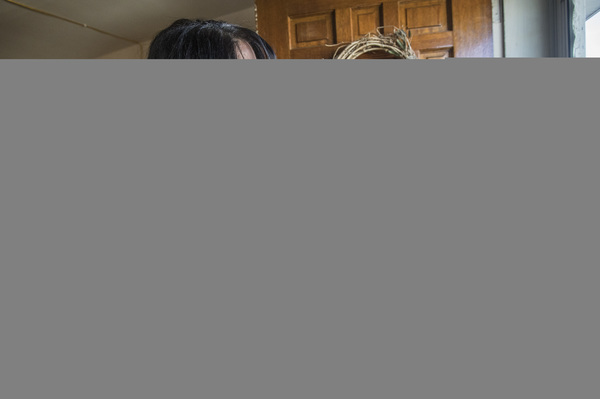
PHILADELPHIA _ On a bitter March morning in 2014, I picked my way across an icy corner in Point Breeze and knocked on Patricia Sankey's storm door. I heard slow, heavy steps and the rattle of keys, and then Sankey opened the inside door.
She was a short, round, older woman dressed in a pink housecoat. Tendrils of cigarette smoke pushed through the storm door's vents; the air inside the home was cloudy with it. She appeared wary.
I asked if she was related to Christina Sankey, 37, who had intellectual and developmental disabilities (I/DD) and had wandered off two weeks before while under the watch of a state-paid caregiver. Her body was found the next day on a sidewalk, five miles away. She had frozen to death overnight.

"I'm her mother," Sankey said.
While under the watch of a state-paid caretaker, Christina Sankey went missing and was found dead the next day.
I told her that I was trying to understand how her daughter went missing in the first place, and that no one seemed to think it was a big deal that Christina's caregiver lost track of her. That the police and coroner had been quick to dismiss the death as a tragic accident with apparently little investigation. That there had been no mention of potential neglect by the caregiver, the way there would be if Christina had been an equally vulnerable child.
I didn't know if anything sinister or reckless had happened, but I wondered if Christina's known disabilities were preventing anyone from giving her death the attention it deserved.
I asked Sankey if I might come inside and speak with her. She refused. But she started talking.
"No one cares about Christina," she said angrily. "My girl is dead, but Ayesha is out there alive and well, taking care of her own children."
We spoke for a half hour, on opposite sides of the smoky doorway. Sankey said that Hussanatu "Ayesha" Wulu, a married mother of two, had been Christina's caregiver for four years. She could be unreliable, but Christina loved her. So Sankey allowed the relationship to continue. Wulu knew that Christina, who had the intellectual capacity of a toddler, was a wanderer, easily distracted, that she was unable to speak. In public places you had to keep her in view and within arm's length at all times or she'd take off, moving fast, heedless of traffic and other dangers.
"She never should have been downtown, in a department store" _ Macy's _ which is where Wulu lost Christina while inspecting baubles at a jewelry counter, Sankey said. "It was no place for my daughter."
After I wrote Sankey's story, called "The Death No One Cares About," the district attorney convened a grand jury investigation into what happened on the last day of Christina's life.
As a result, Wulu was charged and eventually pleaded guilty to one felony count of neglect of care of a dependent person and a misdemeanor count of reckless endangerment. She was placed under house arrest for 11{ to 23 months, then on probation for three years.
The sentence brought no comfort to Sankey.
"We miss Christina every single day," said Sankey, whose surviving child, an adult daughter, also has an intellectual disability. "She was not going to set the world on fire. But she was my world."

An aging demographic
Parents of adults with I/DD followed Christina's case closely, and they called to share their own horror stories about caregiver abuse and agency incompetence. About political and public indifference to the needs of those with I/DD. About the lack of compassion and resources for elderly parents who have become too old and frail to care for their aging, impaired children. About the sudden elimination of educational options when a disabled child turns 21, a descent so dramatic and universal that parents call it "falling off the cliff."
What is the difference between an intellectual disability and a developmental disability?

An intellectual disability is characterized by significant limitations both in intellectual functioning (reasoning, learning, problem-solving) and in adaptive behavior, which covers a range of everyday social and practical skills. This disability originates before the age of 18. Developmental disability is an umbrella term that includes intellectual disability and other disabilities that are apparent during childhood. Developmental disabilities are severe, chronic disabilities that can be cognitive, physical or both. They appear before the age of 22 and are likely to be lifelong.
American Association on Intellectual and Developmental Disabilities
Their stories could fill a book. But each would only nick the surface of a crisis that is barreling toward us like a tsunami: We will soon have more intellectually and developmentally disabled adults living in this country than at any other time in our history.
Advances in medical care have allowed kids born with Down syndrome, for example, to live twice as long as they did just 20 years ago. And the explosion in the number of children with autism _ one in 68 children are now diagnosed _ means we'll soon have a vast population of adults in need of services like those Christina's family had hoped would keep her safe.
Add these numbers to those of children born with the two other most common roots of intellectual disability _ Fragile X syndrome and fetal alcohol spectrum disorder _ and we have a looming social, economic, and moral crisis. What will we do about, with, and for these vulnerable adults and the families who struggle to care for them? And how much are we willing to pay for it?
What families have dealt with is shocking.

Annette Scott, 70, had to remove her intellectually disabled son, Justin, 32, from a group home after his retinas detached as a result of head trauma no one claimed to have witnessed. He is now blind.
In his next placement, he broke his femur for reasons no one could explain