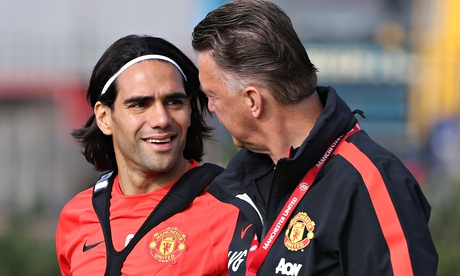
For the best explanation, perhaps it is necessary to go back to Louis van Gaal’s appointment as the Holland coach in 2012, returning to the job he had left 10 years earlier and immediately setting out his “philosophy” – the word that is now his default setting at Manchester United and offers the distinct impression he will be utterly unmoved by any suggestion he has misjudged the Radamel Falcao situation.
Van Gaal’s message was that no one had a tienrittenkaart – the “10-rides ticket” commonly used on Amsterdam public transport – and deliberately brought in younger players, bruising some considerable egos along the way, just as he has for United with such as James Wilson, Paddy McNair and Tyler Blackett. “Names matter to the media but not to me,” he said. “When there isn’t any stimulation by a young group to stir things up, you get stuck. That is why I am always attracted to young players who automatically provide that stimulation. I continually play players who are the most fit; never those who are just big names.”
Rafael van der Vaart was among those to discover they were not hollow words and Robin van Persie began the first game of that new era on the bench. “The previous federation coach, the old Louis van Gaal, did give credit to, and had faith in, recognised players,” Holland’s returning bondscoach explained. “That was something I shouldn’t have done. Now I do exactly the opposite and that works quite well. It also keeps everybody on their toes.”
That was certainly apparent when Falcao could not even make the list of substitutes for United’s latest ordeal, when a team including Van Persie, Wayne Rooney, Ángel di María and Juan Mata could not even muster a shot on target against Southampton and the defeat exposed just what a nonsense it has been lately for Van Gaal to depict them as title challengers.
Would Falcao’s involvement have made a huge difference? Possibly not given there have been only scraps so far to authenticate his status as one of football’s superstars (a wonderfully delivered nutmeg a couple of weekends back barely counts when the opponent is the Yeovil midfielder Joe Edwards) and the Colombian is straying dangerously close to the point where we are entitled to wonder if he will ever be the player he was before his knee ligaments snapped, or the player United hoped he would be.
Van Gaal’s explanation was, in short, that he knew Di María, Luke Shaw and Daley Blind, all returning from injury, would probably have to be substituted. There was, in other words, only one place for a replacement attacker and – this does not say much for Falcao either – “normally I would change Di María for Wilson because I want speed in attack.” As it turned out, Van Persie twisted his ankle and had to go off, meaning Blind stayed on. “I also had Rooney,” Van Gaal pointed out, having moved his captain from midfield to take over from Van Persie. “So when you see the composition of my bench – and if I want to change the playing style with [Marouane] Fellaini – I didn’t have a position for a second striker.”
To a follow-up question on the subject, Van Gaal reverted to his old trick of rebounding the question on the journalist, just as he did when prompted about the team’s obvious issues in central defence and, on a more general theme, the state of progress bearing in mind 37 points from 21 games is precisely the same amount under the faltering David Moyes reign this time last year – but actually one goal down, with fewer shots, crosses and passes, and more long balls.
That Van Gaal spent £153m last summer to improve that record makes it an even more relevant question and the diversionary tactics are both wearisome and a reminder why the Dutch football writers’ association once wrote to him pointing out “his aggressive approach perhaps guarantees success with young, docile players, but is inappropriate at a press conference at which adults are present”. It is clear, too, why Van Gaal’s biographer, Maarten Meijer, wrote that his subject’s “hard shell and toughness in the public are quite extraordinary”, even if it is still several notches below what it was like with Sir Alex Ferguson. Yet they are still legitimate questions, answered or not, and particularly when Moyes’s record against the same teams is a point superior.
The counterargument goes along the lines that Van Gaal is a much more natural fit in Ferguson’s old dugout whereas Moyes, as his friend Sam Allardyce helpfully pointed out, looked like he had aged 10 years in the space of a few months.
Moyes, like Van Gaal, had toyed with the idea of playing Rooney in midfield, albeit with reservations about the player’s understanding of the simple and short give-and-go pass. Ultimately, though, one of the principal reasons he decided against it was because he feared a bad reaction in the media. Likewise, he resisted the temptation to remove more of Ferguson’s fringe players because of the perception of him dismantling a title-winning squad. The top managers do not concern themselves with headlines and chatter; they just get on with it. Van Gaal is in that category, with extraordinarily thick skin, and that automatically makes him much better suited for a club of United’s ambitions.
Yet the point remains: how many times this season have the team of so-called Gaalácticos excelled? Even when they have won it has usually been followed by a stern-faced Van Gaal complaining about the way they have misused the ball. The only real praise has come after the defeats of Hull City and Queens Park Rangers, maybe Newcastle United too, but not once away from Old Trafford has the manager been entitled to feel fully satisfied. Hull and QPR? They are 18th and 19th in the league.
Van Gaal has been fortunate in one respect to have taken the job at a time when Liverpool, Arsenal, Tottenham and Everton have all, to varying degrees, fallen away and the Premier League is, in short, nothing special. He inherited a club that had finished seventh last season so their present position of fourth is at least an upward curve and – this is important for many Old Trafford match-goers – he looks and sounds like a Manchester United manager.
There are other questions, though, that tell a different story about Van Gaal’s first six months in the job. Where, for instance, would they be without David de Gea – and when was the last time this club were so heavily indebted to a goalkeeper? Why has Van Persie flickered only sporadically and is there any real evidence United are suited to the wing-back system and – a first at Old Trafford – the 3-3-2-2 formation used on Sunday?
While all the focus is on Falcao it also seems to have been overlooked how Adnan Januzaj’s brilliant promise has stalled under Van Gaal. Talk to Moyes about Januzaj and his eyes would light up. “A young Cruyff,” he called him behind the scenes. Gary Neville also expected this to be a spectacular season for the 19-year-old. “I am convinced United have a youngster who will become one of the best in the world over the next five years,” he said in August. “A bold statement, I know. And some bold statements return to haunt you. Yet I see someone with temperament, ability, determination. Those eyes express fierce intent. Their message is: no one will stop me.” Januzaj has started four games in the Van Gaal era and was also left off the bench against Southampton; it just hardly went noticed.
Falcao’s absence drew far more attention and the mind goes back to an audience with Van Gaal last September when he could be heard eulogising about the player’s first day in training. “He had one ball and it was in the goal,” the manager recounted. “This is one of the best strikers in the world. He confirmed it in his first training session with me.”
The awkward truth for United is that Falcao has not reaffirmed it since. With three goals in five injury-affected months, it would look almost reckless as it stands if they paid the £43.2m to make his loan arrangement from Monaco a permanent one.