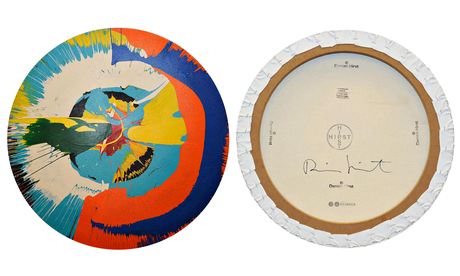
Wait, wait. Let me get my head around this. A man has been jailed for selling fake Damien Hirst paintings to an art dealer, having originally bought them believing them to be real?
To add a surreal footnote, he happens to be a Florida pastor. He was judged guilty – and must go to jail – because by the time he sold them on, he knew them to be fake.
Who wouldn't try to unload such paintings after being stung? Isn't that an understandable human reaction worthy more of a slap on the wrist than a jail sentence?
But pastor Kevin Sutherland has blundered into the art world, where wrong is right, and trash is worth a fortune.
Damien Hirst's paintings are talentless and phoney as hell. Hirst is the fake. His efforts to do "proper" paintings have revealed his total lack of artistic accomplishment. This exposure of his fundamental inability means that it is impossible to take him seriously any more, especially as a painter. While the best of his early animal vitrines have some kind of place in art history, his paintings – spin, spot or realist – are cynical stunts by a man who cannot actually paint. So how on earth can they be of value and why should it be a big deal to fake them?
If the art market gives Hirst's awful paintings financial value – and it does – then it is dealing in nonsense and lies. Hirst's continuing success proves that in the looking-glass world of dealers and collectors, works of contemporary art can have financial and critical value regardless of any actual merit.
Alone among the arts, visual art has become totally divorced from the idea of talent. No one respects a composer who can't play music or a writer who can't string a sentence together. Only in visual art has this strange state of affairs come about where the talented are at a positive disadvantage and fake art sells for a fortune.
In this era of fake art, how can the law seriously come down so hard on a Florida pastor who stupidly blundered into crime? The sentence against him is of course about protecting property, not art. The law makes no aesthetic judgments. Yet the effect is to affirm the power of the art world to define its own perverse reality and profit from it, and perpetuate the right of Damien Hirst to maximise the value of his phoney artistic creations.
This poor pastor made a terrible mistake. He underestimated the gangsters who rule art in our time.