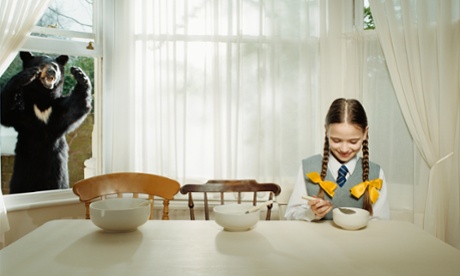
Why are unexpected visitors so popular in children’s books? My three-year-old hates the story of Goldilocks. Since we read it, she has been terrified that when we return home we might find that Goldilocks has visited our house. Are there any stories of nice visitors who behave well who might help to redress the balance?
However Goldilocks is told, it is a difficult story. In some versions she is just an inquisitive child with an under-developed sense of what she is entitled to; in others she is more threatening and sinister – especially for the littlest bear with whom the child reader most identifies since it is his/her chair which is broken, porridge which is eaten and bed that Goldilocks is finally discovered asleep in.
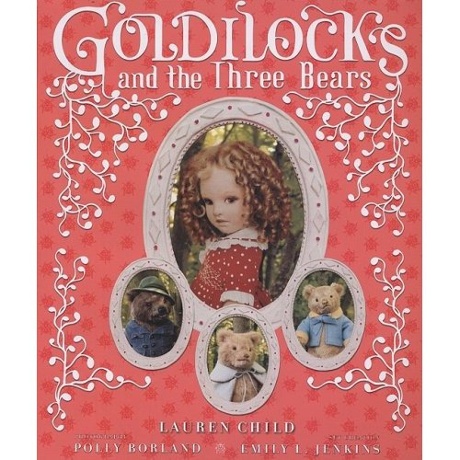
Whatever the emphasis, there is nothing very likeable about a kid who breaks into someone else’s home and tries out their things. How the story is perceived has changed over time. In The Annotated Classic Fairy Tales Maria Tatar noted that in contemporary versions the Goldilocks story is “typically framed today as a discovery of what is ‘just right’, but for earlier generations, it was a tale about an intruder who could not control herself when encountering the possessions of others.”
As a morality tale for children – and adults - who like a sense of justice the fact that in many versions Goldilocks gains only a short term satisfaction and is ultimately forced to jump back out of the window and run away from the comfortable lives of the three bears can be satisfying. But even that satisfaction generally has an unpleasant aspect to it as it implies “good riddance to bad rubbish” which fails to give children any sense of tolerance or understanding.
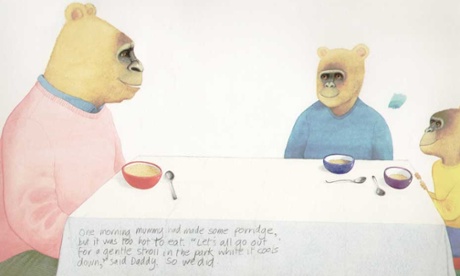
In Me and You Anthony Browne gives a more thought-provoking and less frightening version of the story in his subtle and sophisticated illustrations.
The first recorded version of the story is credited as being published anonymously in 1837 by the poet Robert Southey, but versions of the story with different animal protagonists were in circulation before.
Judged simply in terms of its story telling, Goldilocks fares much better which is why it remains so popular and has been retold in so many ways. The repeated sequences delight children as they can anticipate Goldilocks audacity and revel in the mounting disapproval.
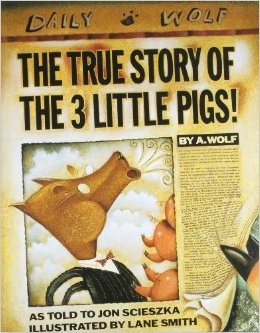
Although all unexpected visitors can be menacing, few are as unsettling as Goldilocks. In some cases such as with the Big Bad Wolf in versions of The Story of the Three Little Pigs because their attempts at forced entry are – at least in some versions – repelled by the Three Little Pigs so that the story comes to be about bravery and resilience against the intruder. In others, the intruder turns their unexpected arrival into something positive. Jon Sieszka’s The True Story of the 3 Little Pigs, illustrated by Lane Smith, is highly recommended!
Snow White is a less worrying intruder than Goldilocks. When she is abandoned in the forest she comes across a cottage and enters to find shelter. Far from disrupting things as Goldilocks does Snow White sets about being helpful to the dwarves and being valued by them.
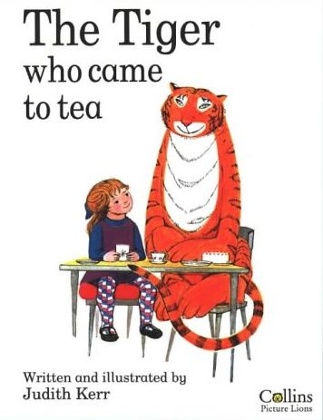
However, all stories about an outsider arriving without invitation and without warning, even a much-loved story such as Judith Kerr’s classic The Tiger Who Came to Tea, carry an underlying message about security and control which are integral to child development.
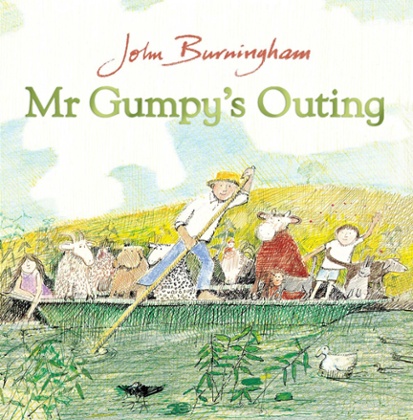
If these most forceful examples of outsiders becoming insiders are too frightening there are other stories which show how outsiders or “intruders” can be managed such as John Burningham’s wonderful Mr Gumpy’s Outing.
Here, Mr Gumpy invites the animals onto his boat on condition that they behave. Of course, they do not! But the catastrophe that follows is itself under control – more or less- and all ends happily with a picnic. Reassuring in every possible way it also shows that surprise can be fun too!
Do you have a question for the Book Doctor? Email childrens.books@theguardian.com or pose it on Twitter @GdnchildrensBks, using #BookDoctor. If you are under 18 and not a member of the Guardian children’s books site join here, we’re packed full of book recommendations and ideas.