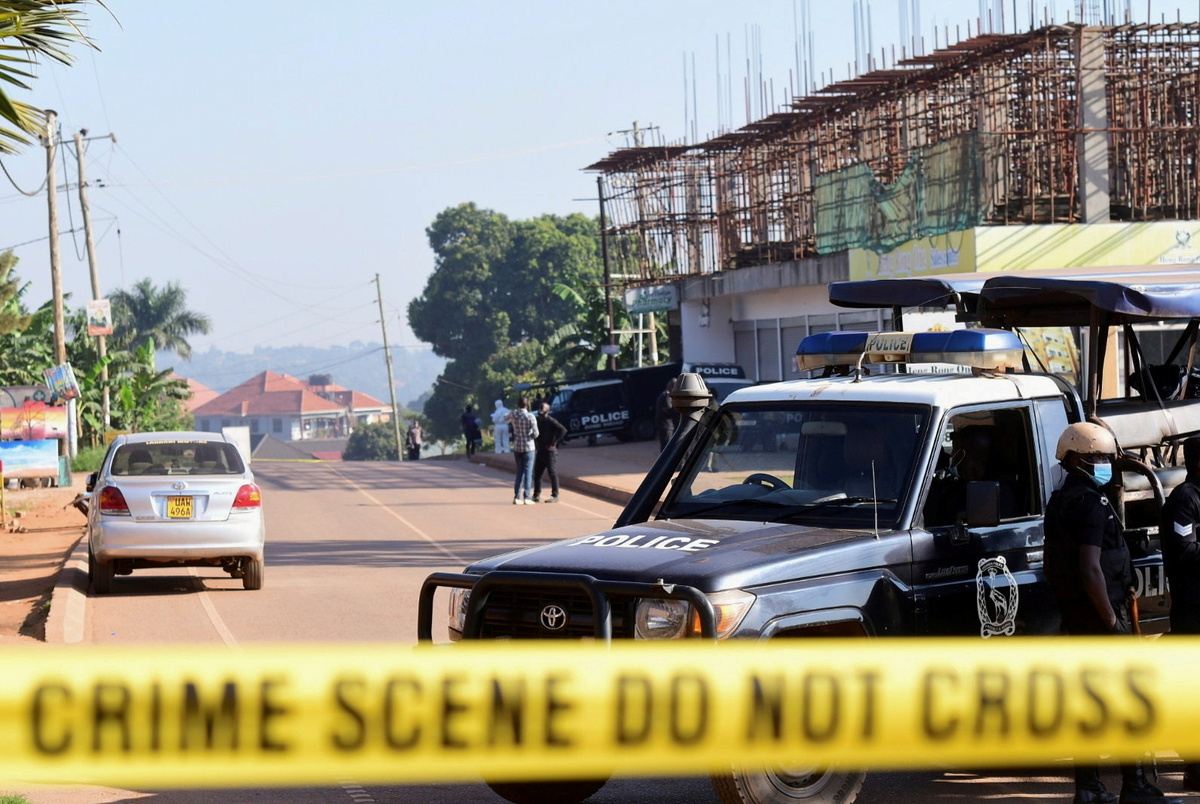
Ugandan authorities blamed Tuesday's deadly suicide bombings on "domestic terror groups" linked to the Allied Democratic Forces (ADF), an Islamist militia with roots in Uganda, based in the Democratic Republic of Congo.
The reclusive group is blamed for killing hundreds of villagers in eastern Congo in nighttime raids over the last two years. The ADF pledged allegiance to the Islamic State in mid-2019.
While there is no evidence of direct command and control by IS over the ADF, IS has claimed two small bombings in Uganda in October.
ADF'S ROOTS
The ADF started as opposition to the Ugandan government in the early 1990s under its then-leader Jamil Mukulu.
It carried out a string of massacres in Congo's Beni territory in 2013. Congo's army launched an operation against it the next year.
Mukulu fled to Tanzania. He was arrested in 2015 and extradited to Uganda. Seka Musa Baluku, who previously served as the group's senior Islamic legal official, took control.
ISLAMIC STATE LINKS
Under Baluku, the ADF shifted focus from trying to install an Islamic government in Uganda, to promoting itself as an international jihadist movement.
In April 2019, the Islamic State claimed its first attack in Congo, and three months later Baluku appeared in an IS propaganda video pledging allegiance to it. The ADF - alongside fighters in Mozambique - was branded as IS's "Central Africa Province" (ISCAP), although the two groups are operationally distinct.
In October 2019, Congo's army launched a second operation against the ADF, unleashing retaliatory attacks against civilians. The ADF killed more than 800 people last year, the United Nations says.
In June, IS claimed responsibility for a double bombing in Beni at a Catholic church and a busy intersection. No one was killed, apart from a suspect that experts say may have been Congo's first suicide bomber.
U.N. experts say fighters from outside Congo have helped the ADF make modest advances in developing improvised explosive devices in the last year, but have not found conclusive evidence IS has control over ADF operations.
THE PUNISHER
Last month, Islamic State made its first claim of responsibility for a blast in Uganda - an attack on a police station in Kampala's Kawempe neighbourhood, which killed no one. It claimed a second blast on Oct. 23 that killed a waitress.
Rwanda said on Oct. 1 that police thwarted a third attempted bombing in Kigali, which they linked to ADF.
Physical evidence suggested those three plots and Tuesday's triple bombing were coordinated by Meddie Nkalubo, nicknamed "Punisher", said Laren Poole from the U.S.-based Bridgeway Foundation, which studies the group.
Nkalubo, a Ugandan in his thirties, joined the ADF around 2016-2017. He oversees communication and propaganda, and making improvised explosive devices, a U.N. expert report found.
(Reporting by Hereward Holland; editing by Katharine Houreld and Lisa Shumaker)