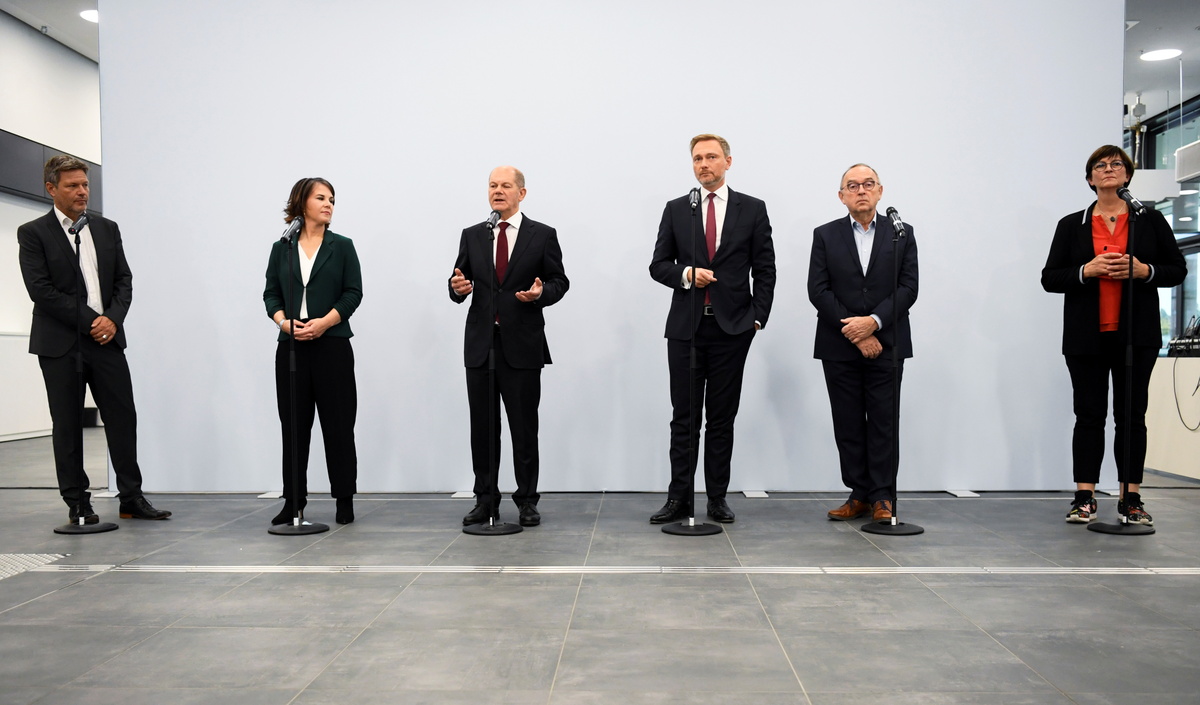
At the start of exploratory coalition talks, Germany's two kingmaker parties - the liberal Free Democrats (FDP) and the Greens - were far apart on issues ranging from the fight against climate change to a general speed limit.
In a draft agreement that will form the starting point for any formal coalition talks presented on Friday, however, the two parties, along with the Social Democrats, laid out the compromises they have been hammering out since the start of the month.
CLIMATE CHANGE
In what could be seen as a win for the Greens and their co-leader Annalena Baerbock, who want to achieve net zero greenhouse gas emissions within 20 years, the draft agreement foresees an exit from coal-fired power stations by 2030, more solar panels on roofs and more onshore and offshore wind energy.
The FDP had wanted Germany to achieve climate neutrality by 2050, while the SPD could have waited until 2045.
However, the Greens have scrapped their plans for a universal speed limit on Germany's 'no limits' motorways, an idea that had little popularity among the FDP led by Christian Lindner.
The two had also disagree on whether combustion-powered cars should be banned in the medium term. In Friday's agreement, the parties advocated for new registrations only of e-fuel-powered vehicles.
TAXES
The parties said they would not hike income taxes, corporate taxes, or value added tax. Instead, "super write-offs" for investments in climate protection and digitalisation will boost the economy.
The agreement did not say whether any taxes could be cut, though. The FDP had sought to cut taxes for everyone, while the Greens wanted to lower the threshold for the top tax bracket and introduce a new tax bracket for ultra-high earners. The SPD had wanted to help those on low and medium incomes and raise taxes for the top 5%.
FOREIGN POLICY
The parties agreed that Germany's foreign policy should be focused on strengthening Europe, including through cooperation with France and Poland, as well as multilateral relations with partners that share Germany's democratic values.
The transatlantic alliance between the United States and its European partners is a central pillar of global cooperation, and NATO is an indispensable part of Germany's security, they said. They also highlighted the importance of Israel's security.
They did not say, though, whether Germany would increase its military spending to NATO's target of 2% of economic output, a move that the Greens had opposed.
INVESTMENTS
The parties said huge investments would be needed to fight the effects of climate change and make progress on digitalisation, education, research and infrastructure.
They aim to cut down on red tape for public and private investment projects, with an aim to at least halve the time it takes to realize them.
However, they aim to stick to Germany's debt brake, which limits new borrowing to a tiny fraction of economic output. The Greens had called for a reform of the debt brake to promote public investment.
Instead, the government should do away with any subsidies and spending that are unnecessary, ineffective, or harmful to the environment and step up the fight against tax evasion, tax avoidance and money laundering. It would also continue to push for the introduction of a global minimum corporate tax.
SOCIAL ISSUES
The FDP has also dropped its opposition to the minimum wage increase, which would be raised to 12 euros ($14) an hour in the first year under the new coalition government.
The parties also aligned on their aim to build 400,000 new apartments a year to fight a housing crisis, lower the voting age to 16 and create a points-based immigration system to draw in qualified workers.
Also promised were adaptations to laws on transgender, family and reproductive rights, in line with the wishes of the younger voter base who turned out behind the FDP and Greens.
All three seem to have stuck to their promise to allow dual citizenship - a huge change for thousands of ethnic Turks, many of whom remain foreign nationals after decades in Germany.
(Reporting by Miranda Murray and Maria Sheahan; Editing by Giles Elgood)